
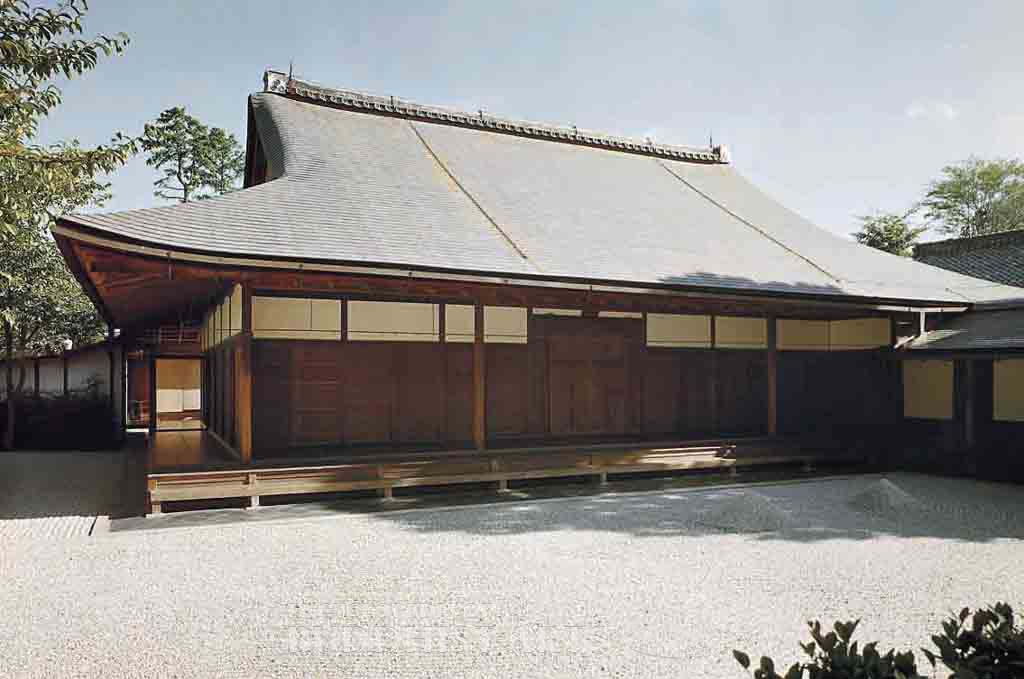
Daisenin Temple Main Hall
Daisenin Temple Main Hall
JAPAN, Kyoto
The hall was built in 1513 during the Muromachi period by Master Kogaku as his personal hermitage. The hall was listed as a National Treasure in 1957.
This south-facing hall is 14.8 m wide and 10.8 m deep. It has a single-eave hip-and-gable roof that is covered with copper tiles. Under the southern eaves there is a wide veranda and at the southeast corner there is a porch leading to the interior. Multiple curved beams are used to support the eaves. The interior space is divided by paper walls together with sliding paper doors. There are ink screen paintings of the Eight Scenic Sites of Hunan, Birds and Flowers of the Four Seasons, and Four Seasons of Farming, all of which have been listed as Important Cultural Properties. The eastern courtyard of the main hall is listed as a Historic Site.
For more details, go to the Encyclopedia of Buddhist Arts: Architecture A-F, page 198.
Cite this article:
author = Hsingyun and Youheng and Johnson, Peter and Mankuang and Lancaster, Lewis,
booktitle = {Encyclopedia of Buddhist Arts: Architecture A-F},
pages = 198,
title = {{Daisenin Temple Main Hall}},
volume = 1,
year = {2016}}