
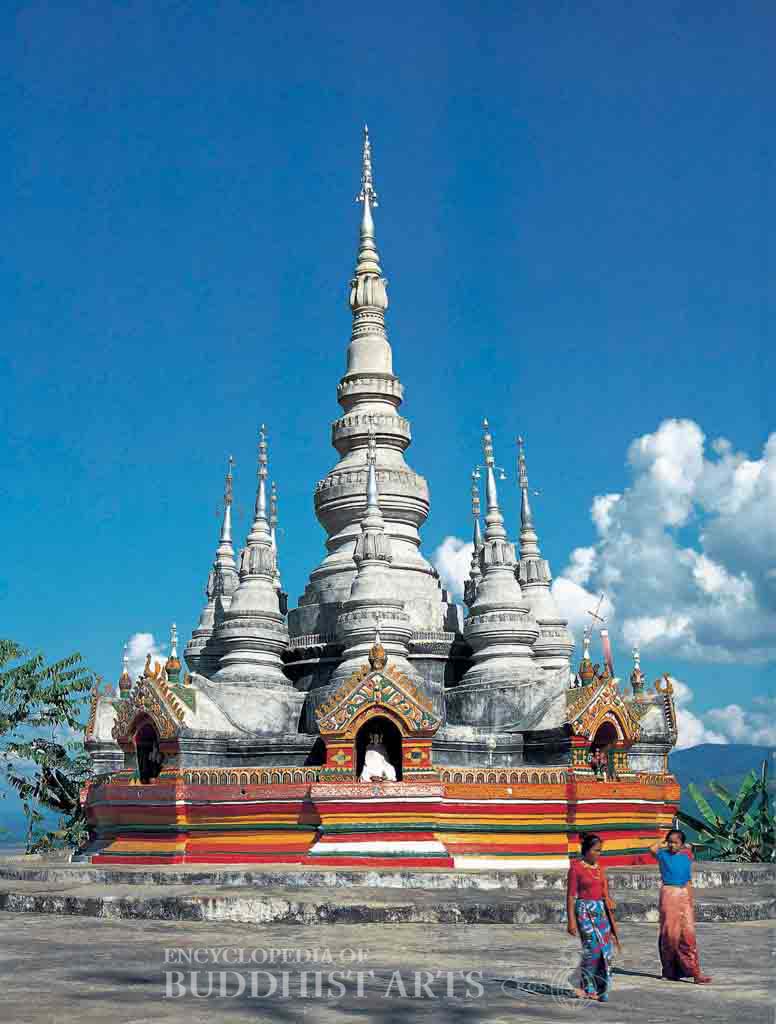
Manfeilong Pagoda
Manfeilong Pagoda
CHINA, Yunnan, Jinghong
This pagoda is also known by local Dai people as Bamboo Shoot Pagoda because of its appearance. It was built in 1204 and consists of nine white pagodas. It was listed as a National Cultural Heritage Site in 1988.
The Sumeru base is octagonal. The main pagoda is 16 m high and its body consists of three inverted bowls, above which are three upturned lotuses. The spire has a bell-shaped base followed by an upturned lotus, stacked rings, a canopy, and a jewel. Surrounding the main pagoda there are eight smaller pagodas, each about 9.1 m high and similar in design to the main one. Close to the edge of the base there are eight Buddha niches with gable roofs. A Buddha statue is enshrined within each niche. Their roofs are decorated with terracotta dragons, phoenixes, peacocks, and miniature pagodas.
According to legend, Sakyamuni Buddha gave a Dharma teaching here, leaving behind a large footprint on a blue limestone rock. This pagoda was built in commemoration of this event. The rock and footprint are preserved in a hidden chamber on the south side of the pagoda. The gilt footprint is 80 cm long and 58 cm wide. There are six giant nagas surrounding the pagodas, each carrying a lotus to symbolize their protection of the Dharma.
For more details, go to the Encyclopedia of Buddhist Arts: Architecture M-S, page 723.
Cite this article:
author = Hsingyun and Youheng and Johnson, Peter and Mankuang and Lancaster, Lewis,
booktitle = {Encyclopedia of Buddhist Arts: Architecture M-S},
pages = 723,
title = {{Manfeilong Pagoda}},
volume = 3,
year = {2016}}