
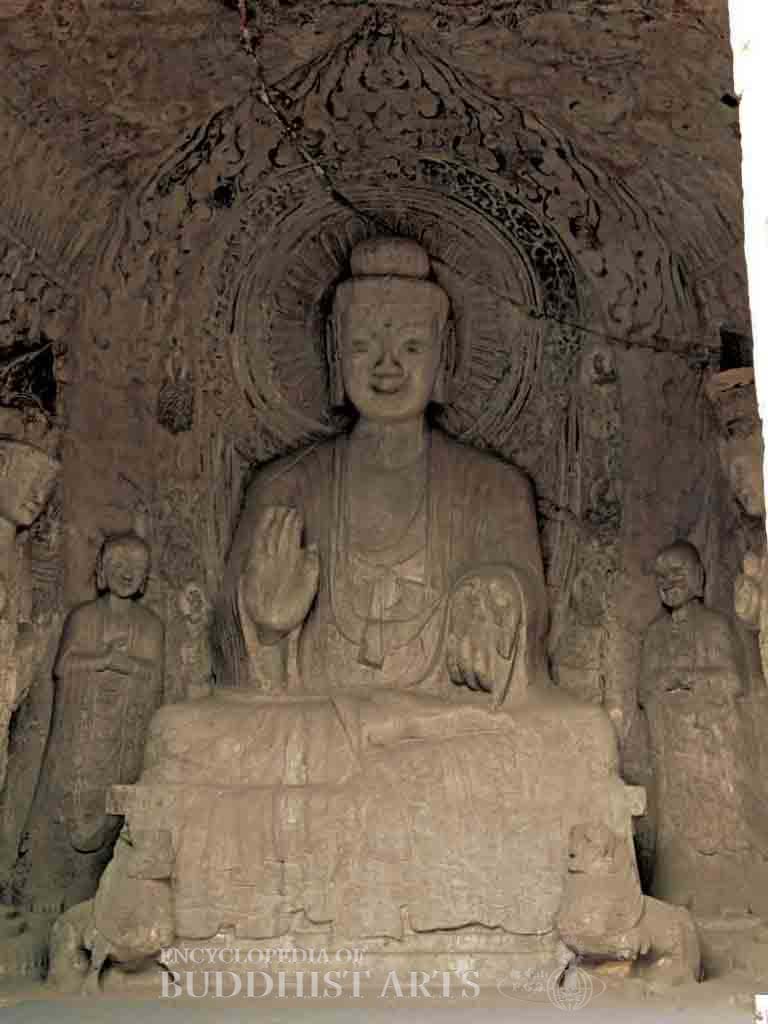
Longmen Grotto 140: Sakyamuni Buddha
Stone
Longmen Grotto 140: Sakyamuni Buddha
CHINA, Henan, Luoyang; Northern Wei dynasty
This seated Sakyamuni Buddha, the main statue within the grotto, is located at the center of the back (west) wall. Seated in a full lotus position, the Buddha has a large usnisa. The nimbus consists of two rings: the innermost ring is composed of lotus petals, while the outermost ring is adorned with a vine-like pattern. The Buddha has a broad, rectangular head and long, crescent-shaped eyebrows with an urna in the center of the forehead. The lively eyes match the bright smile on the small mouth. The Buddha’s nose is broad and the earlobes are elongated. The loose outer robe is opened at the chest to reveal an inner robe. The raised right hand forms the abhaya (fearlessness) mudra, while the left is held downward with the index finger pointing to the ground. The Buddha’s outer robe drapes over the Sumeru throne. The style of the statue is characteristic of the Northern Wei dynasty (386–534).
For more details, go to the Encyclopedia of Buddhist Arts: Caves R-L, page 669.
Cite this article:
author = Hsingyun and Youheng and Johnson, Peter and Mankuang and Huntington, Susan and Edson, Gary and Neather, Robert,
booktitle = {Encyclopedia of Buddhist Arts: Caves R-L},
pages = 669,
title = {{Longmen Grotto 140: Sakyamuni Buddha}},
volume = 6,
year = {2016}}