
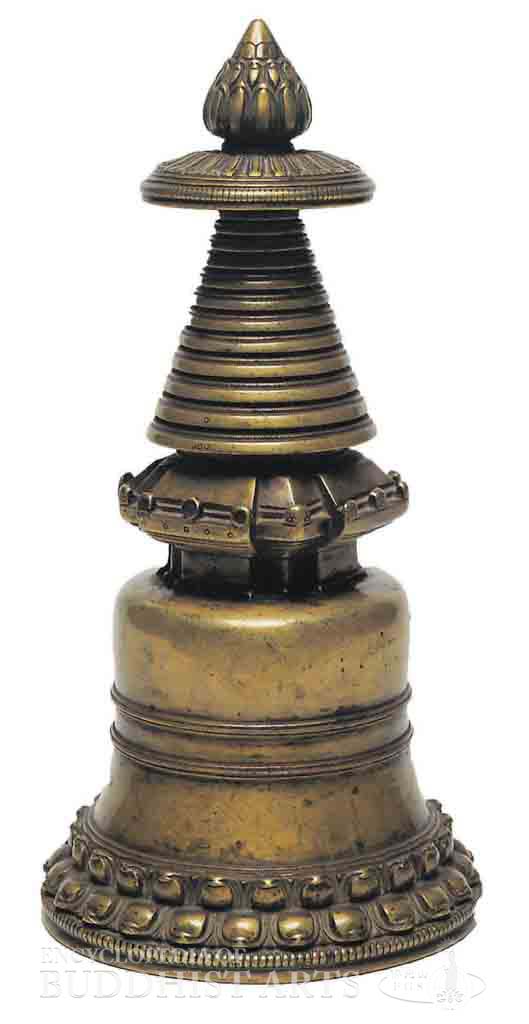
Kadam Stupa
Bronze
Kadam Stupa
CHINA, Tibet
This stupa was created in the Kadam style and modeled on a stupa from northeastern India. The style was brought to Tibet by the monk Atisa, and became popular in the Kadam school of Tibetan Buddhism during the 11th to 13th centuries.
The stupa is divided into three sections: base, body, and spire. The round base features a chain pattern and inverted lotus petals. The lotus is a symbol of purity, and its presence at the base signifies that everything built upon it is unblemished. In the middle of the body, which is plain and shaped like a bell, there are two embossed circles. The base of the spire has multiple corners with the lotus above. The spire includes 13 stacked rings, a canopy with a lotus petal pattern, and a finial in the form of a lotus bud.
For more details, go to the Encyclopedia of Buddhist Arts: Artifacts, page 155.
Cite this article:
author = Hsingyun and Youheng and Youji and Pokorski, Stefanie and Mankuang and Fan, Wen,
booktitle = {Encyclopedia of Buddhist Arts: Artifacts },
pages = 155,
title = {{Kadam Stupa}},
volume = 18,
year = {2016}}