
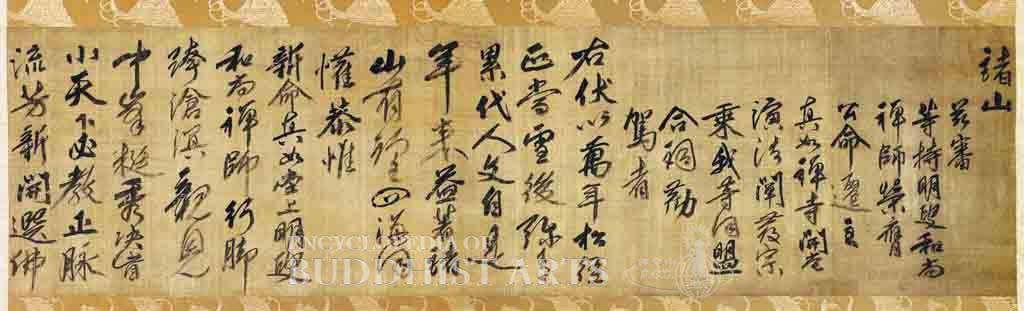
Congratulatory Note to Master Myoso Saitetsu at Ryokoin Temple by Zhuxian Fanxian (detail); Naonbokucho period, dated 1346
Ink on silk
Zhuxian Fanxian
CHINA, Zhejiang, Ningbo; Yuan dynasty
Zhuxian Fanxian, also known as Jikusen Bonsen in Japan, was a Chan monk of the Linji school and calligrapher from a family with the surname Xu, in Mingzhou (present day Xiangshan, Ningbo). After renouncing at a young age, he visited and studied under several eminent masters including Huiji Yuanxi, Yunwai Yunxiu, Yuansou Xingduan, and Zhongfeng Mingben. Later, under the teaching of Chan Master Gulin Qingmao at Baoning Temple in Jiangsu, Zhuxian came to comprehend the ultimate essence of the Dharma.
In 1329, he went to Japan with Mingji Chujun, and during the following year, he served as the first abbot of Kenchoji Temple in Kamakura. Later, he became the abbot of Jomyoji Temple in Shiga and Jochiji Temple in Kanagawa, and stayed at Nanzenji Temple in Kyoto in 1341 and passed away in the temple seven years later.
He authored several publications which include Quotes of Master Zhuxian, Articles Collection of Tianzhu, Songs of Lailai Chan Disciples, Collections of Lailai Chan Disciples Crossing the Sea to the East, and Practices of Master Gulin.
Adept in calligraphy, Zhuxian’s works used powerful brushstrokes to present a fluid and natural style that was both graceful and bold. His extant calligraphic work, Congratulatory Note to Master Myoso Saitetsu, is kept at Ryokoin Temple in Kyoto. Currently a National Treasure of Japan, this piece was written by Zhuxian in 1346. Another work, Congratulatory Verse, is kept at the Nezu Museum in Tokyo, Japan.
For more details, go to the Encyclopedia of Buddhist Arts: People, page 368.
Cite this article:
author = Hsingyun and Youheng and Youlu and Pokorski, Stefanie and Yichao and Mankuang and Miaohsi,
booktitle = {Encyclopedia of Buddhist Arts: People },
pages = 368,
title = {{Zhuxian Fanxian}},
volume = 19,
year = {2016}}