
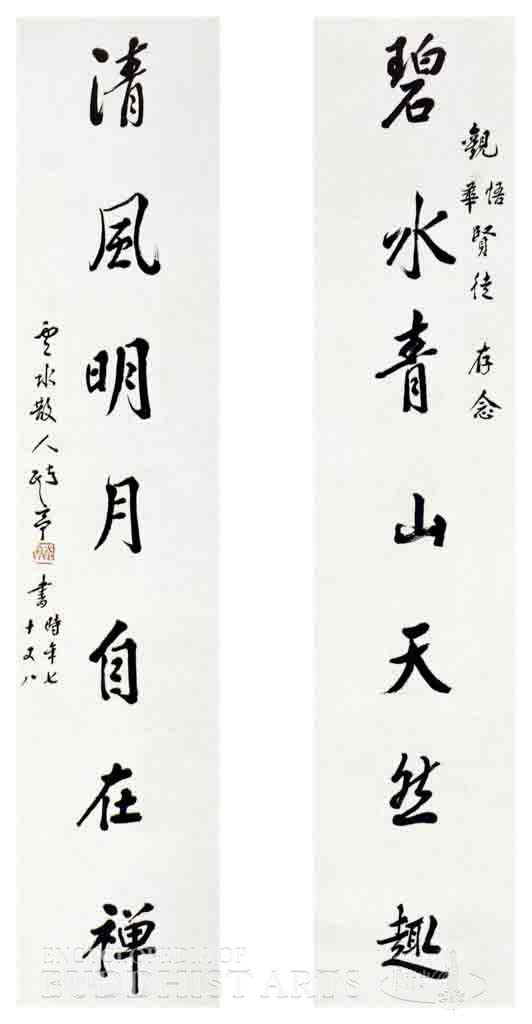
Seven-Character Couplet by Nan Ting; Dated 1977
Ink on paper
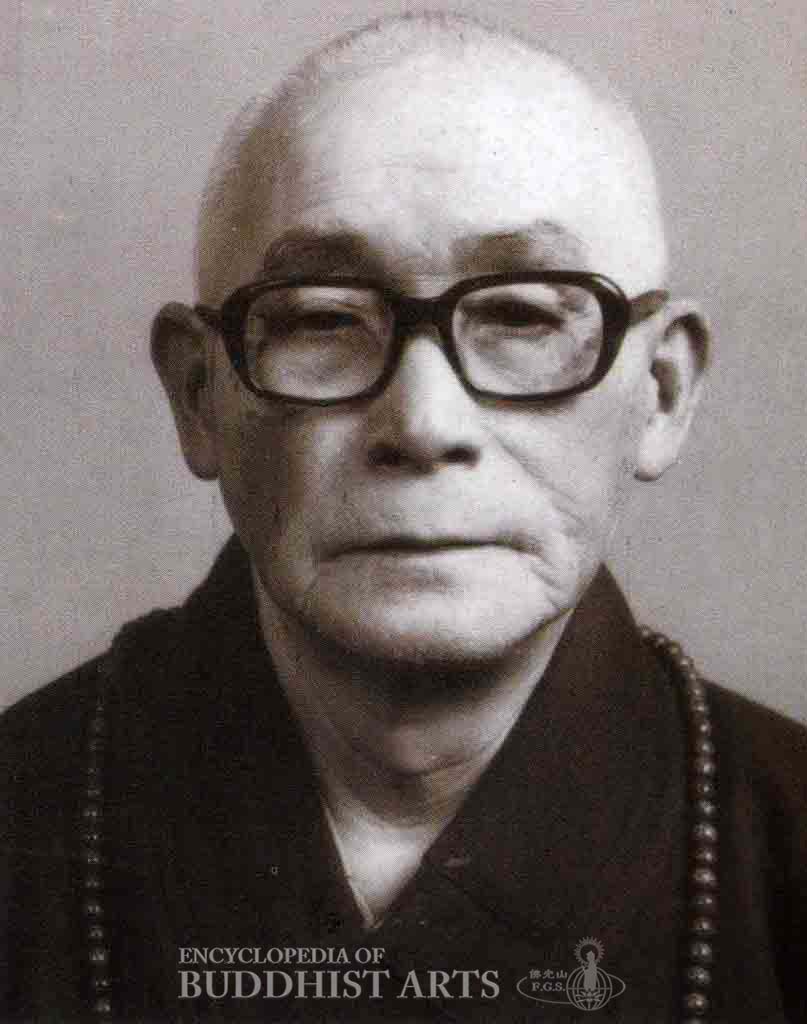
Nan Ting
Nan Ting
CHINA, Jiangsu, Taizhou
Nan Ting had an original family name of Ji, and later took the Dharma name Tanguang. Born in Jiangyan district of Taizhou, he renounced at Guanyin Temple in Jiangsu at the age of 11, and took full ordination at Dinghui Temple in Jiangsu when he turned 21. He studied sutras and commentaries by such masters as Zhiguang, Changxing, and Yinci, and eventually worked his way up to the position of abbot at Guangxiao Temple in Jiangsu. In addition, Nan Ting became chairperson of the Buddhist Association in Taizhou, as well as the director of the Buddhism Research Society. During the Sino-Japanese War, he organized a sangha nursing training class and encouraged young monastics to participate in nursing work.
In 1949, Nan Ting went to Taiwan with monk Zhiguang. In 1952, he established the Huayen Lotus Society in Taipei, raised funds to print the Buddhist Canon, and initiated the program, Voice of Buddhism, to propagate the Dharma on the radio. Alongside Master Hsing Yun and Master Wuyi, he established the Chih-Kwang Senior Vocational Business and Technology High School in 1964. In 1975, he founded the Huayen Buddhist College and in 1979, he expanded the Qiao’ai Buddhist Center and established the Huayen Qiao’ai Children’s Village. Nan Ting also authored Lecture Notes on the Heart Sutra and Lecture on the Amitabha Sutra.
A talented calligrapher, his works include In Praise of Maitreya Bodhisattva on the Stele Wall at Fo Guang Shan Monastery in Kaohsiung, Taiwan. A pillar couplet is kept at Tiantong Temple in Zhejiang, and his Seven-Character Couplet in running script is kept at the Ho’s Calligraphy Foundation in Taipei, Taiwan.
For more details, go to the Encyclopedia of Buddhist Arts: People, page 200.
Cite this article:
author = Hsingyun and Youheng and Youlu and Pokorski, Stefanie and Yichao and Mankuang and Miaohsi,
booktitle = {Encyclopedia of Buddhist Arts: People },
pages = 200,
title = {{Nan Ting}},
volume = 19,
year = {2016}}