
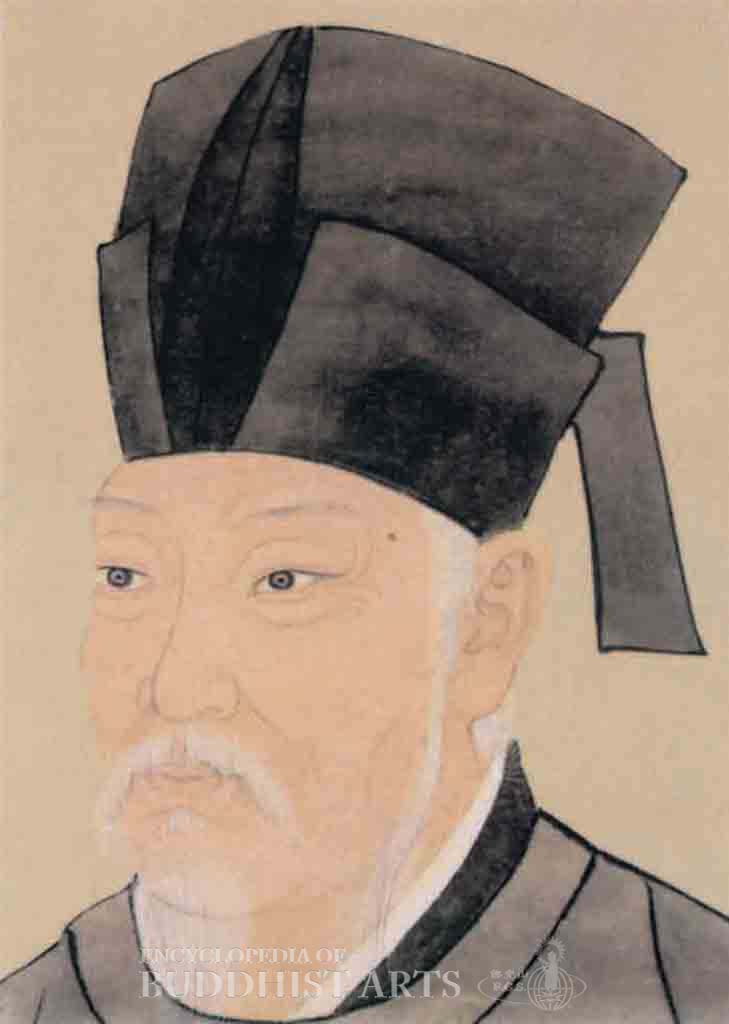
Bai Juyi
Bai Juyi
CHINA, Shanxi, Taiyuan; Tang dynasty
Bai Juyi, also known as the “Xiangshan Jushi,” was a poet and calligrapher. He was a native of Taiyuan and later moved to Xiagui (present day Weinan). Bai was thought to be an immensely intelligent person with an imposing appearance during his youth. He was selected as a scholar in the Hanlin Academy, and later became the Assistant Secretary to the Prince’s Tutor. Bai was eventually appointed as the Minister of Justice, although at one point, he was placed in exiled due to his satirical poetry criticizing Chinese society. He was deeply devout and vowed to be reborn in the Western Pure Land.
Many of his poems showed deep influences of Buddhism. Bai was fond of the Chan school teachings and visited many temples to exchange dialogues with Chan masters. His well-known works include New Music Bureau, Song of Everlasting Regret, and Song of the Pipa Player. These works are highly regarded in the history of Chinese poetry.
It is said that he later repaired an unused part of Xiangshan Temple in Luoyang and lived there as a recluse; hence his nickname, “Xiangshan Jushi.” Bai spent his final years arranging his Collected Works, which was re-edited several times and circulated between Donglin Temple in Lushan, Shengshan Temple in Luoyang, and Nanchan Temple in Suzhou. He is also known to have established a Buddhist society alongside monk Ruman from Foguang Temple in Shanxi.
For more details, go to the Encyclopedia of Buddhist Arts: People, page 5.
Cite this article:
author = Hsingyun and Youheng and Youlu and Pokorski, Stefanie and Yichao and Mankuang and Miaohsi,
booktitle = {Encyclopedia of Buddhist Arts: People },
pages = 5,
title = {{Bai Juyi}},
volume = 19,
year = {2016}}