
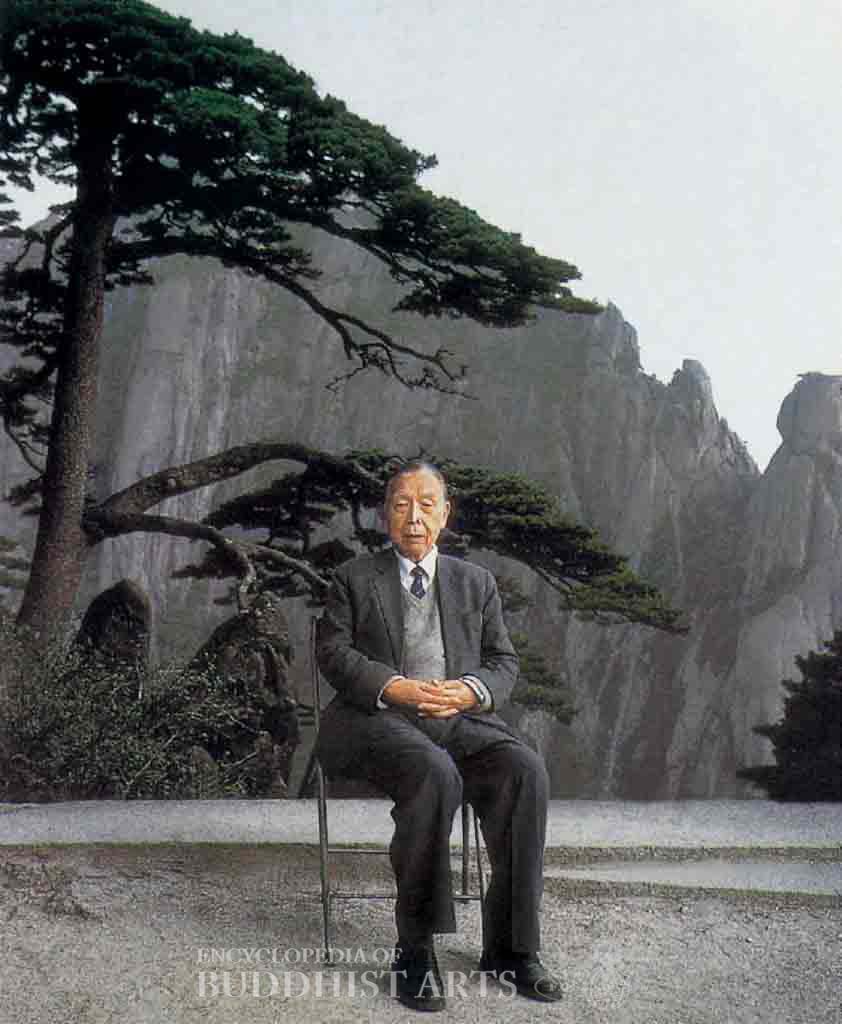
Lu Fo-Ting

Standing Bodhisattva by Lu Fo-Ting; Dated 1982
Ink and color on paper
Lu Fo-Ting
CHINA, Henan, Zhumadian
Originally named Lu Tianci, Lu Fo-Ting was a Buddhist painter and art educator from Biyang county in Zhumadian. He was artistically inclined and skilled in the areas of music, poetry, painting, and calligraphy. Interestingly, Lu began with western-style painting before he later switched to the traditional Chinese form. He moved to Taiwan in 1948 and taught at the National Taichung Teachers College; from then on he worked as a professor at various universities until his retirement. He was awarded several honors and distinctions throughout his long career. Just prior to his passing, Lu fulfilled his life-long desire to become a monk and renounced under the name Quanseng. In doing so, he made a vow to donate the entirety of his works to art galleries and museums for the study of fine arts. He authored several books which include Origins of Chinese Painting, Critical Biography of Shitao, Critique on the History of Chinese Painting, and Philosophy of Chinese Painting.
His early landscape paintings were composed of an unsophisticated style. Later, he created works with a more natural appeal yet with subjective imagery and profound meaning. Lu’s paintings also began to implement oracle-bone script, seal, and clerical script calligraphy. His simple line configurations evoke unique compositions that express words, images, and the concept of Chan all in one. His calligraphy style followed and mixed that of various masters such as Zhong Yao, Wang Xizhi, Chu Suiliang, Ouyang Xun.
Buddhist works by Lu include large ink paintings of the Leshan Great Buddha, Feilai Peak Caves, and Bodhisattva of Dunhuang. Many of his paintings are collected at the Taiwan Museum of Fine Arts in Taichung. His calligraphy entitled Words of Wisdom is engraved on the Stele Wall of Fo Guang Shan Monastery in Kaohsiung, Taiwan, and his Standing Bodhisattva is also kept at the Monastery.
For more details, go to the Encyclopedia of Buddhist Arts: People, page 182.
Cite this article:
author = Hsingyun and Youheng and Youlu and Pokorski, Stefanie and Yichao and Mankuang and Miaohsi,
booktitle = {Encyclopedia of Buddhist Arts: People },
pages = 182,
title = {{Lu Fo-Ting}},
volume = 19,
year = {2016}}