
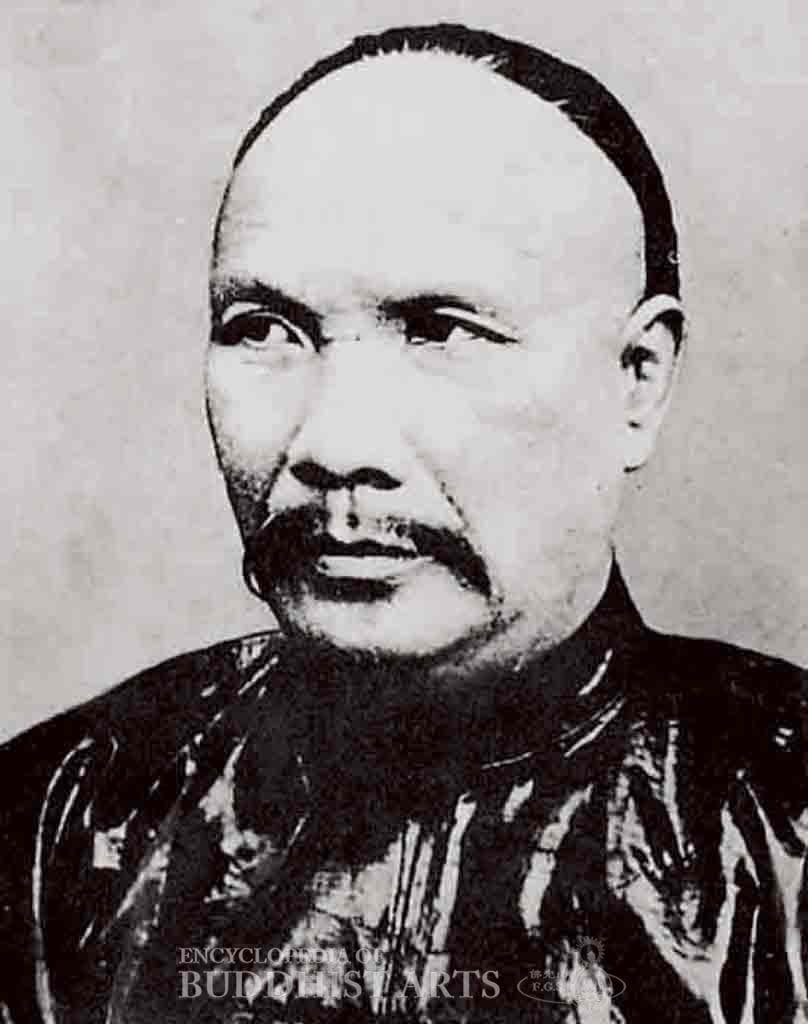
Qiu Fengjia
Chiu Feng-Chia
CHINA, Guangdong, Meizhou
Originally from Jiaying (present day Meizhou, Guangdong), but residing most of his life in Taiwan, Chiu Feng-Chia was a politician, educator, poet, and calligrapher. As a child he was known as a prodigy because of his immense intellect and photographic memory. In 1889, Chiu passed the imperial examination in Beijing and became an Imperial Scholar. He served as director of the Bureau of Forestry and Crafts for the Administration of the State Council before his resignation and return to Taiwan.
He was a lecturer at Taichung Hengwen College, and later established colleges in both Tainan and Jiayi. In 1894, when China and Japan went to war and there was threat of transferring Taiwan to Japanese rule, he worked to retain the country’s independence, but after a failed movement, he fled to Zhenping, Guangdong in China.
Reputed for his poems and calligraphy, as well as his dedication to China, he was admired as the Great Revolutionist and Great Patriot in literary circles and by other prominent individuals such as Liang Qichao. His written works include Poetic Drafts from Cypress Manor and Poetry Anthology of Ling Yun Hairi Building. His calligraphic work, Seven-Character Poem, in running script, is inscribed on the Stele Wall at Fo Guang Shan Monastery in Kaohsiung, Taiwan. The poem was written for the fundraising event organized by Women’s Commission in Hong Kong in 1908.
For more details, go to the Encyclopedia of Buddhist Arts: People, page 27.
Cite this article:
author = Hsingyun and Youheng and Youlu and Pokorski, Stefanie and Yichao and Mankuang and Miaohsi,
booktitle = {Encyclopedia of Buddhist Arts: People },
pages = 27,
title = {{Chiu Feng-Chia}},
volume = 19,
year = {2016}}