
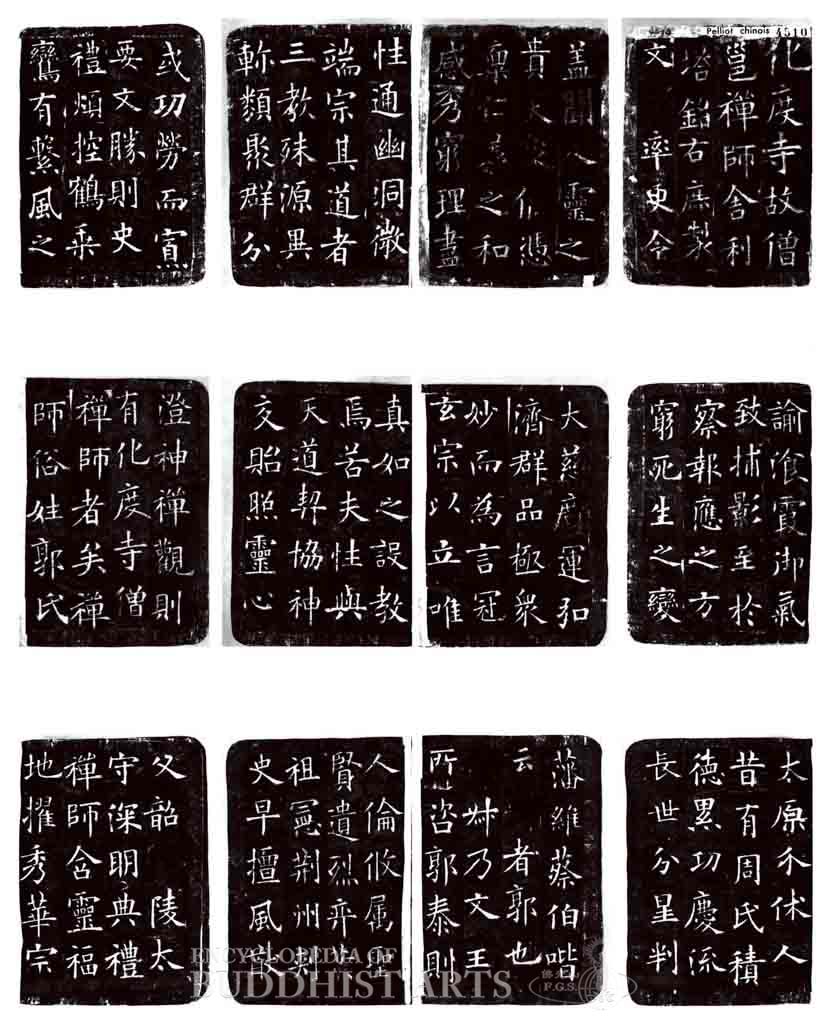
Zhongnanshan: Stele of Master Sengyong at Huadu Temple
Rubbing
Zhongnanshan: Stele of Master Sengyong at Huadu Temple
CHINA, Shaanxi, Xi’an; Tang dynasty
This stele stands in a temple at Zhongnanshan in Xi’an, Shaanxi. The text consists of 35 lines, each containing 33 characters. It was composed by Li Baiyao and scripted by Ouyang Xun. Master Sengyong, a disciple of the Chan monk Sengchou, had a conversation with Chan Master Xinxing after which he was inspired to follow the Teaching of the Three Levels, a movement developed to salvage the age marked by the decline of the Dharma.
The original stele was destroyed during the Song dynasty (960–1279), and only two original rubbings remain. One rubbing is in the Wang Cheng Collection of the Shanghai Library, and the other, a Yuan dynasty (1271–1368) copy, is kept in the Li Ziqi Collection. The latter copy contains postscripts added by Zhao Mengfu and others. All other copies in circulation today are not originals and are rubbings inked from reproduced steles. This includes the pictured rubbing, which is a Dunhuang copy with some of the contents missing.
Ouyang Xun was a Tang dynasty (618–907) calligrapher also known as Xinben from Linxiang, Tanzhou (present day Changsha, Hunan). He employed clerical along with the running script styles of Wang Xizhi and Wang Xianzhi to create the Ouyang style, a dignified and orderly script that is both strong in character, yet serenely at ease. Ouyang is regarded as one of the Four Great Calligraphers of the Early Tang period (618–712). The calligraphic style of this piece is prim and upright, but not lacking in variety. The brushstrokes are strong and well-executed with angular brushwork. Wang Shizhen of the Ming dynasty (1368–1644) highly praised this work. It is regarded as an important piece among Tang dynasty steles and is exemplary of Ouyang’s regular script.
For more details, go to the Encyclopedia of Buddhist Arts: Calligraphy, page 282.
Cite this article:
author = Hsingyun and Youheng and Youlu and Pokorski, Stefanie and Mankuang and Edson, Gary,
booktitle = {Encyclopedia of Buddhist Arts: Calligraphy },
pages = 282,
title = {{Zhongnanshan: Stele of Master Sengyong at Huadu Temple}},
volume = 17,
year = {2016}}