
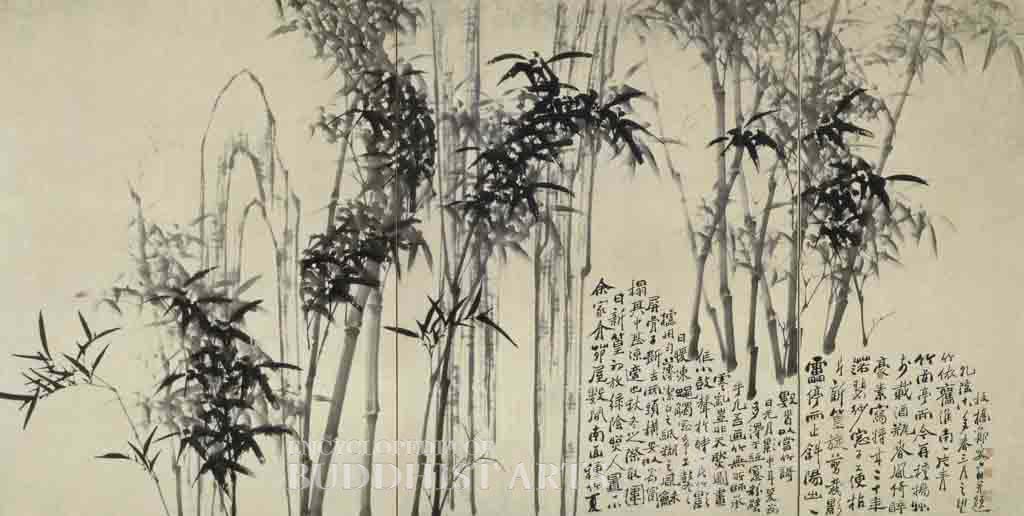
Bamboos by Zheng Xie; Qing dynasty, dated 1753
Ink on paper
Zheng Xie
CHINA, Jiangsu, Taizhou; Qing dynasty
Zheng Xie, also known as Zheng Banqiao, was a painter, calligrapher, and literary writer from Xinghua, Taizhou. He was orphaned at a young age, but his intelligence was apparent even then, and in 1736, he passed the imperial examination and became an Imperial Scholar. After his service, he relocated to Yangzhou and made a living by selling paintings. He is regarded as one of the Eight Eccentrics of Yangzhou, known for his unconventional personality and talents in poetry, calligraphy, and painting. His writings were humorous and popular, most of which reflect societal events.
With a deep interest in Buddhism, Zheng composed several poems and paintings in honor of monk Wufang, whom he befriended. He was noted for his paintings of bamboo, orchids, stones, pines, and chrysanthemum. Zheng also combined his painting and calligraphy skills together to create unique works of art, many of which feature a mixture of the clerical, running, and regular scripts. His calligraphic style was later known as banqiao script.
Many of Zheng’s artworks including Orchids, Bamboos, and Stone, as well as Bamboos, are collected in major museums around the world including the Shanghai Museum, the Palace Museum in Beijing, the Tokyo National Museum in Japan, and the Metropolitan Museum of Art in New York, USA. His Seven-Character Quatrain was engraved on the Stele Wall of Fo Guang Shan Monastery in Kaohsiung, Taiwan.
For more details, go to the Encyclopedia of Buddhist Arts: People, page 354.
Cite this article:
author = Hsingyun and Youheng and Youlu and Pokorski, Stefanie and Yichao and Mankuang and Miaohsi,
booktitle = {Encyclopedia of Buddhist Arts: People },
pages = 354,
title = {{Zheng Xie}},
volume = 19,
year = {2016}}