
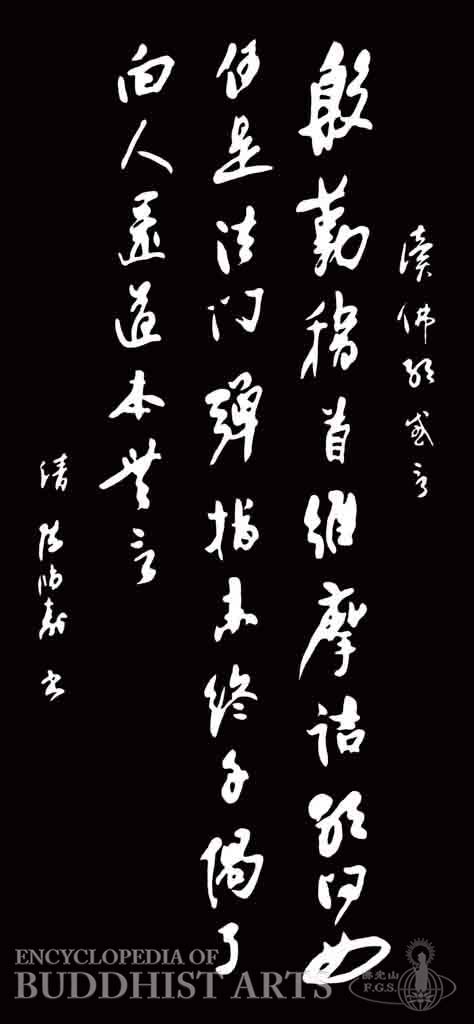
Thoughts After Reading Buddhist Sutras by Chen Hongshou; Qing dynasty
Rubbing
Chen Hongshou
CHINA, Zhejiang, Hangzhou; Qing dynasty
Also known as Zigong, Mansheng or Zhongyu Daoren, Chen Hongshou was a seal engraver, calligrapher, and painter from Qiantang (present day Hangzhou, Zhejiang). In addition to his work as an artist, he served in government positions such as head magistrate and vice governor. Known to be enthusiastic about collecting and studying epigraphy and stele engravings, he was highly praised for his calligraphic works in clerical, seal, and cursive scripts. Chen was also a talented creator of teapots; his zisha (purple sand) teapots were popularly known as Mansheng Teapots.
Regarded as one of the Eight Masters of Xiling, Chen’s seal engravings were modeled after the imperial seals of the Qin (221–207 BCE) and Han (206 BCE–220 CE) dynasties, as well as the styles of Ding Jing and Huang Yi. He employed fluid, sharp, and powerful knife strokes to produce bold and unadorned seal texts. Of equal repute to Chen Yuzhong, they were known together as the Two Chens of Qiantang, and were representatives of the Zhejiang school of Seal Carving.
Chen’s extant seal engraving work, All Are Joyful is a white-character rectangular seal. His calligraphic work, Thoughts After Reading Buddhist Sutras, is engraved on the Stele Wall at Fo Guang Shan Monastery in Kaohsiung, Taiwan. His written works include Seals Collection of Zhongyu Building, Collected Works of Twin Mulberry Building, and Poetry Anthology of Zhongyu Building.
For more details, go to the Encyclopedia of Buddhist Arts: People, page 19.
Cite this article:
author = Hsingyun and Youheng and Youlu and Pokorski, Stefanie and Yichao and Mankuang and Miaohsi,
booktitle = {Encyclopedia of Buddhist Arts: People },
pages = 19,
title = {{Chen Hongshou}},
volume = 19,
year = {2016}}