
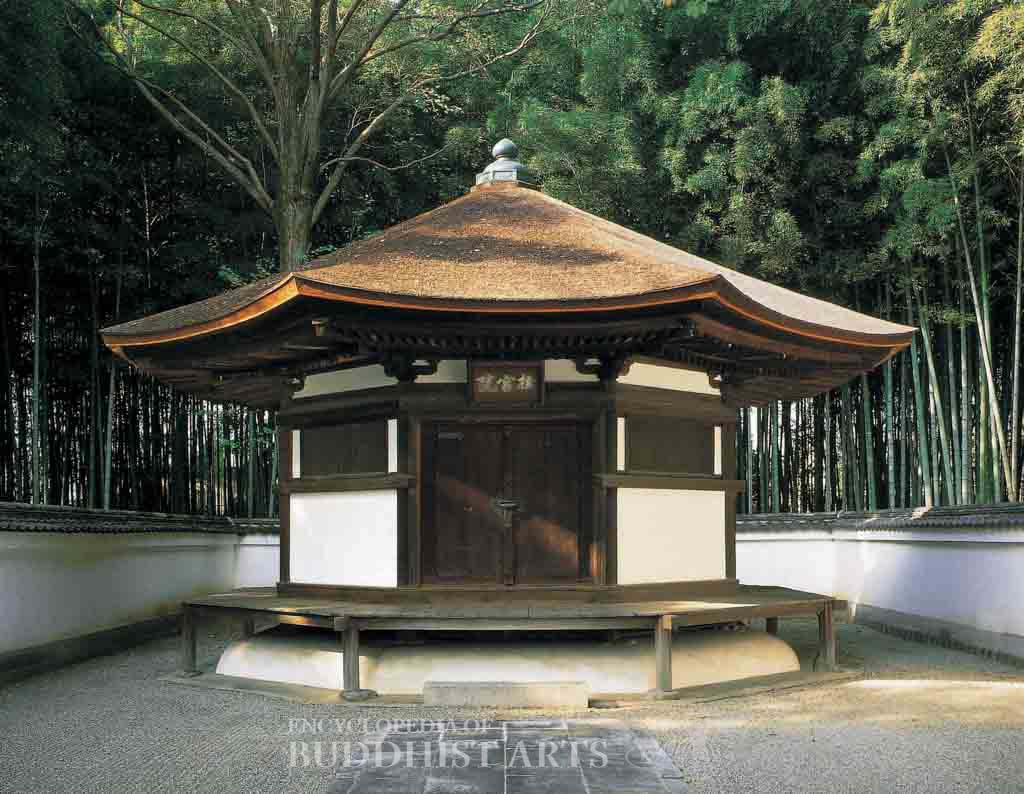
Koryuji Temple: Keiguin Hall
Koryuji Temple
JAPAN, Kyoto
Also known as Uzumasadera Temple and Hachiokadera Temple, Koryuji Temple belongs to the Omuro branch of the Shingon school of Japanese Buddhism. It is one of the Seven Major Temples founded by Prince Shotoku and is the oldest temple in Kyoto. In 603 during the Asuka period, Prince Shotoku presented a statue of the Buddha to the leader of the Hata clan, Hatano Kawakatsu, and in 622 Koryuji Temple was constructed to enshrine the statue. The temple was moved to its present location in 794 during the Nara period, following the relocation of the capital. Despite several disastrous fires, the temple retains some of its main structures.
The principal building include the south gate, Medicine Buddha Hall, Ksitigarbha Hall, lecture hall, Prince Shotoku Hall, kitchen, study room, Treasure Hall, and the Keiguin Hall, which was listed as a National Treasure in 1953.
The two-story, three-bay wide south gate, also known as the Gate of Benevolent Kings, was built in 1702 during the Edo period. It has a hip-and-gable roof covered with cylindrical tiles. Statues of the benevolent kings are enshrined within the gateway. The lecture hall was reconstructed in 1565 during the Muromachi period. It has a single-eave hip roof covered with cylindrical tiles. The Prince Shotoku Hall was built in 1730 during the Edo period. There are lattices with colored illustrations on the ceiling and the hall houses a life-sized wooden sculpture of Prince Shotoku.
The octagonal Keiguin Hall was built in 1251 during the Kamakura period as a tribute to Prince Shotoku. It was modeled after the Hall of Dreams at Horyuji Temple in Nara. Each bay is 2 m wide and it has an octagonal pyramidal roof covered with cypress bark. In the center of the roof is a harmika surmounted by a jewel. The hall used to house a statue of Prince Shotoku seated in half lotus position, but it has been moved to the Treasure Hall.
Koryuji Temple also houses a wooden statue of the Bodhisattva in Contemplation carved during the Asuka to Hakuho period (538–710). It was listed as a National Treasure in 1951. Other National Treasures include sculptures of Amoghapasa Avalokitesvara, Twelve Yaksa Generals, and a Thousand-Armed Avalokitesvara. The painting of Cundi is listed as an Important Cultural Property.
For more details, go to the Encyclopedia of Buddhist Arts: Architecture G-L, page 623.
Cite this article:
author = Hsingyun and Youheng and Johnson, Peter and Mankuang and Lancaster, Lewis,
booktitle = {Encyclopedia of Buddhist Arts: Architecture G-L},
pages = 623,
title = {{Koryuji Temple}},
volume = 2,
year = {2016}}