
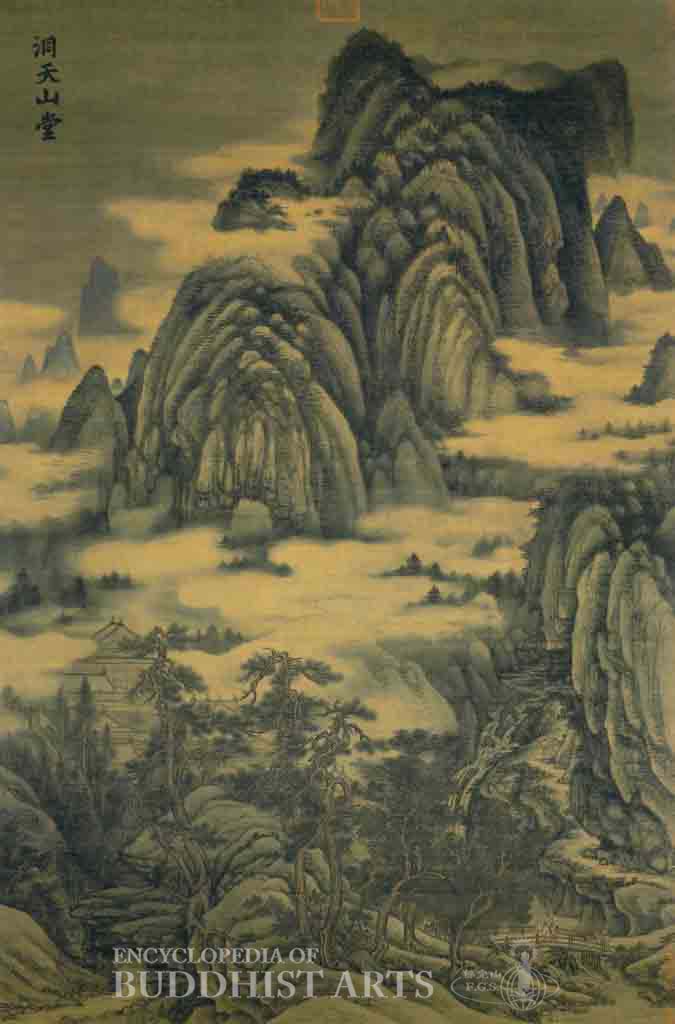
Dongtianshan Hall by Dong Yuan; Southern Tang Kingdom
Ink and color on silk
Dong Yuan
CHINA, Jiangxi, Nanchang; Southern Tang Kingdom
Dong Yuan, also known as Shuda, was a painter from Zongling (present day Jinxian, Nanchang). He once served as deputy officer of the Beiyuan (North Garden) in the imperial court and was therefore also known as Dong Beiyuan.
Although Dong was skilled in painting Buddhist and Daoist figures, especially deities and dragons, he was particularly known for his landscape works. He is known for inventing a series of painting techniques that creatively depicted the exclusive and natural features of the mountains, trees, and rocks in Jiangnan, an area around the Jiangsu and Zhejiang regions. His paintings in ink-wash technique, which became known as the Jiangnan landscape style, resembled that of Wang Wei, and his use of color showed influence from Li Sixun.
Dong was reputed alongside Juran, and together they were referred to as Dong Ju. Additionally, with Jing Hao, Juran, and Guan Tong, he is regarded as one of the Four Great Landscape Painters between the Five Dynasties (907–960) and early Song dynasty (960–1279). His unique style also comprised part of the Three Schools of the Northern Song dynasty (960–1127), alongside that of Li Cheng and Fan Kuan.
Several of Dong’s paintings still exist today. Landscapes of the Xiao and Xiang Rivers is kept at the Palace Museum in Beijing and Summer Mountains is at the Shanghai Museum. In addition, the National Palace Museum in Taipei, Taiwan retains his works entitled Celebration of the People of the Capital’s Countryside and Dongtianshan Hall.
For more details, go to the Encyclopedia of Buddhist Arts: People, page 49.
Cite this article:
author = Hsingyun and Youheng and Youlu and Pokorski, Stefanie and Yichao and Mankuang and Miaohsi,
booktitle = {Encyclopedia of Buddhist Arts: People },
pages = 49,
title = {{Dong Yuan}},
volume = 19,
year = {2016}}