
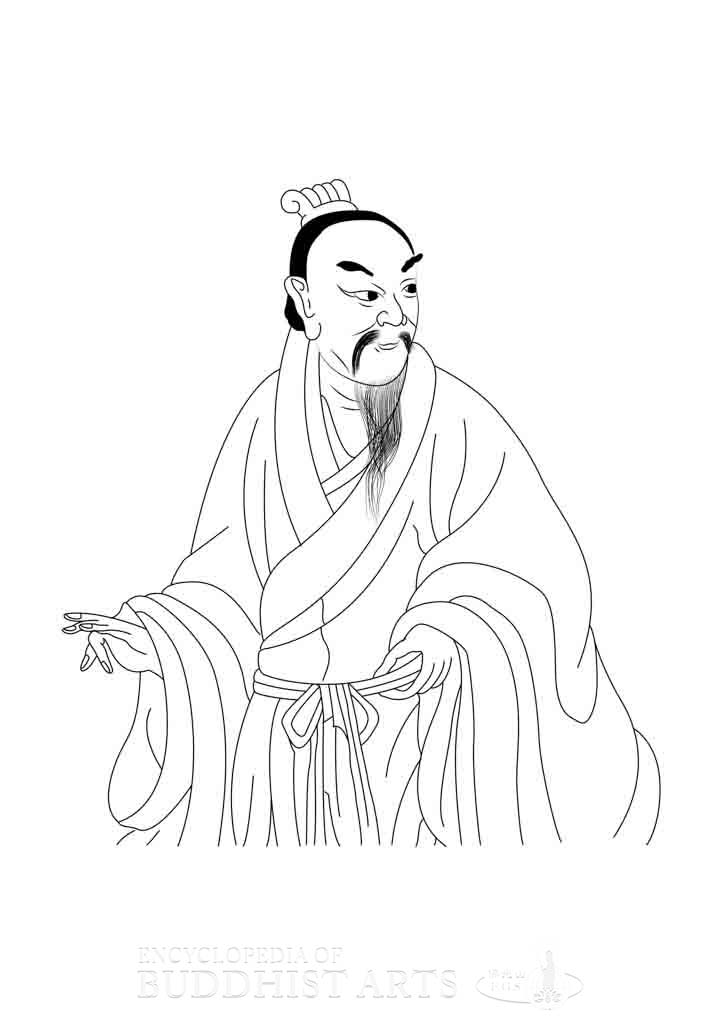
Mi Fu
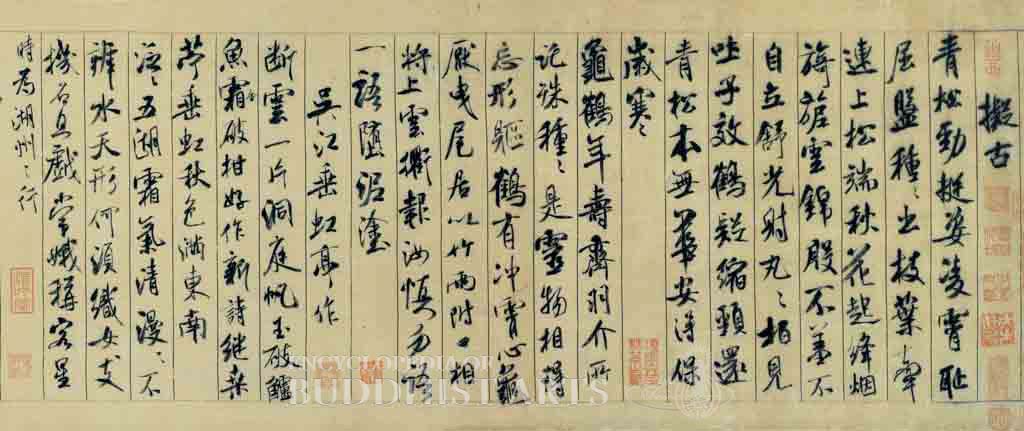
On Sichuan Silk by Mi Fu; Northern Song dynasty, dated 1088
Ink on silk
Mi Fu
CHINA, Shanxi, Taiyuan; Northern Song dynasty
Mi Fu, also known as Yuanzhang or Haiyue Waishi, was a renowned calligrapher, painter, art theorist, and seal engraver. He was known to have converted to Buddhism in his later years and studied the teachings of the Chan school, remaining devoted until his passing.
As an outstanding calligrapher, Mi was particularly skilled in cursive script. His early works were influenced by Yan Zhenqing, Liu Gongquan, and Ouyang Xun. He later focused, however, on copying the famous writings of the Wei (386–556) and Jin (265–420) dynasties, particularly that of Wang Xizhi and Wang Xianzhi. The influence gained from his study of these ancient works was expressed through his own innovative style, which elicits a feeling of energy and fluidity. In addition, Mi used his skills in seal engraving to create signatures for his own works. Alongside Cai Xiang, Huang Tingjian, and Su Shi, Mi is regarded as one of the Four Calligraphy Masters of the Song dynasty.
Driftwood, bamboo, and stones were among Mi’s preferred subjects to depict in his landscape paintings. Inspired by Dong Yuan’s style, he used a flat brush to create large ink patches that characteristically portrayed misty scenery. Mi believed that landscape painting was among the superior forms of art, next to Buddhist painting. He is known for having once said, “Buddhist paintings provide moral guidance, and in doing so, they can be deemed superior. Then comes the depiction of landscapes and natural elements. As for paintings of human figures, birds, and animals, they are for the amusement of the gentry, and as such, they cannot be considered pure artistic treasures.”
Mi’s existing calligraphic works include Records of Fangyuan Temple in Hangzhou; On Sichuan Silk, Commentary on Cursive Script and Letter from Mi Fu to Su Shi About Reclaiming a Purple-Gold Inkstone, all of which are kept at the National Palace Museum in Taipei, Taiwan; Letter from Mi Fu to Master Bu’er, kept at Art Museum in Chinese University of Hong Kong; and Sutra of Wisdom and Quiescence, kept at the Shanghai Library; among several others at various museums and galleries around the world. Mi also authored several books including the famous History of Painting, History of Calligraphy, Quotes of Haiyue, and Inscriptions of Haiyue.
For more details, go to the Encyclopedia of Buddhist Arts: People, page 191.
Cite this article:
author = Hsingyun and Youheng and Youlu and Pokorski, Stefanie and Yichao and Mankuang and Miaohsi,
booktitle = {Encyclopedia of Buddhist Arts: People },
pages = 191,
title = {{Mi Fu}},
volume = 19,
year = {2016}}