
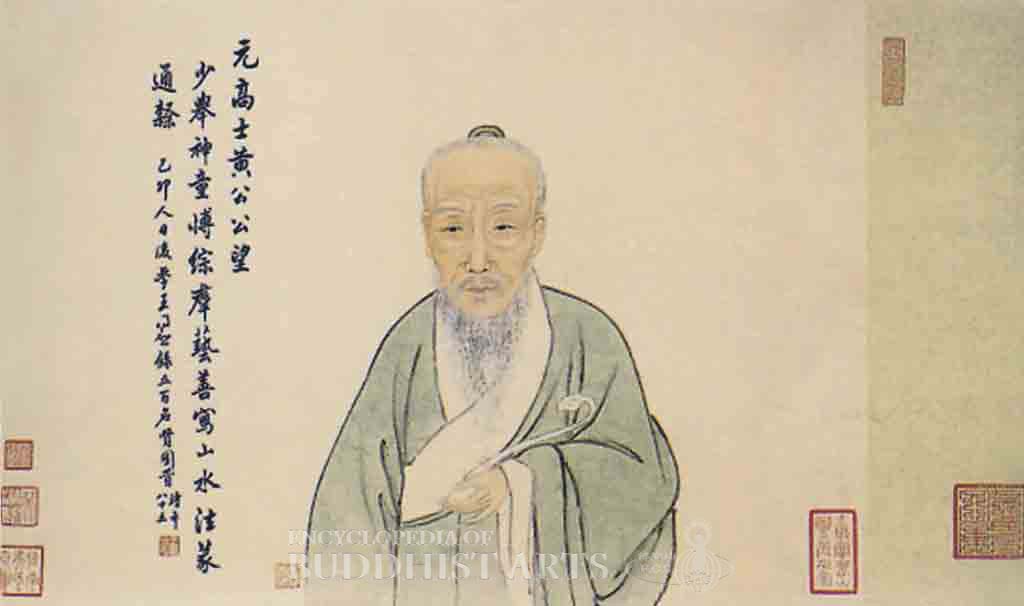
Huang Gongwang; Dated 1915
Ink and color on paper
Huang Gongwang
CHINA, Jiangsu, Suzhou; Yuan dynasty
Originally named Lu Jian but changed to Huang Gongwang after being adopted by a Huang family in Changshu, Suzhou, Huang is a well-known painter and calligrapher. From an early age he displayed extraordinary talents and was considered a child prodigy. Huang quickly developed unparalleled knowledge on a wide range of subjects including Buddhism, Daoism, and history. He was eventually appointed a junior official in the imperial court.
Huang was adept in various calligraphic scripts stemming from ancient influences. His own style is comprised of natural and elegant features. Alongside Wu Zhen, Wang Meng, and Ni Zan, Huang was recognized as one of the leading figures among the Four Calligraphy Masters of the Yuan dynasty (1271-1368).
Although he began painting later in life, Huang became an expert in landscape painting. His style was originally influenced by Dong Yuan and Juran, and he later learned under the famed Zhao Mengfu, who helped him develop his own unique style. Huang’s paintings tend to feature light colors illustrating landscapes and mountain tops with various stones. Moreover, his brushwork focuses on the inner spirit of the subject despite his unadulterated drawing style. Huang’s works ultimately imparted a substantial influence on the painting style of the Ming (1368–1644) and Qing (1644–1911) dynasties.
At the age of 81, Huang accomplished one of his greatest works, Dwelling in the Fuchun Mountains. The painting, which is considered by some to be one of the best Chinese paintings in existence, was circulated among famous art collectors including Shen Zhou, Dong Qichang, and Wu Hongyu. An interesting anecdote relating to this painting is that the collectors supposedly tried to burn the painting before Huang’s death in order to allow for it’s passing into his afterlife. Fortunately, Huang’s nephew Wu Ziwen managed to retrieve the painting from the flames, but the painting was burnt into two separate pieces. The first half of the painting, known as the Remaining Mountain, is currently kept in the Zhejiang Provincial Museum in Hangzhou, and the other half is known as Master Wuyong Scroll and is now kept at the National Palace Museum in Taipei, Taiwan.
For more details, go to the Encyclopedia of Buddhist Arts: People, page 100.
Cite this article:
author = Hsingyun and Youheng and Youlu and Pokorski, Stefanie and Yichao and Mankuang and Miaohsi,
booktitle = {Encyclopedia of Buddhist Arts: People },
pages = 100,
title = {{Huang Gongwang}},
volume = 19,
year = {2016}}