
Faxing Temple Perfect Enlightenment Hall: Twelve Perfect Enlightenment Bodhisattvas
Clay

Faxing Temple Perfect Enlightenment Hall: Twelve Perfect Enlightenment Bodhisattvas
Faxing Temple Perfect Enlightenment Hall: Twelve Perfect Enlightenment Bodhisattvas
Faxing Temple Perfect Enlightenment Hall: Twelve Perfect Enlightenment Bodhisattvas
Faxing Temple Perfect Enlightenment Hall: Twelve Perfect Enlightenment Bodhisattvas
CHINA, Shanxi, Changzhi; Northern Song dynasty
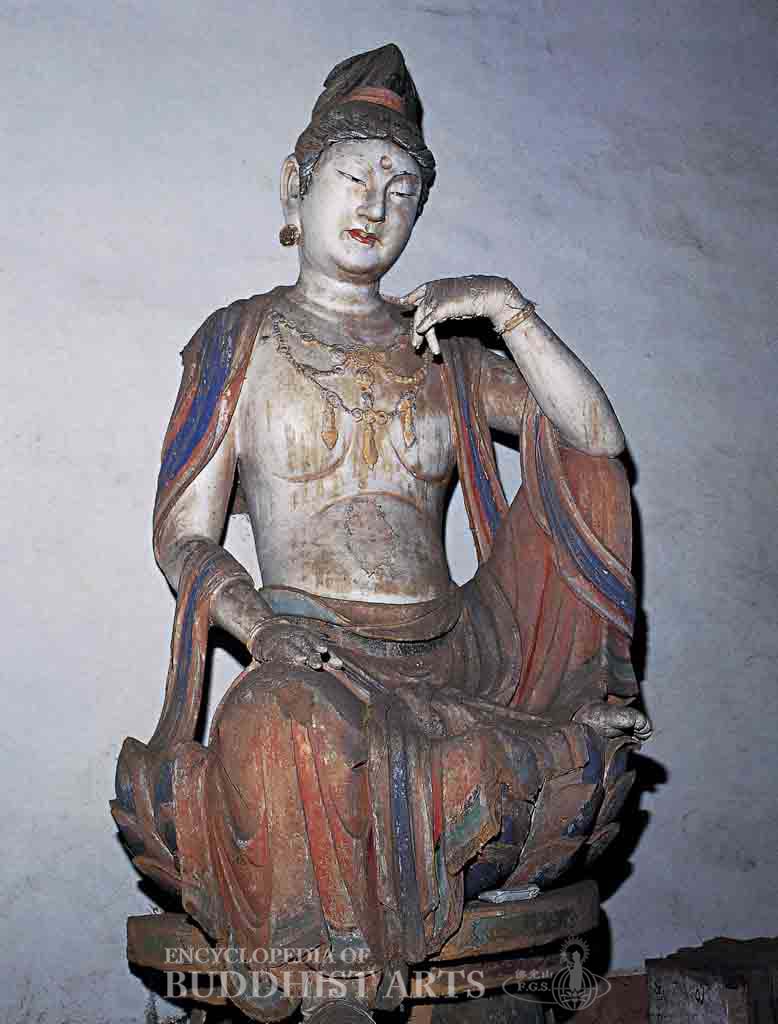
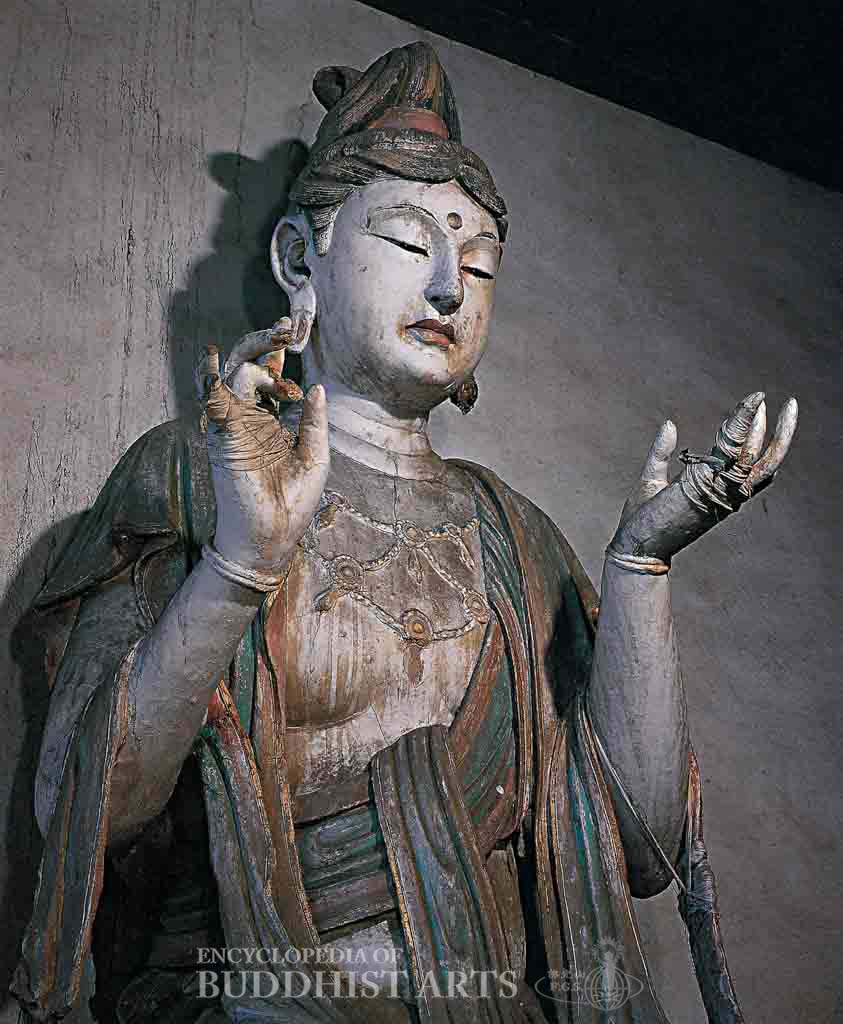
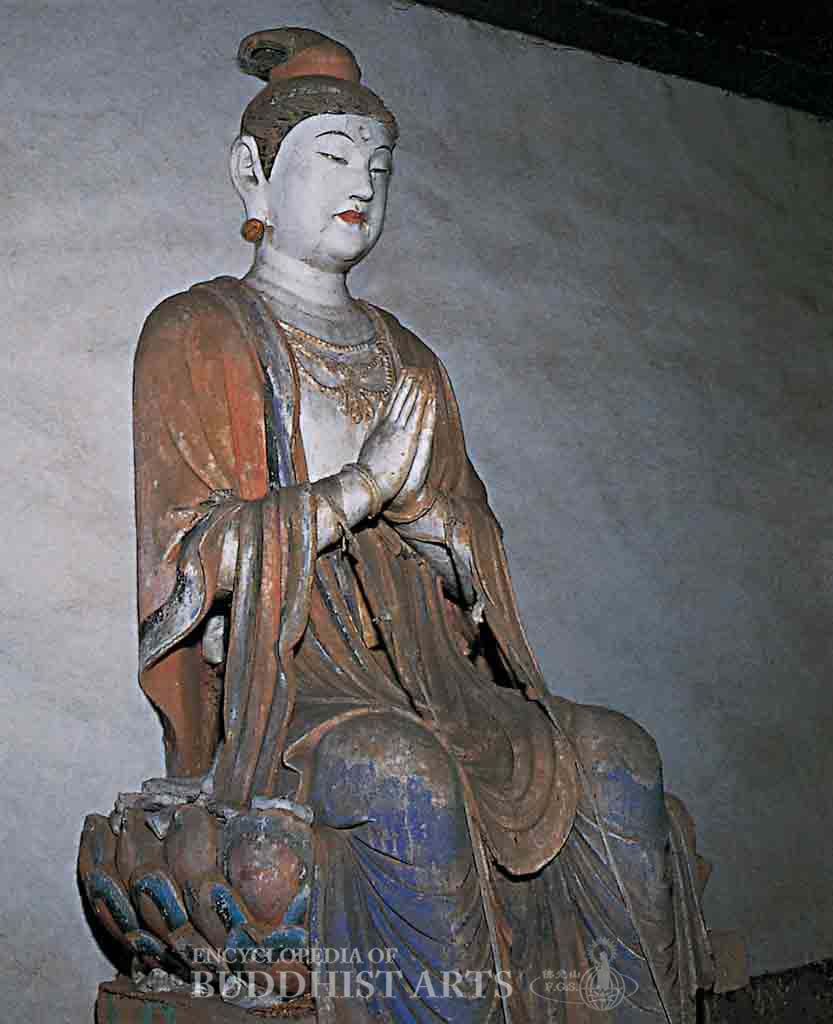
These statues are located along the side walls of the hall. All twelve have their hair braided into cockleshell topknots. Though they have similar facial features, they are differentiated by their various sitting postures. The hands of many of them are damaged but there is variety in their elegant gestures, while a few are held in mudras.Their clothing also differs, with some dressed in loosely draped robes and stoles while others have bare upper bodies. All the figures, however, wear the elaborate necklaces typical of Bodhisattvas. The statues are dated and the names of their creators are recorded, which is rare for the period.
The Twelve Perfect Enlightenment Bodhisattvas were described in the Sutra of Perfect Enlightenment, which became popular during the Song dynasty (960–1279) and was propagated particularly by the Huayan and Chan schools. Each Bodhisattva in the sutra in turn asks the Buddha a set of questions about doctrine, practice and the nature of true enlightenment. Some of the Bodhisattvas are well known and others are identified by doctrinal descriptors. They appear in this order: Manjusri, Samantabhadra, Universal Vision Bodhisattva, Vajragarbha, Maitreya, Pure Wisdom Bodhisattva, Unhindered Power and Virtue, Sound Discernment, Purifier of All Karmic Hindrances, Universal Enlightenment, Perfect Enlightenment, and Foremost in Virtue and Goodness Bodhisattva.
For more details, go to the Encyclopedia of Buddhist Arts: Sculpture A-F, page 321.
Cite this article:
author = Hsingyun and Youheng and Lovelock, Yann and Chou, Yuan and Huntington, Susan and Edson, Gary and Neather, Robert,
booktitle = {Encyclopedia of Buddhist Arts: Sculpture A-F},
pages = 321,
title = {{Faxing Temple Perfect Enlightenment Hall: Twelve Perfect Enlightenment Bodhisattvas}},
volume = 10,
year = {2016}}