
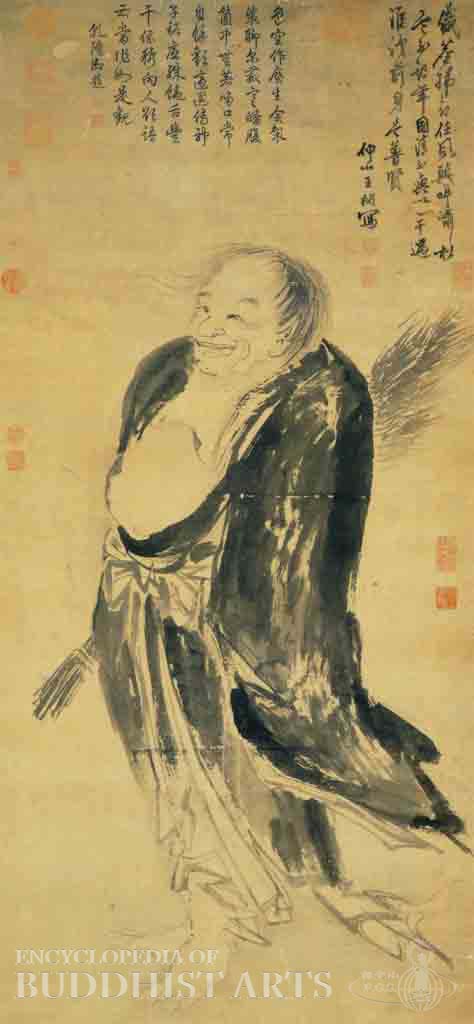
Shide by Wang Wen; Ming dynasty
Ink on paper
Wang Wen
CHINA, Jiangsu, Wuxi; Ming dynasty
Wang Wen was a calligrapher and painter who was also known as Ziyu or Shizhai. He became an Imperial Scholar in 1538. Initially appointed as a clerical officer in the Ministry of Revenue, he later served as chief of the Department of Justice in Guangdong. However, by mid-career, Wang decided to return home to live a life of seclusion.
He was skilled in the painting of landscapes, figures, flowers, and birds, using an elegant and refined color palette. Among his collection of paintings are Shide, kept at the National Palace Museum in Taipei, Taiwan; Lotus Flowers and Boats Crossing the Lake, at the Nanjing Museum in Jiangsu; and Watching a Waterfall from a Creek-Side Pavilion, at the Shandong Provincial Museum in Jinan.
Also proficient in poetry and calligraphy, Wang never studied the style of any particular school, yet his own style was strong and highly praised. His calligraphic works, Poem About Self, a work in cursive script, is kept at the Tianjin Museum, and Poems of Realization at Huishan Temple, in running-regular script, is kept at the Palace Museum in Beijing.
For more details, go to the Encyclopedia of Buddhist Arts: People, page 283.
Cite this article:
author = Hsingyun and Youheng and Youlu and Pokorski, Stefanie and Yichao and Mankuang and Miaohsi,
booktitle = {Encyclopedia of Buddhist Arts: People },
pages = 283,
title = {{Wang Wen}},
volume = 19,
year = {2016}}