
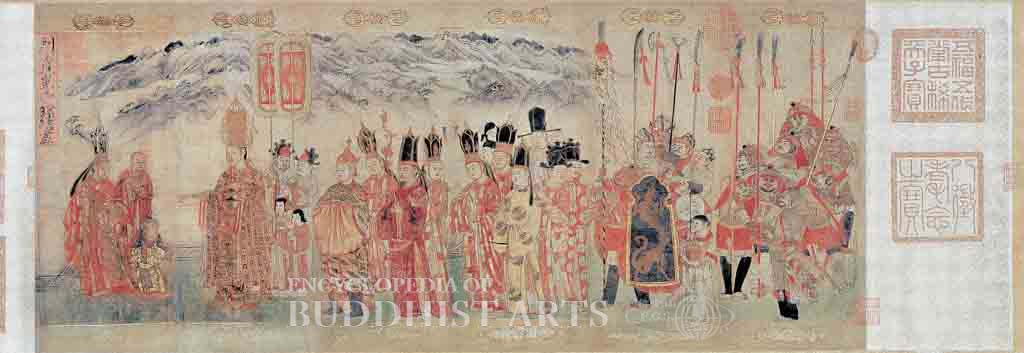
Long Scroll of Buddhist Images - Emperor Duan Zhixing Paying Respect to the Buddha
Ink and color on paper
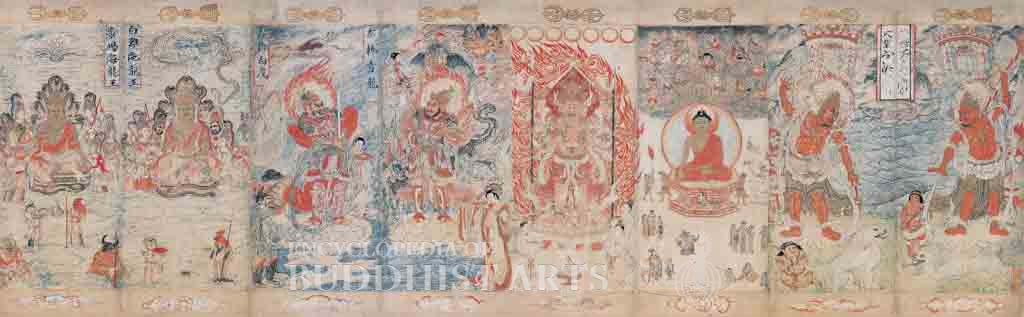
Long Scroll of Buddhist Images - Buddhas and Dharma Protectors
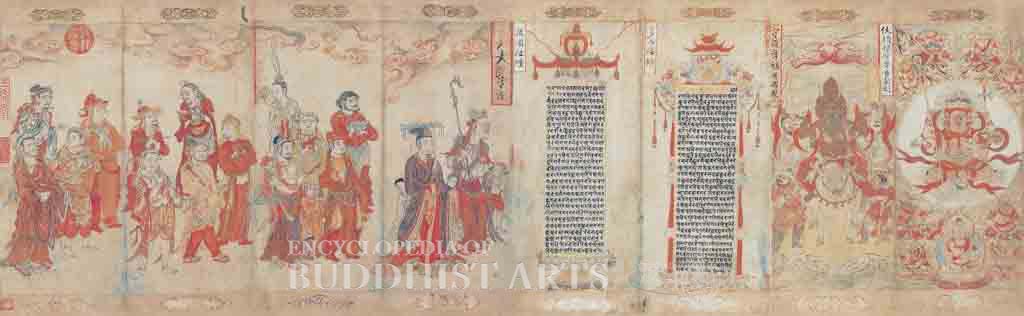
Long Scroll of Buddhist Images - Kings of the Sixteen Kingdoms

Long Scroll of Buddhist Images - Sixteen Arhats (detail)


Long Scroll of Buddhist Images
CHINA; Dali Kingdom
An inscription on the first section of this scroll dedicates it to King Duan Zhixing (reigned 1172–1199) of the Dali Kingdom, suggesting that it was created during his rule. Later inscriptions written by the monk Miaoguang in 1180 indicate that it was painted by the Dali artist Zhang Shengwen. However, the varied styles of the illustrations suggest that they were likely painted by a group of artists. There are no records of Zhang in books of art history, but this reference makes it appear that he was a famous Buddhist artist of his time.
Another inscription on the scroll, this one by Emperor Qianlong (reigned 1736–1795), states that it was kept in the Tianjie Temple during the rule of Emperor Taizu (reigned 1368–1398) of the Ming dynasty. In the time of Emperor Zhengtong (reigned 1435–1449), the scroll was soaked in water, necessitating its conversion to book form. Later, it was restored to its original form as a scroll. Accordingly, there have likely been some accidental changes in the order and the composition of the illustrations. The scroll is 30.4 cm in height, 1,612 cm in length, and is divided into three sections. The 72.2 cm long first section depicts Emperor Duan Zhixing paying respect to the Buddha. The 1,490.7 cm long second section forms the main body of the scroll, with illustrations of over 100 figures, including various Buddhas, Bodhisattvas, Arhats, Heavenly Kings, and Dharma protectors. The third section is 49.1 cm long, and portrays the kings of the 16 kingdoms.
In the first section of the scroll, Emperor Duan Zhixing is shown wearing imperial robes and a crown. Behind him are elegantly dressed officials, warriors carrying weapons, and barefooted soldiers. An official and a monk lead the emperor and the crown prince toward the Buddha. The image is a rare visual record of the customs and royalties of the Nanzhao (752–902) and Dali (937–1253) Kingdoms. The second section of the scroll contains depictions of many different figures, including Sakyamuni Buddha, the Sixteen Arhats, the patriarchs of the Chan school, the three assemblies of Maitreya Buddha, the Medicine Buddha assembly, and several images of Avalokitesvara Bodhisattva inspired by Vajrayana Buddhism. Buddhist figures unique to the Nanzhao and Dali Kingdoms are also shown. The third section of the scroll portrays kings from South Asia, Southeast Asia, the Central Plains, and regions of Yunnan. There are also images of officials and tribal leaders.
The Nanzhao and Dali kingdoms were situated in the middle of the Central Plains, close to Tibet and Southeast Asia. Thus, the influence of several different artistic styles can be seen in the paintings. For example, the lines and details in the depictions of the three assemblies of Maitreya and the Medicine Buddha assembly are done in the same style as in Tang (618–907) and Song (960–1279) dynasty illustrations, and the organization of the figures is also similar. Affinities with Tibetan Buddhist images are also especially evident in the portrayal of some of the figures in the Sakyamuni Buddha assembly. A Southeast Asian influence can be seen in the image of Avalokitesvara. The portrayal of some figures is bold and original, while others are painted in a traditional manner. The numerous inscriptions on the scroll provide valuable information for research on the art and religion of the Dali Kingdom.
For more details, go to the Encyclopedia of Buddhist Arts: Painting I-O, page 488.
Cite this article:
author = Hsingyun and Youheng and Youlu and Wilson, Graham and Manho and Mankuang and Huntington, Susan,
booktitle = {Encyclopedia of Buddhist Arts: Painting I-O},
pages = 488,
title = {{Long Scroll of Buddhist Images}},
volume = 15,
year = {2016}}