
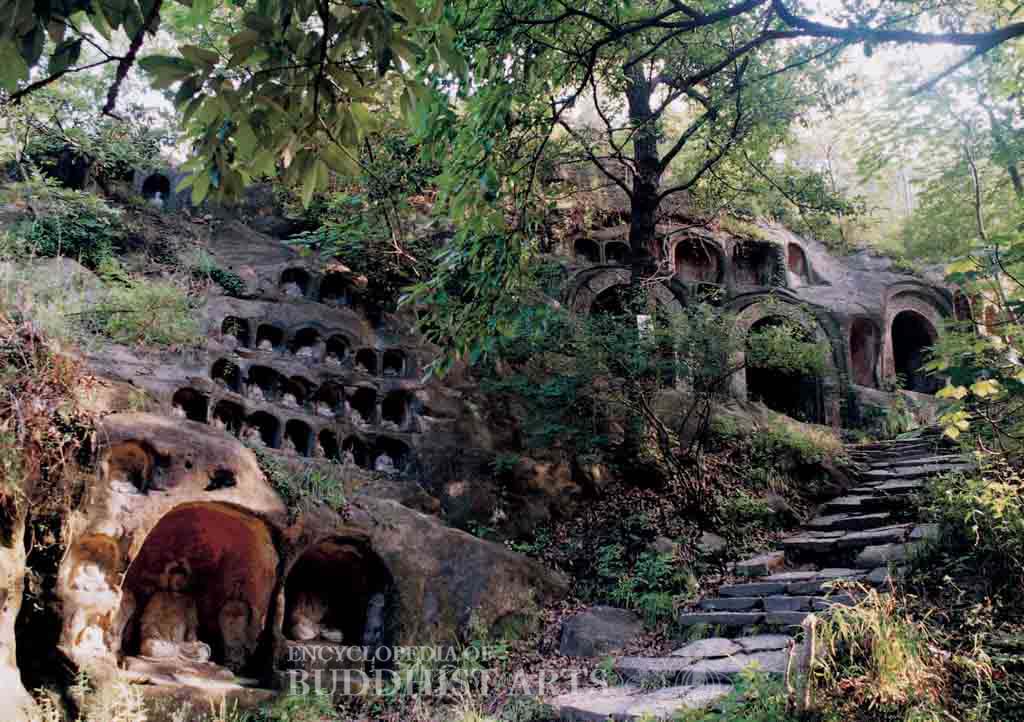
Qixiashan Caves
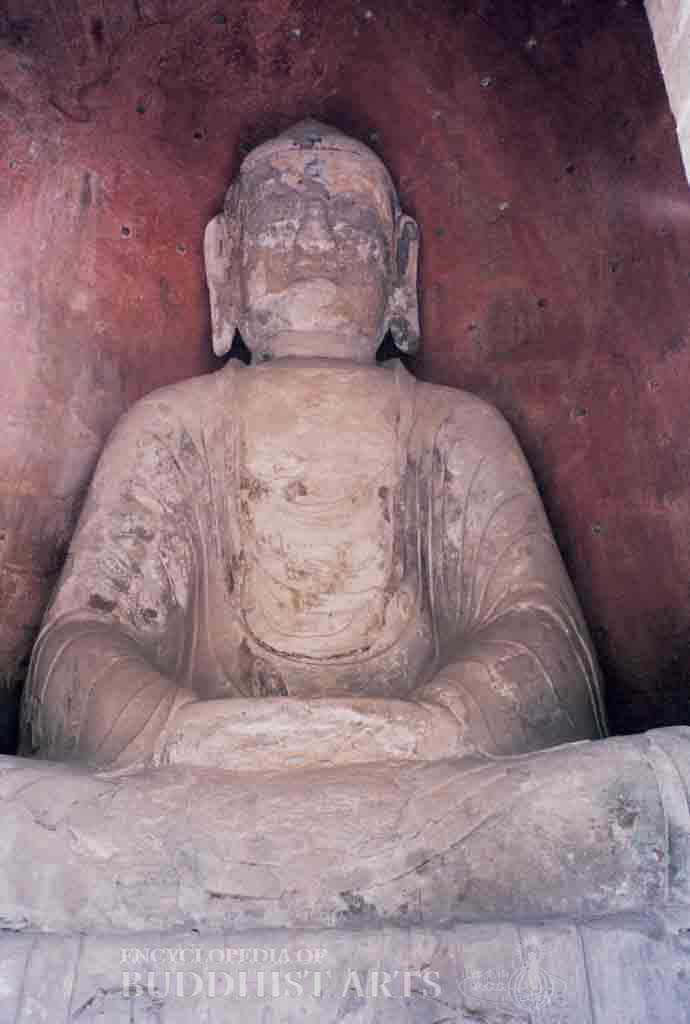
Qixiashan Caves: Hall of the Three Sages - Amitabha Buddha; Southern Qi dynasty
Stone
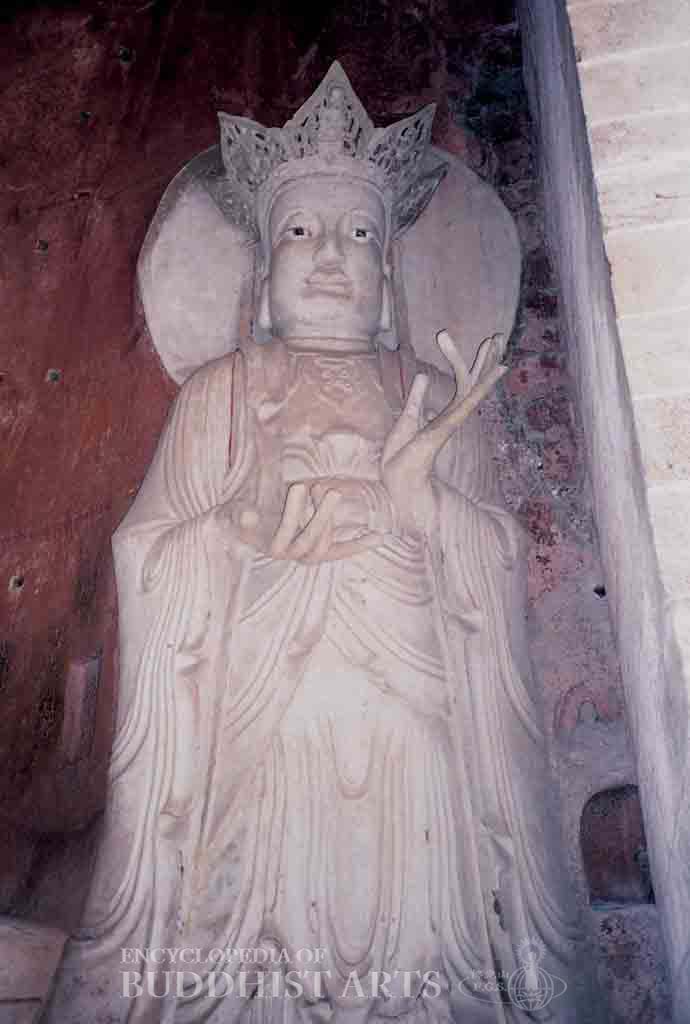
Qixiashan Caves: Hall of the Three Sages - Mahasthamaprapta Bodhisattva; Southern Qi dynasty
Stone
Qixiashan Caves
CHINA, Jiangsu, Nanjing
These caves are located on a cliffside northeast of Qixia Temple at Qixiashan, situated about 22 km northeast of Nanjing, Jiangsu. During the Southern Qi dynasty (479–502), Fadu, a monk, turned Ming Sengshao’s residence into a vihara according to the late landowner’s will. The vihara was renamed Qixia Temple in 1007 of the Song dynasty (960–1279). The niche statues were carved on the cliffside. Work on the statues in the main niches began in the Southern Qi dynasty and continued into the Liang dynasty (502–557). The Ming dynasty (1368–1644) continued its construction and restoration work. Today, there are 294 caves and niches containing 515 sculptures. The caves are listed as a Provincial Cultural Heritage Site.
Carving during the Southern Dynasties (420–589) mainly concentrated on the two largest niches, placed side by side. The slightly larger right niche is known as the Hall of the Three Sages. The front section of the niche’s original ceiling collapsed and was replaced with a tiled roof in the Ming dynasty. Traces of holes to support beams along the cliffside also indicate that a wooden structure may have been installed on the cliff during the Ming dynasty. Carved inside the niche is an Amitabha Buddha Triad. The central statue of Amitabha Buddha is flanked by Avalokitesvara and Mahasthamaprapta Bodhisattvas. The three statues were repeatedly restored in later periods; however, the drapes of Amitabha Buddha’s robe and the lower garments of the Bodhisattvas are original.
Next to the Hall of the Three Sages is the smaller of the two principal niches. A U-shaped stone altar can be found within this niche, with statues of Sakyamuni and Prabhutaratna Buddhas on the back wall. Bodhisattvas flank both Buddhas. Sakyamuni and Prabhutaratna sit in full lotus position wearing monastic robes that cover both shoulders, with their hands forming the dhyana (meditation) mudra. This style is often seen in works of the middle and late Northern Wei (386–534) dynasty in the Central Plains, such as the Longmen Grottoes’s Binyang Grotto and the Gongxian Caves.
Small niche statues from the Southern Dynasties are found along the cliffside. The subjects of these statues include seated Buddhas, the Thousand Buddhas, and figures in contemplative poses. These niches still maintain their original styles.
For more details, go to the Encyclopedia of Buddhist Arts: Caves Mo-S, page 1332.
Cite this article:
author = Hsingyun and Youheng and Johnson, Peter and Mankuang and Huntington, Susan and Edson, Gary and Neather, Robert,
booktitle = {Encyclopedia of Buddhist Arts: Caves Mo-S},
pages = 1332,
title = {{Qixiashan Caves}},
volume = 8,
year = {2016}}