
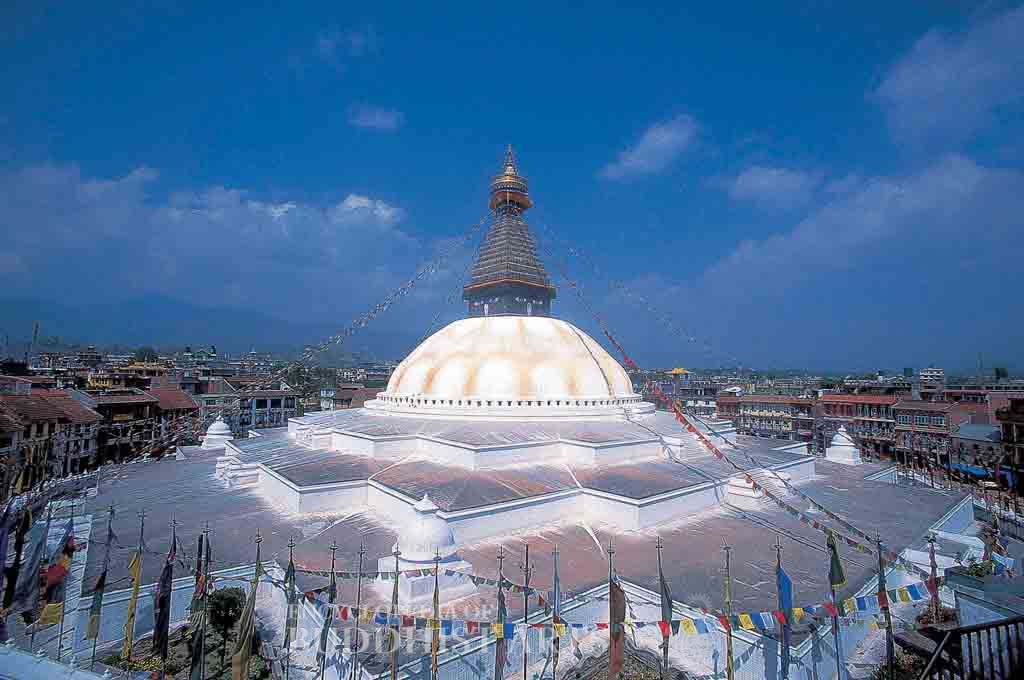
Boudhanath Stupa
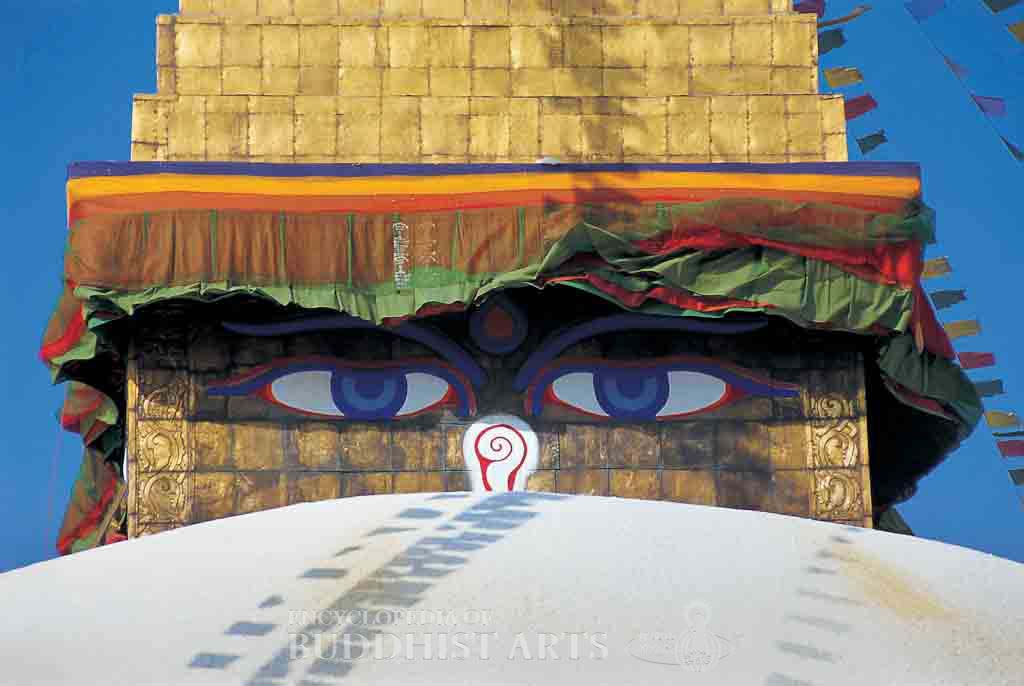
Boudhanath Stupa: Buddha’s Eyes
Boudhanath Stupa
NEPAL, Kathmandu
Boudha means Enlightened and Nath means Stupa. There are a number of variations in the spelling, for example Boudha Stupa and Bodnath Stupa, and it is also known as Khasa Caitya, Chorten Chempo (Great Stupa), and Jyarung Khasyor. It is the largest stupa in Nepal and is a prominent landmark in the capital, and it is one of the best examples of Nepalese-style stupas. It has been said that the origins of the stupa date back to the 5th century. It has been subject to renovations over time, including repairs by King Shivadeva I (reigned 590–604) and King Pratapa Malla (reigned 1631–1674). In 1979 the Kathmandu Valley, including Boudhanath Stupa, was inscribed on the UNESCO World Heritage List.
The entire stupa is built according to a mandala. It measures 36 m in height and over 100 m in diameter. The main entrance is on the north side. The base consists of three tiered platforms in the shape of a square with multiple corners. On the first platform there are six small white stupas in the form of inverted bowls: four are in the north and two are in the south. The main body of the stupa is in the form of an inverted white bowl, which is decorated with lotus petals. At its base there are 108 niches with bas-reliefs of Avalokitesvara. At the apex of the bowl there is a harmika painted with a pair of Buddha’s eyes on each side, which is typical of a Nepalese stupa. The eyes are in red, white, and blue, which is both attractive and striking. The number one in Nepali, symbolizing unity, is painted beneath the eyes, while a third wisdom eye is drawn above the eyes. Above the platform there is a 13-tier pyramid forming the spire representing the stages of cultivation in order to become a Buddha. At the top of the spire there is a gilded canopy followed by a gilded finial.
The outermost walls of the stupa contain 147 niches and are set with 735 prayer wheels. Pilgrims and travelers circumambulate the stupa while turning the wheels. Built on an ancient route to Tibet, it is one of the most important centers for Tibetan Buddhists and today over 50 Tibetan temples surround it.
For more details, go to the Encyclopedia of Buddhist Arts: Architecture A-F, page 96.
Cite this article:
author = Hsingyun and Youheng and Johnson, Peter and Mankuang and Lancaster, Lewis,
booktitle = {Encyclopedia of Buddhist Arts: Architecture A-F},
pages = 96,
title = {{Boudhanath Stupa}},
volume = 1,
year = {2016}}