
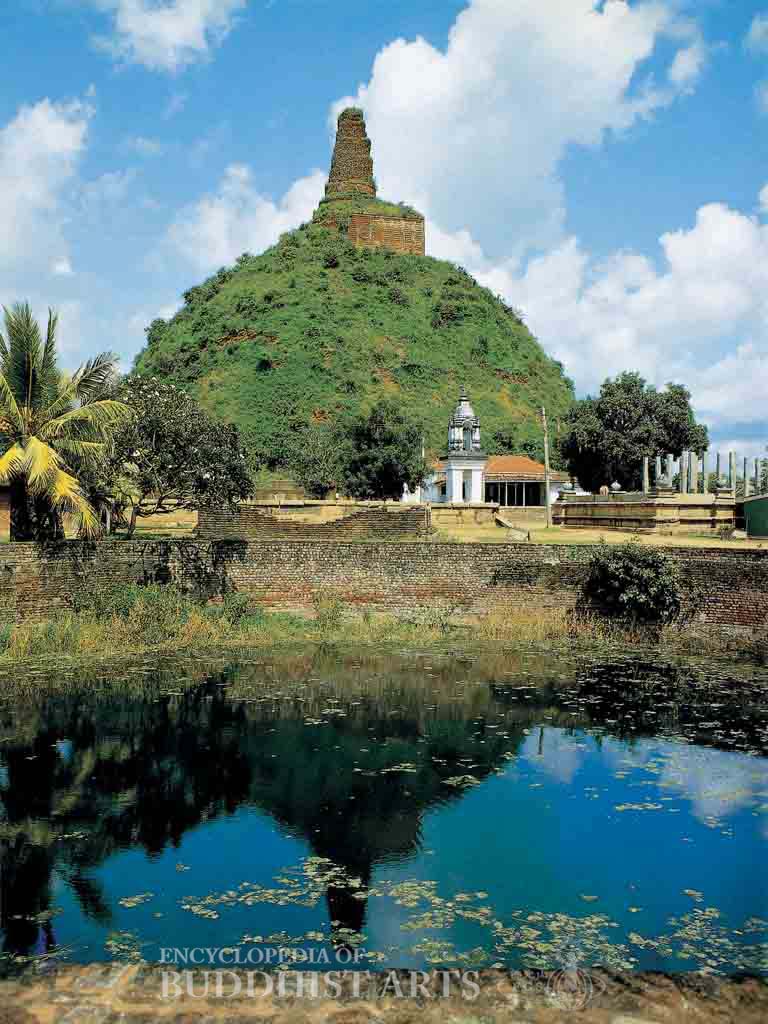
Abhayagiri Vihara
Abhayagiri Vihara
SRI LANKA, North Central Province, Anuradhapura
Abhayagiri Vihara means the Monastery of the Hill of Fearlessness. According to the historical records, when King Vattagamani Abhaya (reigned 89–77 BCE) regained control of his kingdom from foreign invaders, he built the Abhayagiri Vihara on the site of a Jain monastery. The monastery was offered to Mahatissa Thera in gratitude for his support in fighting off the invaders.
When the Chinese monk Faxian visited between 410 and 412, he described the grandeur of the stupa, which was lavishly embellished with gold, silver, and various gems. He stated that there were 5,000 monks studying there. The monastery had an international reputation and attracted scholars from many countries. Gunavarman, a Kashmiri monk, Amoghavajra, an Indian monk, and others spent time at the vihara before they moved on to China to propagate Buddhism. It became a great center of learning and the Vinaya commentary Samantapasadika was compiled at this monastery. However, during the 13th century the monastery was destroyed, along with Anuradhapura, and all that is left is the stupa, together with some ruins. As part of the Sacred City of Anuradhapura, it was listed as a UNESCO World Heritage Site in 1982.
Aligned on an east-west axis, the monastery complex occupied an area of 200 ha. The major buildings were the Abhayagiri stupa, the image house, Bo Tree Shrine, chapter house, ceremonial anointing hall, assembly halls, and dining halls. There were a number of residential units for groups of monks together with libraries and teaching facilities. There is a large stone trough used for holding rice for around 5,000 monks, together with a smaller one for holding gruel. There were also a variety of tanks, including the Kuttam Pokuna. Today there is also a modern residence and a museum at the site.
The stupa is 75 m high with a diameter of 106.5 m. It is in the shape of a paraboloid rice grain heap with a square harmika and conical spire of stacked rings. It is currently in the process of being restored.
For more details, go to the Encyclopedia of Buddhist Arts: Architecture A-F, page 1.
Cite this article:
author = Hsingyun and Youheng and Johnson, Peter and Mankuang and Lancaster, Lewis,
booktitle = {Encyclopedia of Buddhist Arts: Architecture A-F},
pages = 1,
title = {{Abhayagiri Vihara}},
volume = 1,
year = {2016}}