
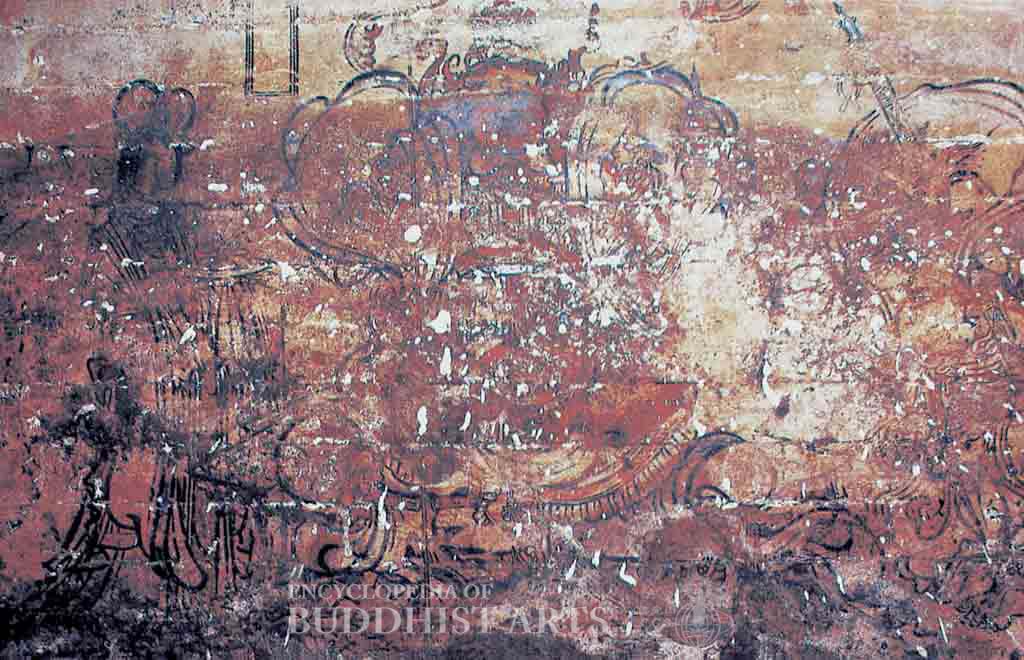
Wugou Jingguang Pagoda: Four Heavenly Kings - Vaisravana (north wall)
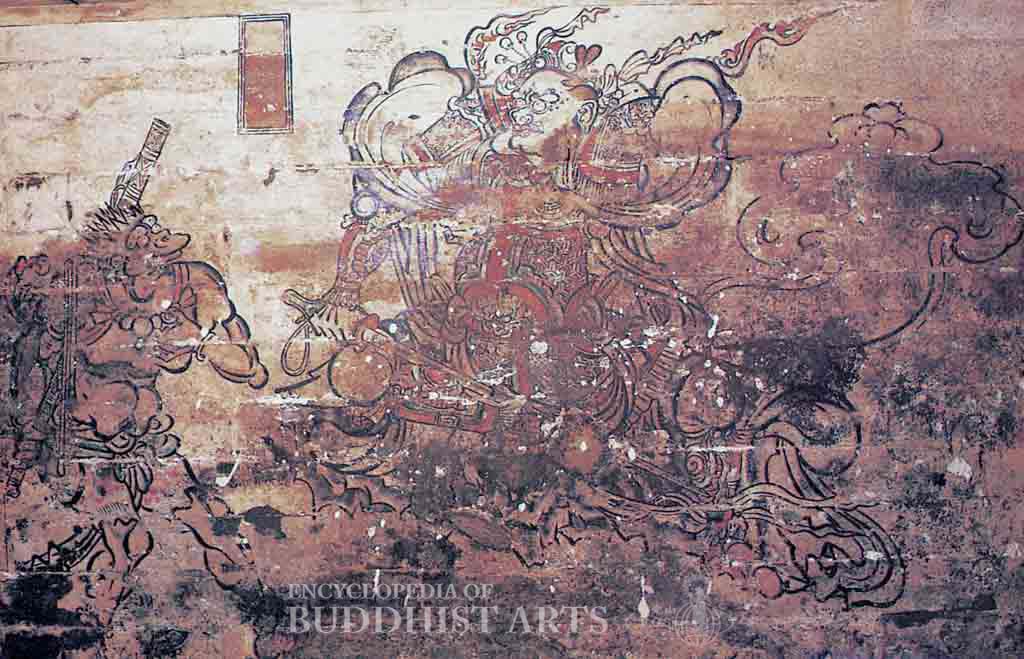
Wugou Jingguang Pagoda: Four Heavenly Kings - Virupaksa (west wall)
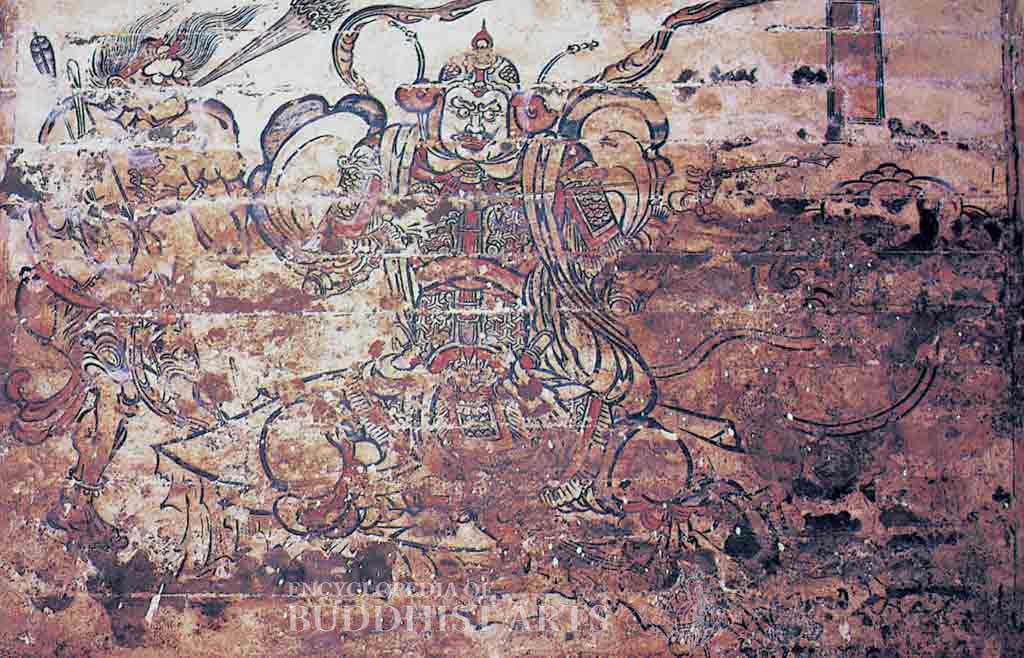
Wugou Jingguang Pagoda: Four Heavenly Kings - Virudhaka (south wall)
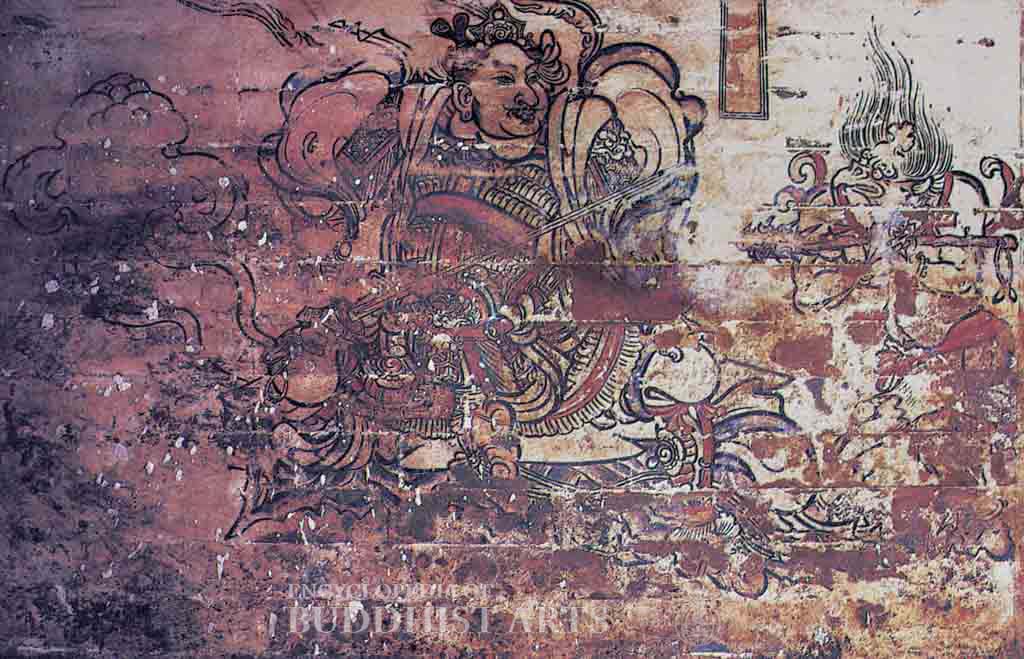
Wugou Jingguang Pagoda: Four Heavenly Kings - Dhrtarastra (east wall)
Wugou Jingguang Pagoda: Four Heavenly Kings
CHINA, Liaoning, Shenyang; Liao dynasty
The Four Heavenly Kings and their attendants are painted on the four walls of the Wugou Jingguang Pagoda Underground Palace. The murals are believed to date from 1044, the same year the pagoda was built. According to the sutras, the Four Heavenly Kings guard the four directions extending outwards from Mount Sumeru. They are Vaisravana, Heavenly King of the North, Virudhaka, Heavenly King of the South, Dhrtarastra, Heavenly King of the East, and Virupaksa, Heavenly King of the West. The figures are each painted on the wall that corresponds with the direction that they protect.
All four kings are depicted as robust figures clad in armor and billowing stoles. They all sit on rocks with their legs spread wide, appearing ready to spring into action. Vaisravana wears a crown and has wide eyes that gaze upwards. He holds a trident in his right hand and supports a pagoda with his left. The Heavenly King is flanked by a yaksa bearing a sword and a heavenly being carrying a tray of jewels. Virupaksa has a large nose and a prominent cleft in his chin. He rests a sword held in his right hand on his right knee. A figure with spiked hair and multiple eyes stands on the left, carrying the scabbard of the sword. Virudhaka wears a helmet and has an intense expression. He looks down intently at an arrow held with both hands. A muscular figure holding a bow stands on the left. Dhrtarastra has large cheeks and hooded eyes. He rests a sword against his right knee. A figure with a beaked nose and long hair stands on the right, holding a mace in his joined hands.
The murals are painted with flowing, unrestrained brush strokes, recalling the style of the Tang dynasty (618–907). They are similar to images of the Four Heavenly Kings painted at the Jueshan Temple Pagoda during the Liao dynasty (907–1125) and those at Fogong Temple Shijia Pagoda dating from the Liao and Jin (1115–1234) dynasties.
For more details, go to the Encyclopedia of Buddhist Arts: Painting P-Z, page 1021.
Cite this article:
author = Hsingyun and Youheng and Youlu and Wilson, Graham and Manho and Mankuang and Huntington, Susan,
booktitle = {Encyclopedia of Buddhist Arts: Painting P-Z},
pages = 1021,
title = {{Wugou Jingguang Pagoda: Four Heavenly Kings}},
volume = 16,
year = {2016}}