
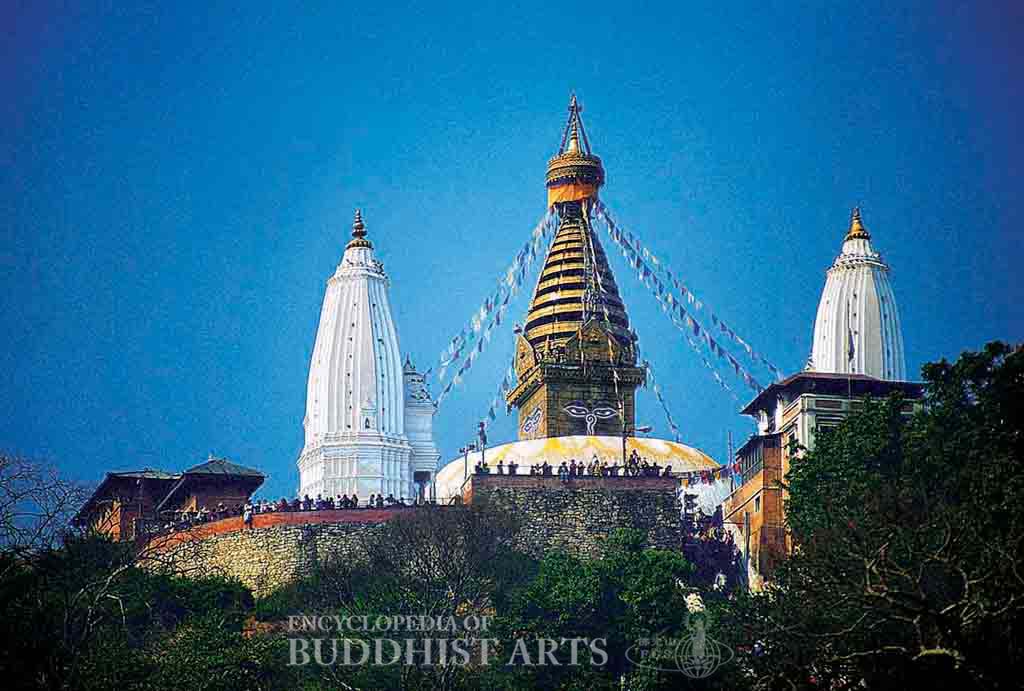
Swayambhunath Stupa
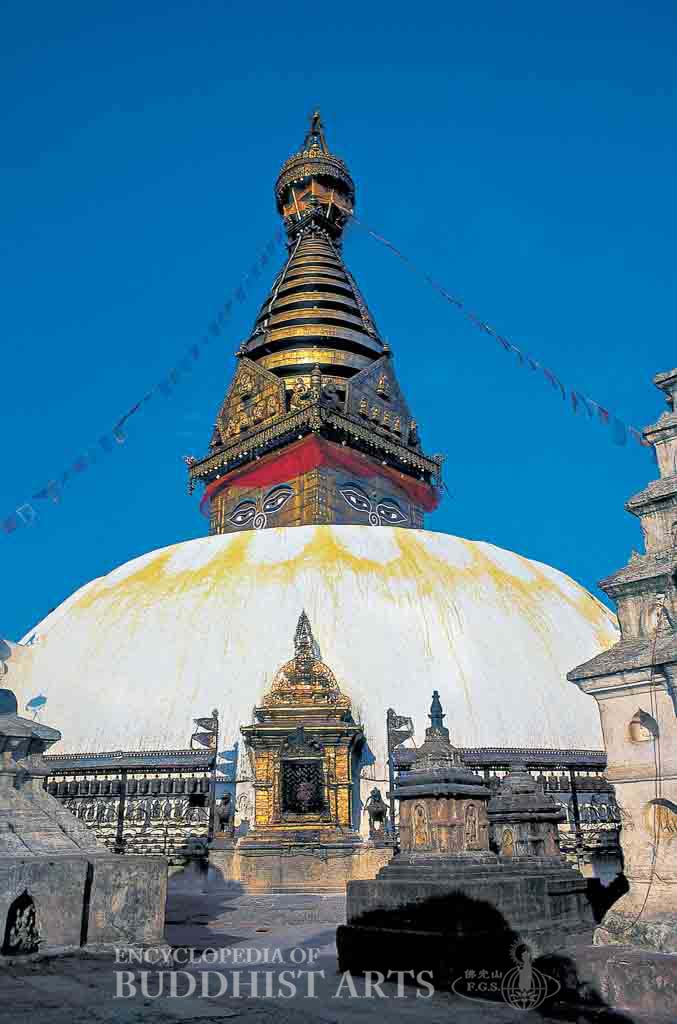
Swayambhunath Stupa
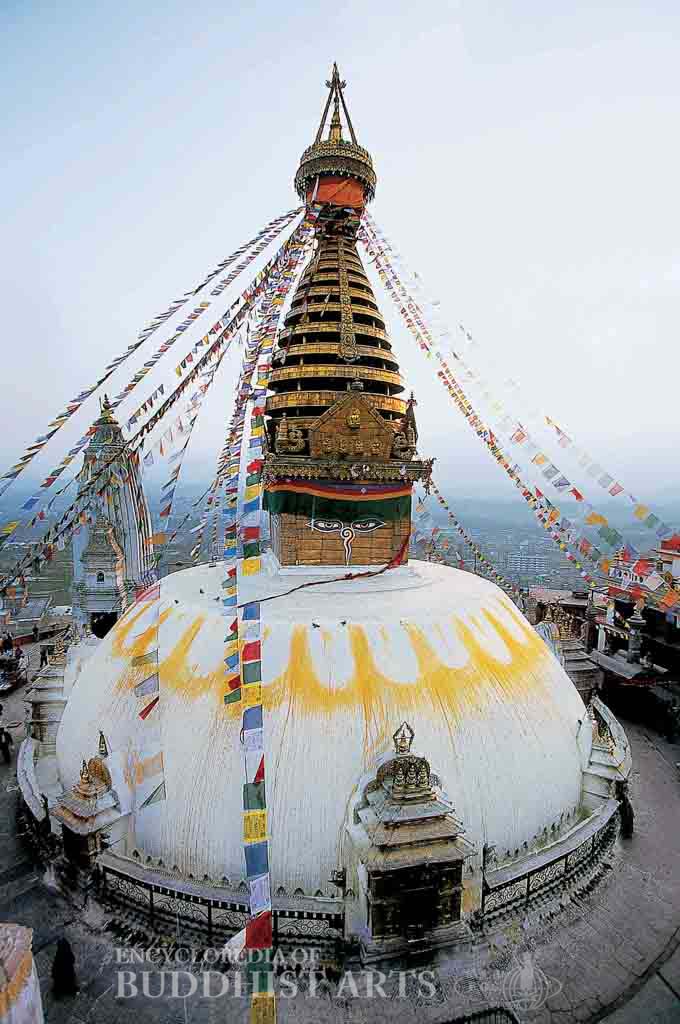
Swayambhunath Stupa
Swayambhunath Stupa
NEPAL, Kathmandu
Swayambhunath means Self-Existent or Self-Created Stupa. It is commonly spelled Swoyambhunath or Swayambhu Stupa, and it is also known as the Monkey Temple due to the many monkeys living around the area. Located on a hill in the Kathmandu Valley, it is one of the oldest stupas in Nepal. The exact year of its construction is unknown, but according to scholars it is thought to have been built around the 5th century by King Vrisadeva (reign years unknown) of Licchavi. It has experienced numerous misfortunes resulting from the forces of nature and human attack. It has been expanded and reconstructed numerous times. Based on an inscription, the earliest renovation was conducted in 1129. In 1349 it was destroyed by Muslims and rebuilt in 1372. In 1751 it underwent large-scale renovation. In 2010 it was completely renovated again. As part of the entire Kathmandu Valley, the Swayambhunath Stupa was listed as a UNESCO World Heritage Site in 1979.
Situated on a hill, Swayambhunath is reached after ascending around 365 stone steps. The whole stupa is 33 m high and is divided into five sections consisting of a circular base, a dome-shaped body, a square brick harmika, stacked rings on the spire, and a finial, symbolizing earth, water, fire, air, and space respectively. The stupa body is in the style of an inverted white bowl. There are five delicate bronze niches with Dhyani Buddhas at intervals around the base of the bowl. Surrounding the base there are 108 small Buddha niches. The base of the spire consists of a square brick harmika, with a pair of Buddha’s eyes painted on each side, expressing infinite compassion. The third eye between the eyebrows symbolizes supreme wisdom. The symbol that looks like a nose is the number “one” in Nepali, representing unity. Above the harmika there are gilded plaques of Dhyani Buddhas. Above them there are the 13-tier gilt stacked rings of the spire, symbolizing the 13 stages of cultivation leading to Buddhahood. The canopy on top represents the final accomplishment which is nirvana.
The stupa is surrounded by prayer wheels, each with a repoussé Six-Syllable Mantra. Pilgrims and travelers circumambulate it, turning the wheels and showing respect to the Buddha as a means of praying for blessings. There are temples, small stupas, and stone Buddha statues around the main stupa.
For more details, go to the Encyclopedia of Buddhist Arts: Architecture M-S, page 1071.
Cite this article:
author = Hsingyun and Youheng and Johnson, Peter and Mankuang and Lancaster, Lewis,
booktitle = {Encyclopedia of Buddhist Arts: Architecture M-S},
pages = 1071,
title = {{Swayambhunath Stupa}},
volume = 3,
year = {2016}}