
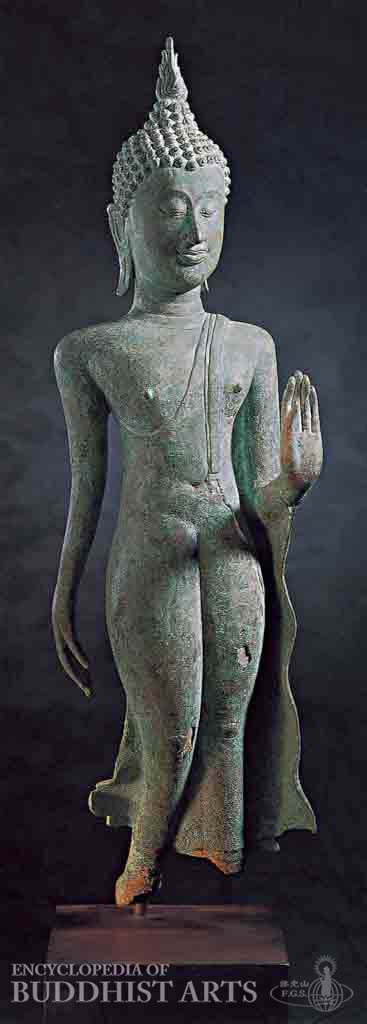
Sukhothai: Walking Buddha
Bronze
Sukhothai: Walking Buddha
THAILAND, Sukhothai
Standing Buddhas in movement are frequently found from the early Sukhothai Kingdom (circa 1238–1438). This sculptural style likely originated in Sri Lanka. The softly curved body in a pronounced walking gait is typical of walking statues from the Sukhothai period.
The flame-shaped ornament rising from the usnisa is commonly found on Thai statuary. Crescent-shaped eyebrows link directly with the nasal bridge, and the corners of the eyes are upturned, while the lips are outlined to accentuate the mouth on the oval face. Elongated earlobes hang on either side of the neck. The Buddha has long, slender arms, and the left hand is raised in the abhaya (fearlessness) mudra. The thin monastic robe leaves the right shoulder bare and is barely visible but for faint hemlines and the rippling fall of the material from the left arm, which adds emphasis to the movement of the body.
For more details, go to the Encyclopedia of Buddhist Arts: Sculpture St-Z, page 1174.
Cite this article:
author = Hsingyun and Youheng and Lovelock, Yann and Chou, Yuan and Huntington, Susan and Edson, Gary and Neather, Robert,
booktitle = {Encyclopedia of Buddhist Arts: Sculpture St-Z},
pages = 1174,
title = {{Sukhothai: Walking Buddha}},
volume = 13,
year = {2016}}