
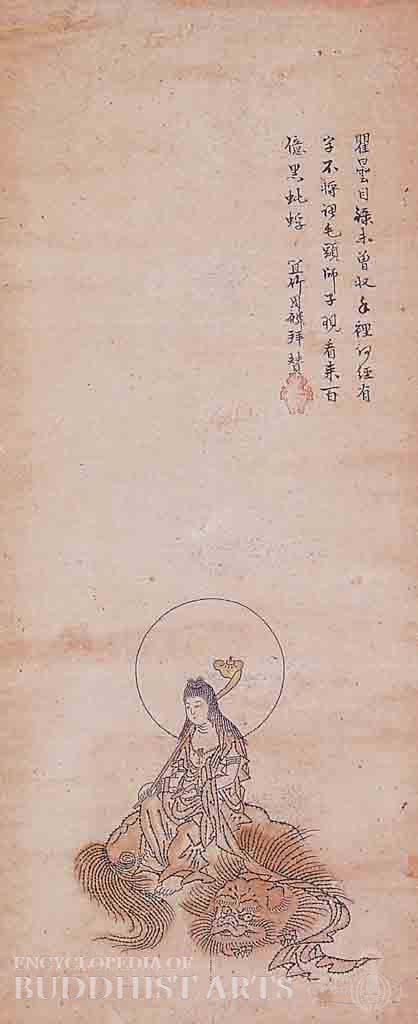
Manjusri Bodhisattva
Ink and color on paper
Manjusri Bodhisattva
JAPAN; Muromachi period
An inscription in the top right corner dates this picture to 1501 of the Muromachi period and states that it was painted by a monk from Kenninji Temple. The inscription also contains a poem by the Japanese monk Keijo Shurin of Shokokuji Temple which reads: “Buddha never held a catalog (of scriptures) in his hand, how could there be any sutras? The words cannot say anything of the hair of a lion. Now we see the coming of ten billion black ants.”
The lines that form this unique image are covered with the five Sanskrit syllables of Manjusri Mantra, “a ra pa ca na.” Manjusri is depicted as a youthful figure with long hair. The left hand holds a scroll, while the right hand grasps a ruyi (wish-fulfilling talisman) that rests against the shoulder. The Bodhisattva is seated in relaxed posture on the back of a lion, and has a large, plain nimbus. Light watercolors are applied between the lines of this concise image as shading.
For more details, go to the Encyclopedia of Buddhist Arts: Painting I-O, page 513.
Cite this article:
author = Hsingyun and Youheng and Youlu and Wilson, Graham and Manho and Mankuang and Huntington, Susan,
booktitle = {Encyclopedia of Buddhist Arts: Painting I-O},
pages = 513,
title = {{Manjusri Bodhisattva}},
volume = 15,
year = {2016}}