
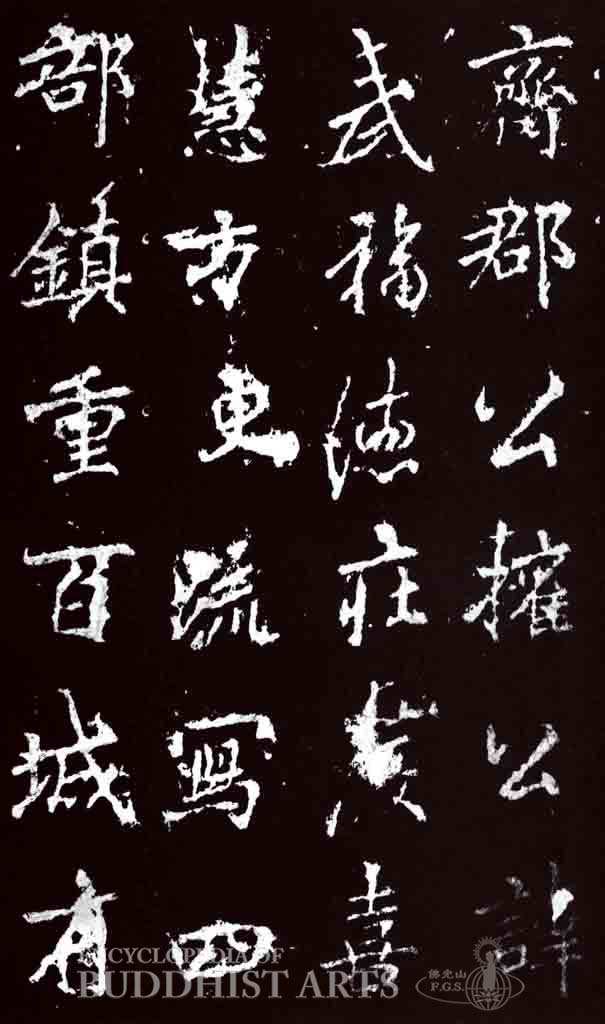
Lushan Temple: Stele (detail)
Rubbing
Lushan Temple: Stele
CHINA, Hunan, Changsha; Tang dynasty
The stele, also known as Yuelu Temple Stele, is now installed in the Yuelu Academy of Classical Learning in Changsha, Hunan. Li Yong, the author and calligrapher of the inscribed text, was 53 when the work was produced. It records the construction history of Lushan Temple and consists of 28 lines of 56 characters each. Numerous rubbings of the stele were made during the Northern Song dynasty (960–1127), and the most valuable piece is currently part of the collection at the Suzhou Museum in Jiangsu.
The neat and orderly inscription is monumental when viewed in totality. It is composed with bold, sturdy, and energetic strokes, switching naturally between regular and running scripts. The strokes are either straight or canted, and each character may be compact or sparse in form. There is an animated flamboyance and rhythm in the layout of this exemplary piece of calligraphy.
Li Yong, also known as Taihe, was a calligrapher from the Tang dynasty (618–907). The talented calligrapher emulated the Two Wangs (Wang Xizhi and Wang Xianzhi), but developed his own style. He was responsible for the calligraphy of over 800 stone inscriptions, and was most fluent in running script. Li was instrumental in reforming the use of regular script on stone inscriptions, which was customary since the Wei Jin period (220–420). Li Yangbing of the Tang dynasty regarded him as having “the hand of a sage.”
For more details, go to the Encyclopedia of Buddhist Arts: Calligraphy, page 147.
Cite this article:
author = Hsingyun and Youheng and Youlu and Pokorski, Stefanie and Mankuang and Edson, Gary,
booktitle = {Encyclopedia of Buddhist Arts: Calligraphy },
pages = 147,
title = {{Lushan Temple: Stele}},
volume = 17,
year = {2016}}