
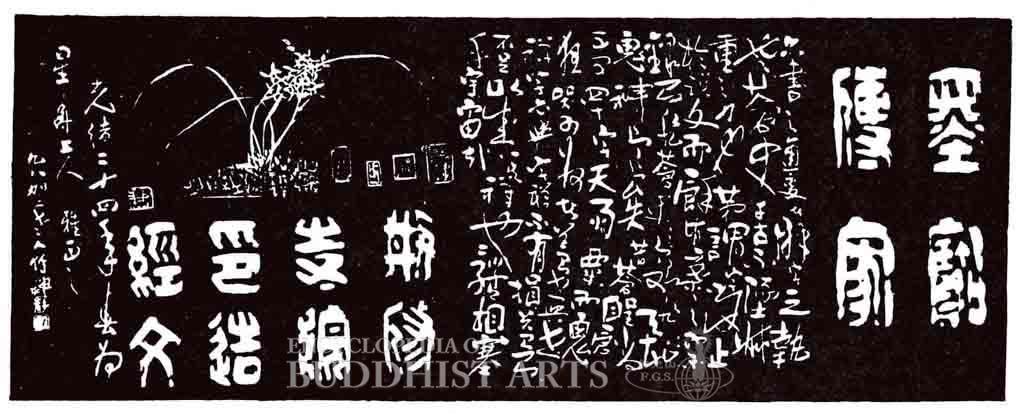
Avatamsaka Sutra Preface Stele in Jiufen Chan Style (detail)
Rubbing
Avatamsaka Sutra Preface Stele in Jiufen Chan Style
CHINA; Qing dynasty
This 1,002-character text is a preface to the Avatamsaka Sutra that was originally inscribed on a stone stele in Baoguang Temple in Sichuan. Zhuchan, a monk who coined the term “jiufen” (nine parts), referred to his style as a simple addition to the “bafen” (eight parts) script. He described this addition as a “Chan moment,” and his intention was notably consistent with the Chan school practices.
The Han clerical script is characterized by its abundant use of both left- and right-falling horizontal strokes. When joined, these two strokes form the character for “ba” (eight), and the script was thus referred to as “bafen” (eight parts). During the early Qing dynasty (1644–1911), Zheng Banqiao built on this nomenclature and developed what he called the “liufenban” (six-and-a-half parts) script. Perhaps inspired by Zheng, Zhuchan invented his jiufen script. A variation on cursive, the script is reminiscent of Zheng’s stylistic disarray, described as “a street strewn with randomly placed stones.” The jiufen script is largely a seal script in which each character is rectangular and seal-like with slanted corners. On occasion, the “goose tail” typical of clerical script is visible. The characters are composed as if they were imprinted, creating an innovative and novel composition.
Zhuchan, whose lay surname was Wang, was also known as Xigong. He was a Qing dynasty monk and artist from Liangshan (present day Liangping, Sichuan). Skilled in poetry and seal carving, Zhuchan was particularly accomplished in both calligraphy and painting.
For more details, go to the Encyclopedia of Buddhist Arts: Calligraphy, page 16.
Cite this article:
author = Hsingyun and Youheng and Youlu and Pokorski, Stefanie and Mankuang and Edson, Gary,
booktitle = {Encyclopedia of Buddhist Arts: Calligraphy },
pages = 16,
title = {{Avatamsaka Sutra Preface Stele in Jiufen Chan Style}},
volume = 17,
year = {2016}}