
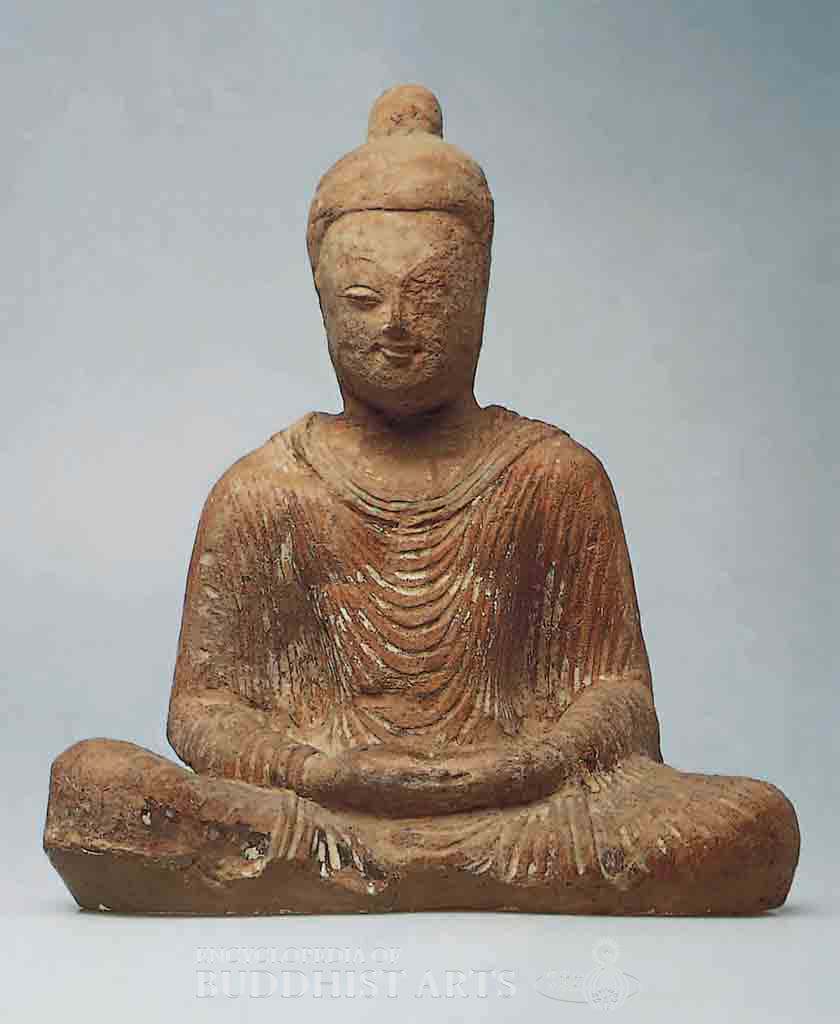
Kashgar: Seated Buddha
Clay
Kashgar: Seated Buddha
CHINA, Xinjiang, Kashgar
The statue is a good example of early Buddhist artwork from Central Asia. It was excavated from Kashgar, which was once known as Shule and flourished as a cultural and economic hub between the East and West.
The Buddha is seated in lotus position with hands in the dhyana (meditation) mudra. The hair is smooth and almost cap-like, rising to a high usnisa. The worn face, with its heavy-lidded eyes and eyebrows falling to the line of the nose, is set well down from the high forehead. The monastic robe covers both shoulders and falls in narrow folds. Slight traces of green, black and red pigment are still visible on the work, with traces of gold foil.
For more details, go to the Encyclopedia of Buddhist Arts: Sculpture G-M, page 526.
Cite this article:
Hsingyun, et al. "Kashgar: Seated Buddha." Encyclopedia of Buddhist Arts: Sculpture G-M, vol. 11, 2016, pp. 526.
Hsingyun, Youheng, Yann Lovelock, Yuan Chou, Susan Huntington, Gary Edson, and Robert Neather. 2016. "Kashgar: Seated Buddha" In Encyclopedia of Buddhist Arts: Sculpture G-M, 11:526.
Hsingyun, Youheng, Lovelock, Y., Chou, Y., Huntington, S., Edson, G., & Neather, R.. (2016). Kashgar: Seated Buddha. In Encyclopedia of Buddhist Arts: Sculpture G-M (Vol. 11, pp. 526).
@misc{Hsingyun2016,
author = Hsingyun and Youheng and Lovelock, Yann and Chou, Yuan and Huntington, Susan and Edson, Gary and Neather, Robert,
booktitle = {Encyclopedia of Buddhist Arts: Sculpture G-M},
pages = 526,
title = {{Kashgar: Seated Buddha}},
volume = 11,
year = {2016}}
author = Hsingyun and Youheng and Lovelock, Yann and Chou, Yuan and Huntington, Susan and Edson, Gary and Neather, Robert,
booktitle = {Encyclopedia of Buddhist Arts: Sculpture G-M},
pages = 526,
title = {{Kashgar: Seated Buddha}},
volume = 11,
year = {2016}}