
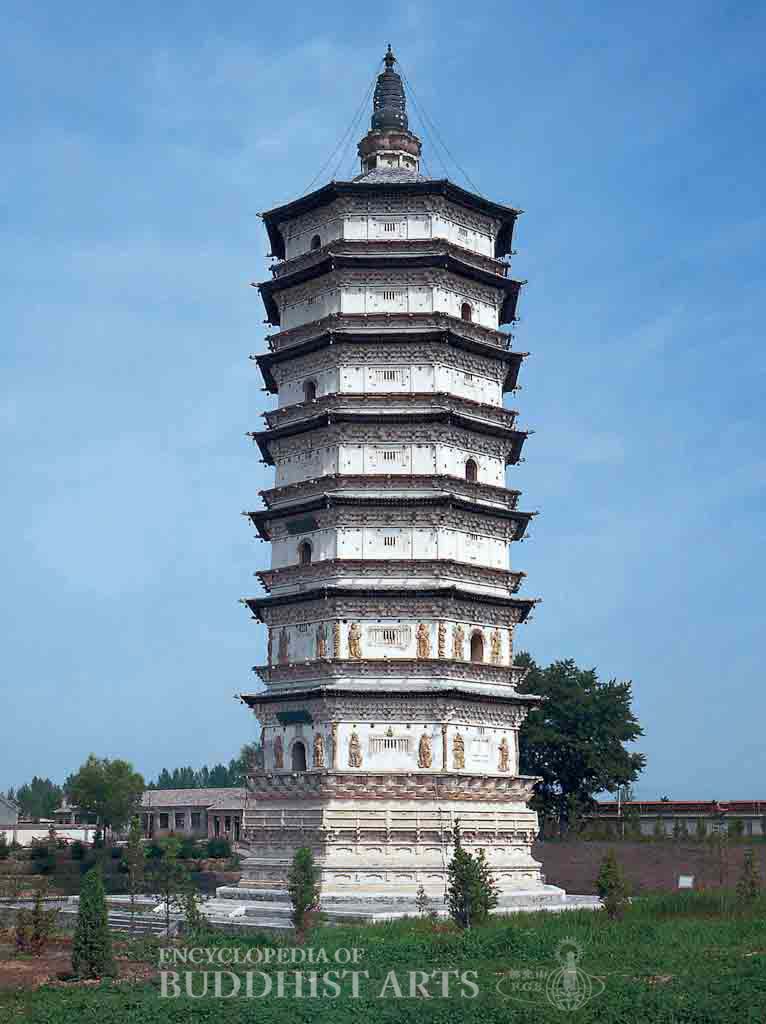
Hohhot White Pagoda
Hohhot White Pagoda
CHINA, Inner Mongolia, Hohhot
The name of the pagoda means Ten Thousand Scrolls of the Avatamsaka Sutra. It is located about 17 km east of Hohhot and was built during the rule of Emperor Shengzong (reigned 982–1031) of the Liao dynasty. Originally it was the sutra repository pagoda of a temple at Fengzhou during the Liao dynasty (907–1125). Since the body of the pagoda is covered in white plaster, it is commonly known as the White Pagoda. During the early Ming dynasty (1368–1644) the temple was damaged in warfare and only the pagoda was left. In 1986 it underwent renovation and the spire was restored. It was listed as a National Cultural Heritage Site in 1982.
The seven-story octagonal brick pagoda is over 55.6 m high. It has a Sumeru-shaped base with upturned lotus petals at the top. On two levels of the lower base there are four ogee arch shapes on each side. There are doorways on the north and south sides of the first, third, fifth and seventh stories, and on the east and west sides of the second, fourth and sixth stories. Either a false door or a false vertical bar window is carved on the remaining sides. Each story has eaves supported by imitation bracket sets. There is a wind chime hanging at each corner of the eaves. On either side of the doors and windows there are Dharma protectors on the first and second stories and pilasters on the third to the seventh stories. Inside the pagoda there are six stone tablets from the Jin dynasty (1115–1234) and more than four hundred inscriptions in Chinese, Khitan, Jurchen, Phags Pa, Mongolian, and Tibetan, written by visitors over the years. The pagoda has a spiral staircase that reaches to the top. The spire is 9 m high and consists of the base, upright lotuses, an inverted bowl, stacked rings, and jewels.
For more details, go to the Encyclopedia of Buddhist Arts: Architecture G-L, page 441.
Cite this article:
author = Hsingyun and Youheng and Johnson, Peter and Mankuang and Lancaster, Lewis,
booktitle = {Encyclopedia of Buddhist Arts: Architecture G-L},
pages = 441,
title = {{Hohhot White Pagoda}},
volume = 2,
year = {2016}}