
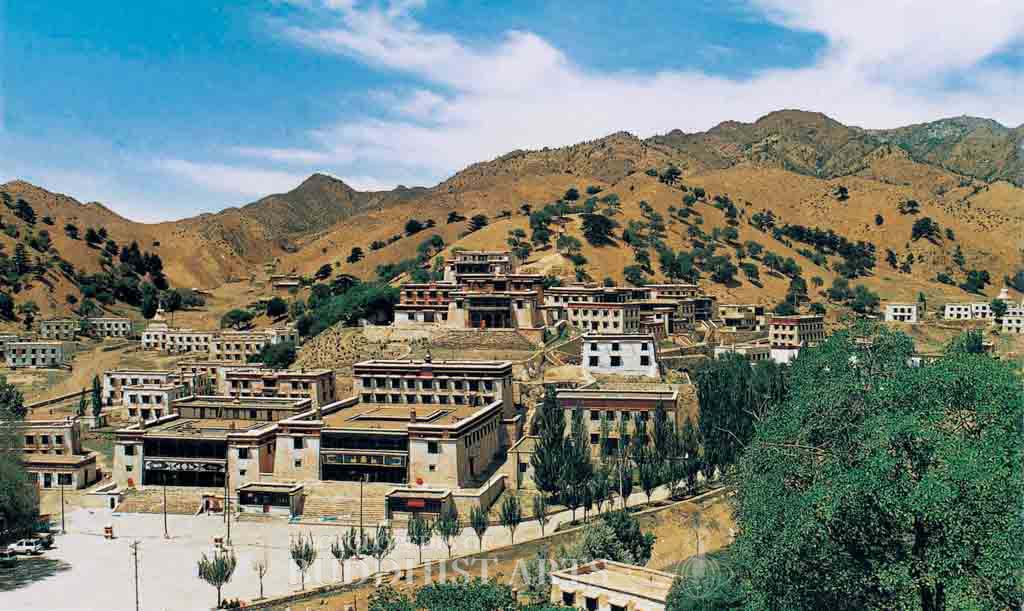
Badgar Monastery (aerial view)
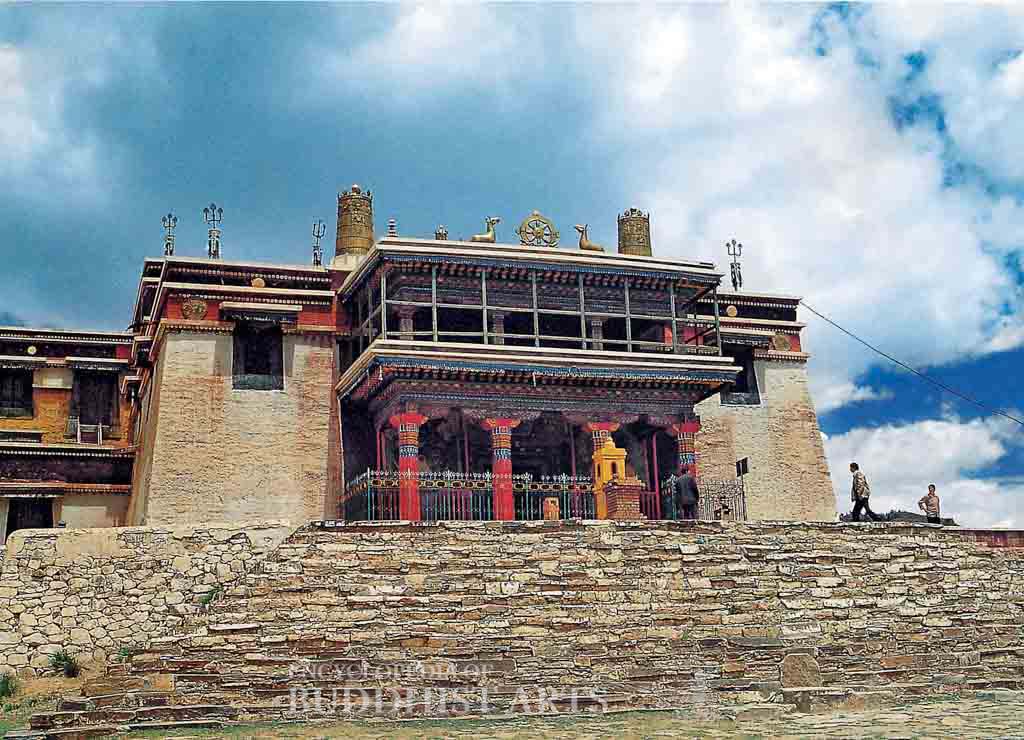
Badgar Monastery: Dukor Temple
Badgar Monastery
CHINA, Inner Mongolia, Baotou
Also known as Wudangzhao Temple and Guangjue Temple, Badgar Monastery is located on the southern slopes of Jihuluntu Mountain. It is a large, well-preserved Gelug school monastery. It was first built during the rule of Emperor Kangxi (reigned 1661–1722) of the Qing dynasty and underwent large-scale expansion in 1727 before being renovated in 1749. It was listed as a National Cultural Heritage Site in 1996.
The main buildings include six temples, three residences, and one mausoleum containing the remains of successive incarnate lamas. The monastery was built according to an architectural blueprint brought from Tibet by its founder, Lobsang Sangye Gyatso. Thus all the buildings were constructed in traditional Tibetan style. Each temple is composed of an entrance hall, an assembly hall, and an inner shrine. They are made from brick and stone. They have flat roofs, small windows, and a red ocher band that runs along the top of each building.
The Suguru Temple is the largest structure and was built in 1758 during the Qing dynasty. It has a two-story portico, which is five bays wide. The assembly hall consists of a single high story, while the inner shrine consists of four stories. The Dukor Temple contains Kalacakra College, one of the four main colleges at the monastery. The college focuses on the study of astronomy, calendar science, mathematics, and the code of construction of mandalas. The front portico is extended and open on both levels. On the roof of the portico there are two deer and a Dharma wheel, with two golden pillars on top of the main part of the building. The portico is made of wood and is decorated with splendid paintings, creating a contrast with the wide white walls. A 9 m high bronze statue of Tsongkhapa, the founder of the Gelug school, is enshrined inside the shrine.
For more details, go to the Encyclopedia of Buddhist Arts: Architecture A-F, page 30.
Cite this article:
author = Hsingyun and Youheng and Johnson, Peter and Mankuang and Lancaster, Lewis,
booktitle = {Encyclopedia of Buddhist Arts: Architecture A-F},
pages = 30,
title = {{Badgar Monastery}},
volume = 1,
year = {2016}}