
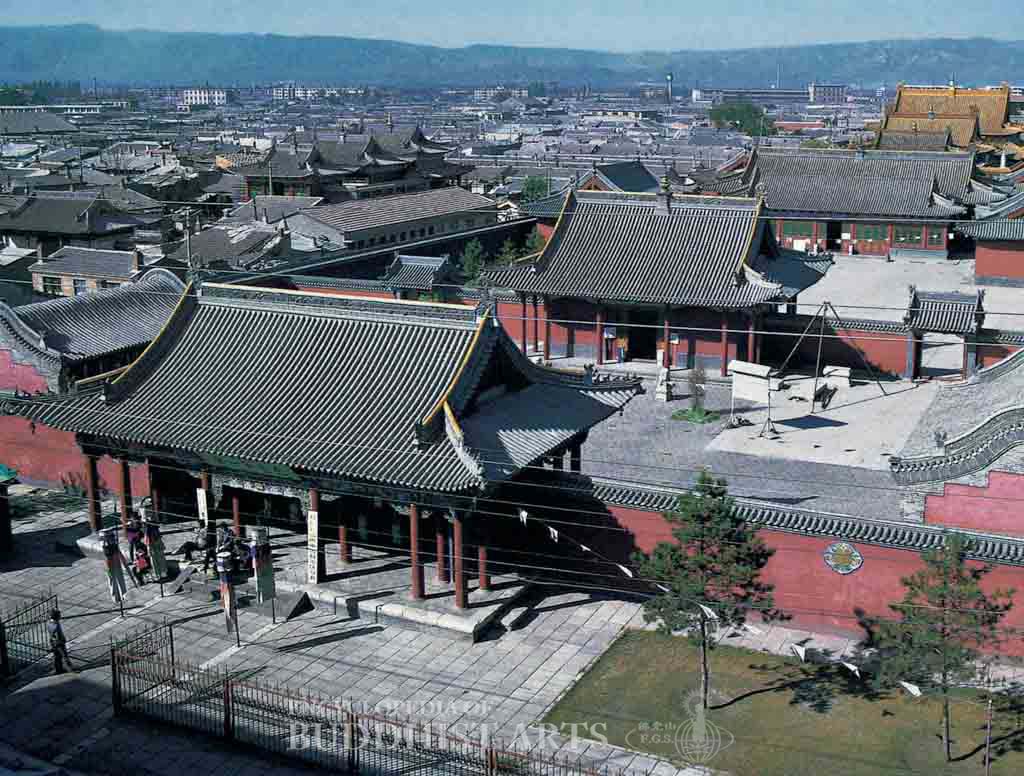
Ih Juu Monastery
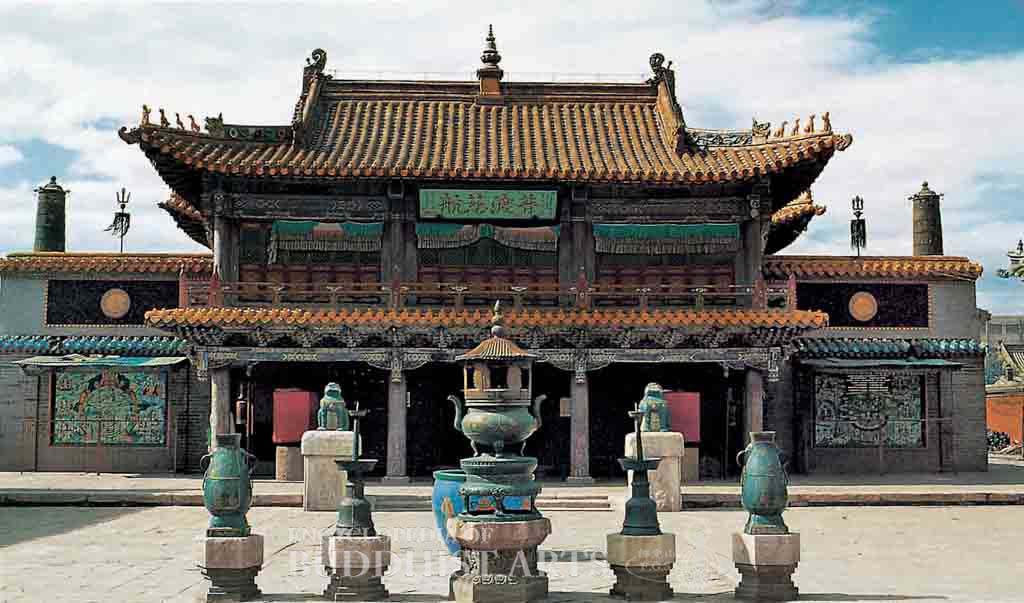
Ih Juu Monastery: Great Assembly Hall Veranda
Ih Juu Monastery
CHINA, Inner Mongolia, Hohhot
It means Great Temple in Chinese and also has the Mongolian names Ih Zuu and Yekhu Zuu. It is also known as Yinfo (Silver Buddha) Temple because of the silver statue of Sakyamuni Buddha housed in the shrine there. First completed in 1579 during the Ming dynasty, the monastery was reconstructed in 1640 and expanded in 1697 during the Qing dynasty. It was listed as a National Cultural Heritage Site in 2006.
The temple faces south and occupies 3 ha. The buildings on the central axis, starting in the south, include the main temple gate, Dharma Protector Hall, Bodhi Intermediate Hall and the central hall. All the buildings are in Chinese architectural style, except the central hall, which is a fusion of Chinese and Tibetan styles. The seven-by-eight bay central hall consists of a veranda, an assembly hall and an inner shrine, which are all connected. The hall has three parallel hip-and-gable roofs. The veranda is three bays wide by two bays deep and has two stories. The first floor of the veranda is an open space. The upper story is surrounded by a low balustrade. The central hall houses many Buddhist texts, among which the Kangyur of the Tibetan Canon is the most valuable. Other artifacts preserved there include Dharma instruments, musical instruments, and objects used for making offerings. The five-by-five bay inner shrine is surrounded by cloisters. There are 17 statues from the Ming dynasty (1368–1644) enshrined on the high altars on the north, east, and west walls. On the north wall there are statues of Kasyapa Buddha, Sakyamuni Buddha, Maitreya Buddha and the Third Dalai Lama, Sonam Gyatso. On the walls of the assembly hall there are Qing dynasty murals from the rule of Emperor Guangxu (reigned 1875–1908).
For more details, go to the Encyclopedia of Buddhist Arts: Architecture G-L, page 490.
Cite this article:
author = Hsingyun and Youheng and Johnson, Peter and Mankuang and Lancaster, Lewis,
booktitle = {Encyclopedia of Buddhist Arts: Architecture G-L},
pages = 490,
title = {{Ih Juu Monastery}},
volume = 2,
year = {2016}}