
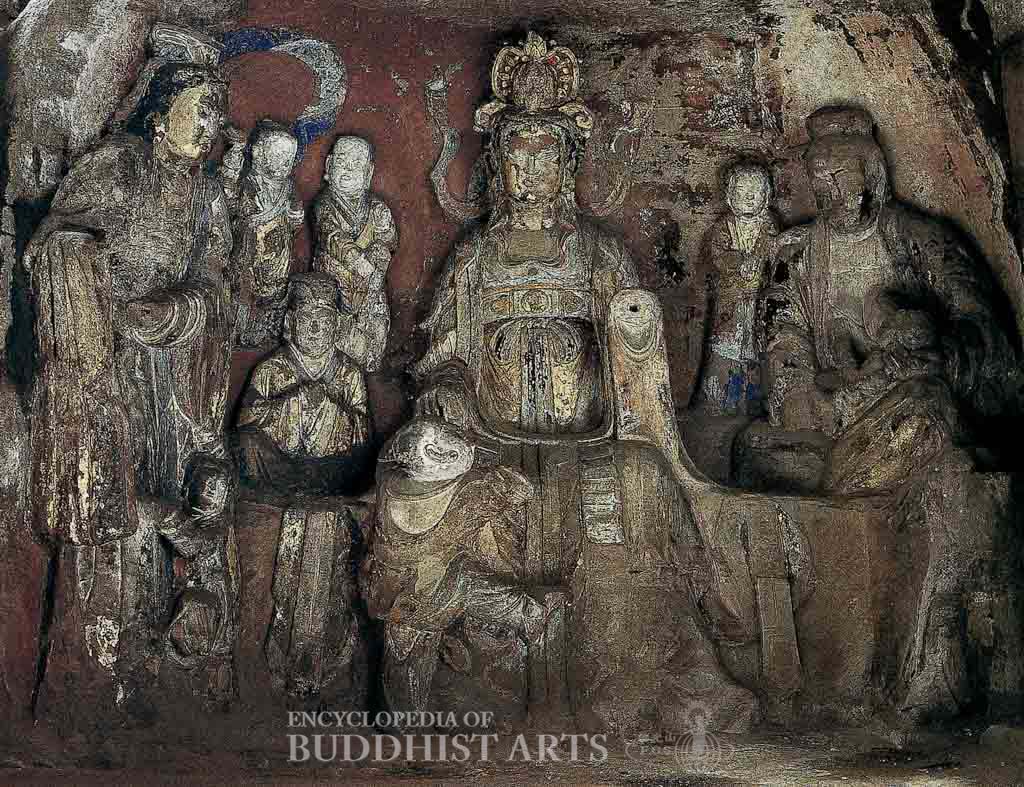
Dazu Rock Carvings Shimenshan: Cave 9 - Hariti
Dazu Rock Carvings Shimenshan
CHINA, Chongqing, Dazu
Located 20 km southeast of Dazu, Chongqing, this site encompasses carvings at Shimenshan and Chenjiayan, as well as the former location of Shengfudong Temple.
The majority of the carvings at Shimenshan were completed between 1094 and 1151 of the Song dynasty. The thirteen numbered caves and niches at the site contain over 400 carvings in total. Caves and Niches 1 to 6, 12, and 13 have inscriptions with precise dates of construction. The sculptures depict both Buddhist and Daoist themes. A stele written by Deng Sheng in 1182 and known as the Shimen Cave Stele states that the carvings do not belong to any specific religion, and that the statues of saints, Buddhas, demons, and heavenly beings are all mingled within one area. Examples of carvings with Buddhist themes include the Medicine Buddha in Cave 1, Sakyamuni Buddha in Cave 3, Avalokitesvara Bodhisattva in Caves 4 and 6, Mahamayuri Bodhisattva in Cave 8, and Hariti in Cave 9. Carvings with Daoist themes include the Jade Emperor in Cave 2, One-Legged Five-Magical Emperor in Cave 7, and the Three Emperors in Cave 10.
The Medicine Buddha in Cave 1 is flanked by Ksitigarbha and Avalokitesvara Bodhisattvas. Two standing Bodhisattvas and two donors are carved on the surrounding walls. An inscription in the cave dates it to the year 1151. Cave 3, featuring Sakyamuni Buddha, two of his disciples, and the Bodhisattva of Fragrant Flowers, was built in 1096. The central figure in Cave 4 is Water-Moon Avalokitesvara; this cave was built in 1094. Cave 5, unique among the caves at Shimenshan, was constructed in 1785 of the Qing dynasty. The main statue in this cave is Amitabha Buddha. Cave 6 was constructed in 1141 of the Southern Song dynasty, and houses an Amitabha Buddha Triad and a depiction of ten Avalokitesvara Bodhisattvas. Cave 9 features a statue of Hariti wearing a traditional bride’s dress and accessories. A boy sits on her knee, and she is surrounded by several toddlers, a wet nurse, and a nanny.
The Chenjiayan site is at the top of a small hill approximately 1.5 km east of Shimenshan. There are two caves at the site that contain Buddhist carvings. Cave 1 is referred to as the Perfect Enlightenment Cave; it houses statues of the Trikaya Buddhas flanked by Manjusri and Samantabhadra Bodhisattvas. There are five Bodhisattvas on each of the side walls. Cave 2 contains carvings of the Seven Buddhas of the Past as well as the disciples, Mahakasyapa and Ananda. Manjusri and Samantabhadra Bodhisattvas are carved on the side walls. Unfortunately, this cave has suffered severe weathering, and many of the carvings have been damaged.
For more details, go to the Encyclopedia of Buddhist Arts: Caves A-E, page 297.
Cite this article:
author = Hsingyun and Youheng and Johnson, Peter and Mankuang and Huntington, Susan and Edson, Gary and Neather, Robert,
booktitle = {Encyclopedia of Buddhist Arts: Caves A-E},
pages = 297,
title = {{Dazu Rock Carvings Shimenshan}},
volume = 5,
year = {2016}}