
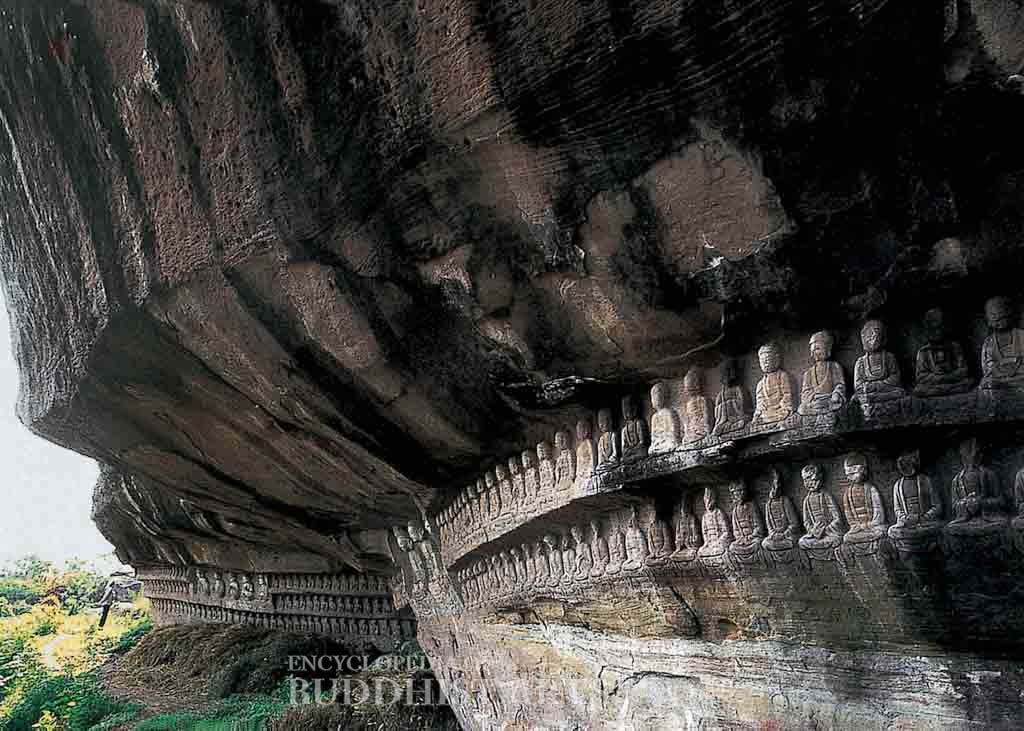
Dazu Rock Carvings Shizhuanshan: Thousand Buddha Cliff
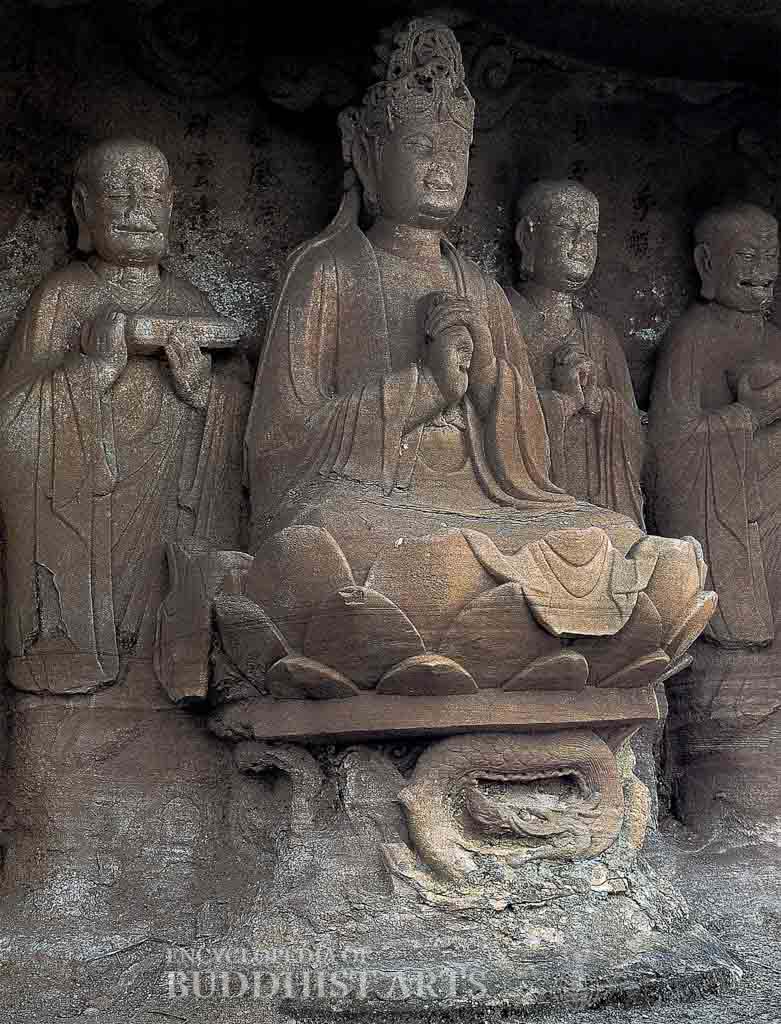
Dazu Rock Carvings Shizhuanshan: Niche 7 - Trikaya Buddhas - Dharmakaya Buddha and Disciples
Dazu Rock Carvings Shizhuanshan
CHINA, Chongqing, Dazu
The Shizhuanshan (Stone Seal Mountain) carvings are located in Fohui village of Shizhuo county, 22.5 km southwest of Dazu, Chongqing. Shizhuanshan is an integral part of the Dazu Rock Carvings. The artworks at this site include those located at Shizhuanshan and Thousand Buddha Cliff. Development of Shizhuanshan first began in 1082 during the Northern Song dynasty. The Thousand Buddha Cliff, according to the inscriptions at the site, was built during the Ming dynasty (1368–1644). Originally, there was also a temple on Shizhuanshan, but all that remains are stone statues and tablets. The Thousand Buddha Cliff is situated north of Shizhuanshan. The sculptures there portray both Buddhist and Daoist themes. There are a total of ten numbered niches at the site. The main Buddhist figures depicted are the Amitabha Buddha Triad, Ksitigarbha Bodhisattva, Avalokitesvara Bodhisattva, and the Thousand Buddhas. The area is listed as a Provincial Cultural Heritage Site.
The carvings at Shizhuanshan include Buddhist, Daoist, and Confucian themes, and are distributed among twelve numbered niches. Buddhist sculptures include Tejaprabha Buddha, Manjusri Bodhisattva, Samantabhadra Bodhisattva, Avalokitesvara Bodhisattva, Ksitigarbha Bodhisattva, the Ten Kings of Hell, Hariti, and Chan Master Zhigong. There are carvings of Confucius and the Ten Great Disciples in Niche 6, the Trikaya Buddhas in Niche 7, and Laojun in Niche 8. The layouts and structures of the three niches are identical, making them a classic example of carvings featuring themes from all three religions that share the same sculptor, donor, time period, and location.
Hariti, the central figure in Niche 1, wears a traditional bride’s dress and accessories, and holds a boy with one hand and a fruit in the other. The main figure in Niche 2 is Chan Master Zhigong accompanied by a disciple. Niche 5 features Manjusri and Samantabhadra Bodhisattvas, both sitting in full lotus position on lotus thrones. The thrones are carried on the backs of a blue lion and a six-tusked elephant, respectively. An inscription outside of the niche dates from 1090 and identifies the sculptors as Wen Weijian from Yueyang, and his sons Ju’an and Juli. The Trikaya Buddhas Niche, Niche 7, features Dharmakaya Buddha at the center, flanked by Sambhogakaya Buddha and Nirmanakaya Buddha. Just inside the niche is an inscription dating from 1082 and identifying the sculptors as Wen Weijian and his sons Juyong and Juli. Niche 9 contains carvings of the Ten Kings of Hell and Ksitigarbha, as well as an inscription dating it to the year 1096. Niche 10 houses a statue of the Tejaprabha Buddha accompanied by other figures, but the carving has been significantly damaged and most of the figures can no longer be identified. An inscription on the wall of the niche dates it to the time between 1086 and 1094.
A stele chronicling the construction of the Shizhuanshan carvings is located in the hall of Fohui Temple. The tablet inscription dates from 1090 and is written with the name Yan Xun. The Shizhuanshan carvings were sponsored by Yan and sculpted by members of the Wen clan.
For more details, go to the Encyclopedia of Buddhist Arts: Caves A-E, page 300.
Cite this article:
author = Hsingyun and Youheng and Johnson, Peter and Mankuang and Huntington, Susan and Edson, Gary and Neather, Robert,
booktitle = {Encyclopedia of Buddhist Arts: Caves A-E},
pages = 300,
title = {{Dazu Rock Carvings Shizhuanshan}},
volume = 5,
year = {2016}}