
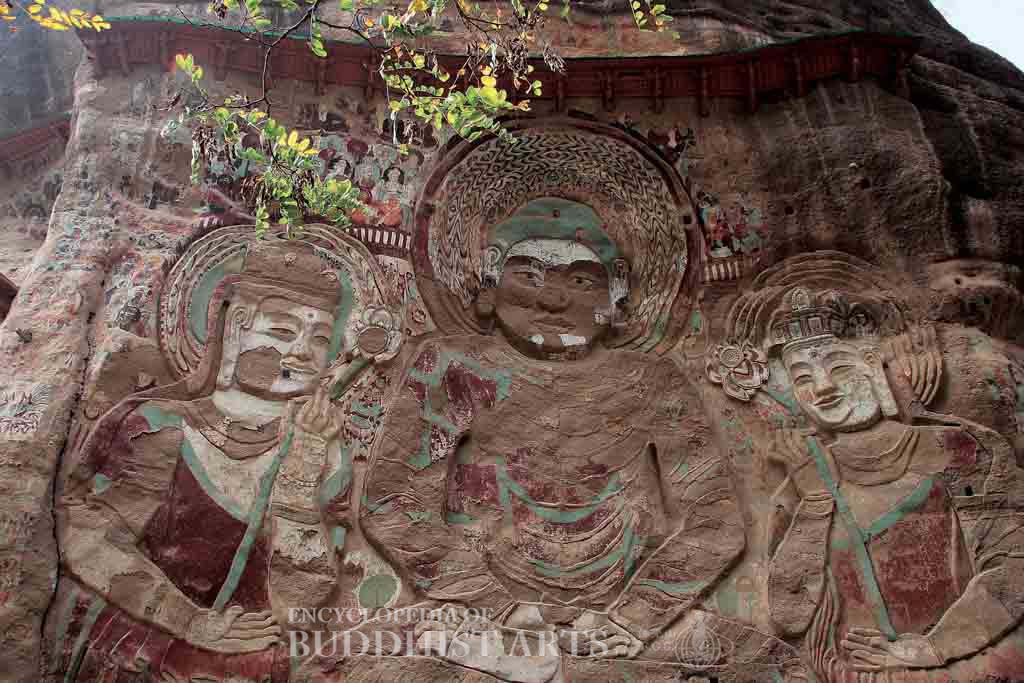
Lashao Temple Caves Niche 1: Sakyamuni Buddha Triad (detail)
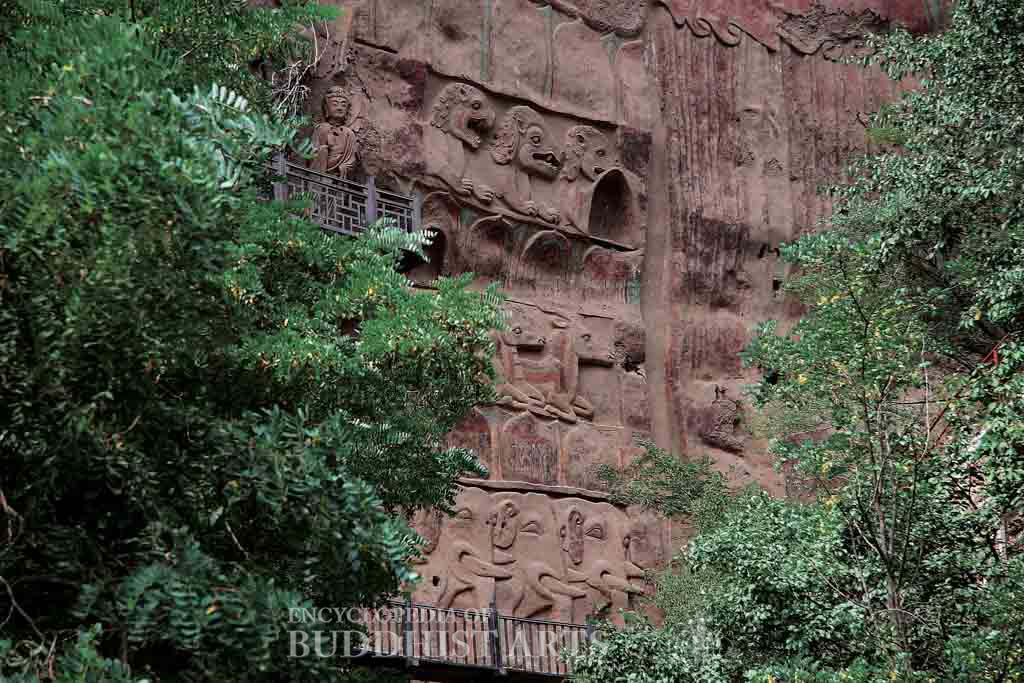
Lashao Temple Caves Niche 1: Sakyamuni Buddha Triad - Throne
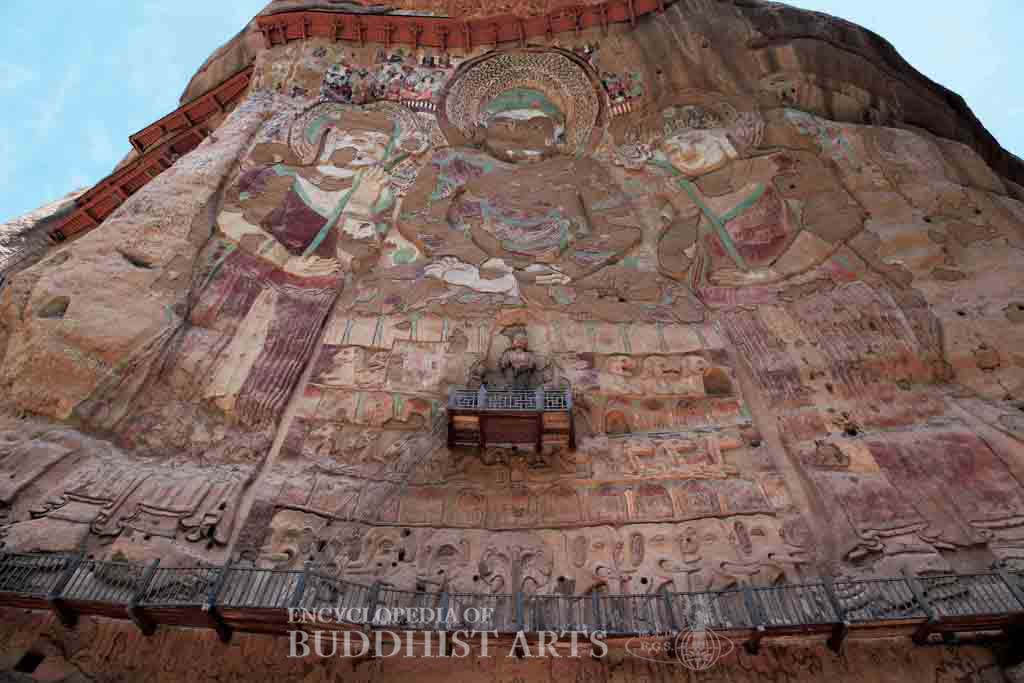
Lashao Temple Caves Niche 1: Sakyamuni Buddha Triad
Lashao Temple Caves Niche 1: Sakyamuni Buddha Triad
CHINA, Gansu, Tianshui; Northern Zhou dynasty
Covering a total area of 3,600 sq m on the north cliff face, this relief depicts Sakyamuni Buddha flanked by attending Bodhisattvas Manjusri and Samantabhadra. According to an inscription, the carving was commissioned by General Yuchi Jiong and others.
The Buddha’s head has a flattened usnisa, mineral green in color. The round white face is rendered with big eyes, long eyebrows, and thick lips. Portrayed with a strong build, the Buddha sits in full lotus position upon a lotus throne, and the hands form the dhyana (meditation) mudra. A red monastic robe, separated into segments via thick mineral green lines, covers both shoulders.
The attendant Bodhisattvas, positioned to either side of Sakyamuni Buddha, hold long-stemmed lotus flowers. Their figures are robust and gently incline inward towards the Buddha. Headdresses, with simple flower decorations, adorn the heads of the Bodhisattvas. Stoles entwine their shoulders and drape to the ground. Their white faces, with large rounded jaws, long eyebrows and eyes, bear a relaxed expression. The elongated earlobes extend to the shoulders and the necks display ribbon-like necklaces. The Bodhisattvas wear loose-fitting robes.
Behind each of the figures’ heads, there is a multi-layered nimbus with diamond shape decorations. An intriguing feature of the relief is the six-layer Sumeru throne upon which the Buddha sits. Each layer features a row of images such as lotuses, lions, deer, or elephants.
For more details, go to the Encyclopedia of Buddhist Arts: Caves R-L, page 644.
Cite this article:
author = Hsingyun and Youheng and Johnson, Peter and Mankuang and Huntington, Susan and Edson, Gary and Neather, Robert,
booktitle = {Encyclopedia of Buddhist Arts: Caves R-L},
pages = 644,
title = {{Lashao Temple Caves Niche 1: Sakyamuni Buddha Triad}},
volume = 6,
year = {2016}}