
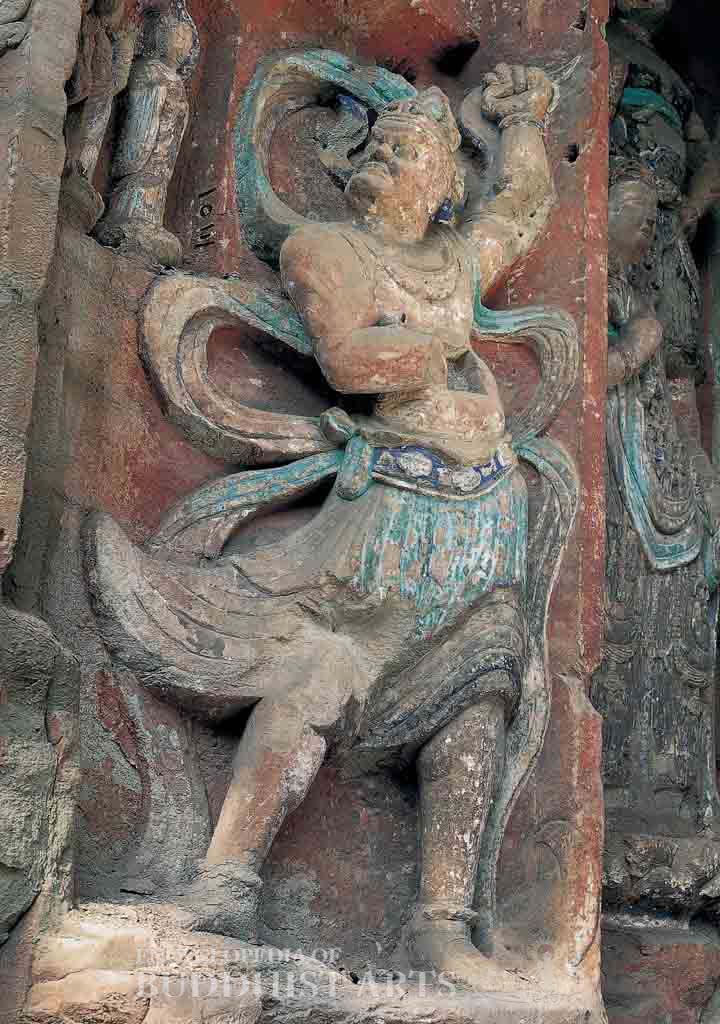
Chonglongshan Rock Carvings: Niche 93 - Warrior
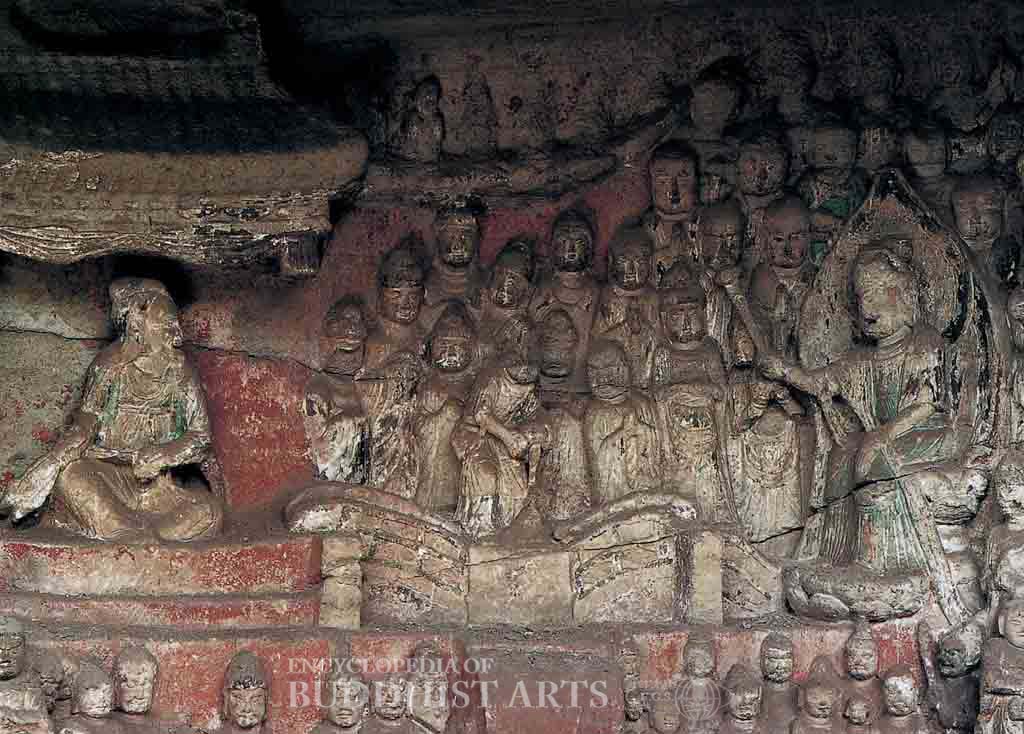
Chonglongshan Rock Carvings: Niche 23 - Illustration of Vimalakirti Sutra
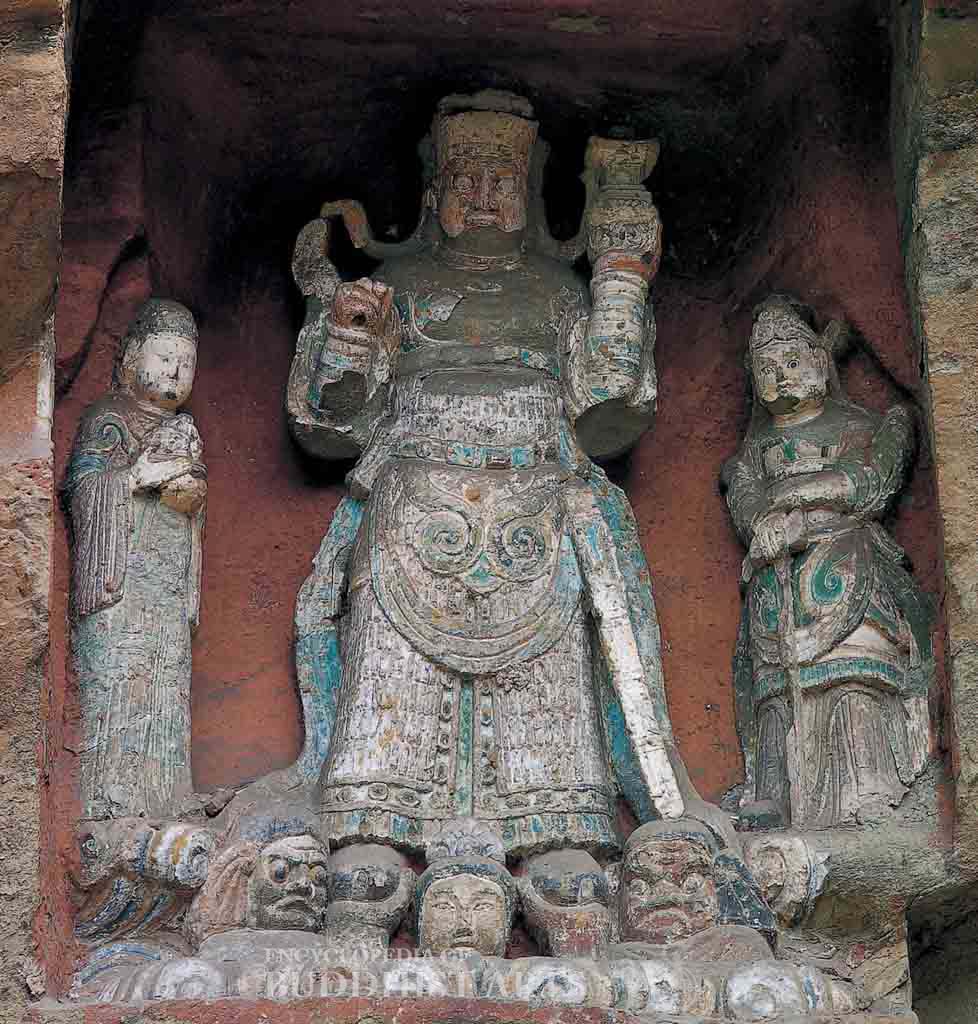
Chonglongshan Rock Carvings: Niche 58 - Vaisravana
Chonglongshan Rock Carvings
CHINA, Sichuan, Neijiang
Located within Chonglongshan (Double Dragon Mountain) in Zizhong county of Neijiang, the Chonglongshan Rock Carvings were constructed from 780 to 783 during the Tang dynasty. Construction was halted during the Huichang persecution of Buddhism and was resumed in 866 by Shao Tai, who gathered financial resources following his appointment as the governor of Zizhou. There are currently 172 numbered niches with 1,713 sculptures scattered around the two cliffs of Junziquan (Gentleman Fountain) and Gubeiyan (Ancient North Cliff). The largest niche, Niche 1, contains a Sakyamuni Buddha statue that is 5.35 m high, while the smallest statue reaches only 0.2 m in height. This area is listed as a Provincial Cultural Heritage Site.
The caves are mainly rectangular with flat ceilings. The door lintels are often decorated with drapery, vine-like designs, and floating clouds. Typical sculptures include Sakyamuni Buddha, the Medicine Buddha, illustrations of the Western Pure Land, Thousand-Armed Avalokitesvara, Ksitigarbha Bodhisattva, and Vaisravana. The inscriptions recording the sculptures and restoration were engraved between the years 847 to 879, 890 to 891, 938 to 965, and, finally 1008 to 1016.
The sculptures can be divided mainly into four periods: Mid-Tang period (756–846), Late Tang period (846–907), Five Dynasties (907–960), and the Northern Song dynasty (960–1127). The combination of a Buddha, two disciples, and two Bodhisattvas was quite common during the Mid-Tang period. The representative niches include Niches 58, 62, 63, 93, 113, and 115. Niche 58 is sculpted with Vaisravana stepping on the palms of two demons. Niche 93 contains 26 sculptures, including an Avatamsaka Triad, and the entrance is sculpted with two warriors. The main statues in Niche 93 are the Avatamsaka Triad with Vairocana Buddha seated with legs crossed, and flanked by Manjusri Bodhisattva riding a lion and Samantabhadra Bodhisattva riding an elephant. Niche 113 is sculpted with a total of 91 sculptures. The main statue, Thousand-Armed Avalokitesvara Bodhisattva seated with legs pendent on the back wall, is flanked by Heavenly Kings, other Bodhisattvas, disciples, and attendants.
Niches 23 and 54 were constructed during the Late Tang period. Sutra illustrations are sculpted in the rectangular Niche 23, and Manjusri Bodhisattva sits with legs pendent upon a lotus pedestal on the right side of the niche. Niche 54 is a rectangular niche with a flat ceiling and contains a representation of Ksitigarbha Bodhisattva as a monk. The Bodhisattva holds a wish-fulfilling jewel in front of the chest and stands on a lotus pedestal.
The Chonglongshan Rock Carvings are populated with sculptures typical of the Mid-Tang and Late Tang periods, as well as the Five Dynasties period, including various Bodhisattvas and Pure Land illustrations. In contrast, niche sculptures added after those periods tend to emphasize figures making offerings.
For more details, go to the Encyclopedia of Buddhist Arts: Caves A-E, page 207.
Cite this article:
author = Hsingyun and Youheng and Johnson, Peter and Mankuang and Huntington, Susan and Edson, Gary and Neather, Robert,
booktitle = {Encyclopedia of Buddhist Arts: Caves A-E},
pages = 207,
title = {{Chonglongshan Rock Carvings}},
volume = 5,
year = {2016}}