
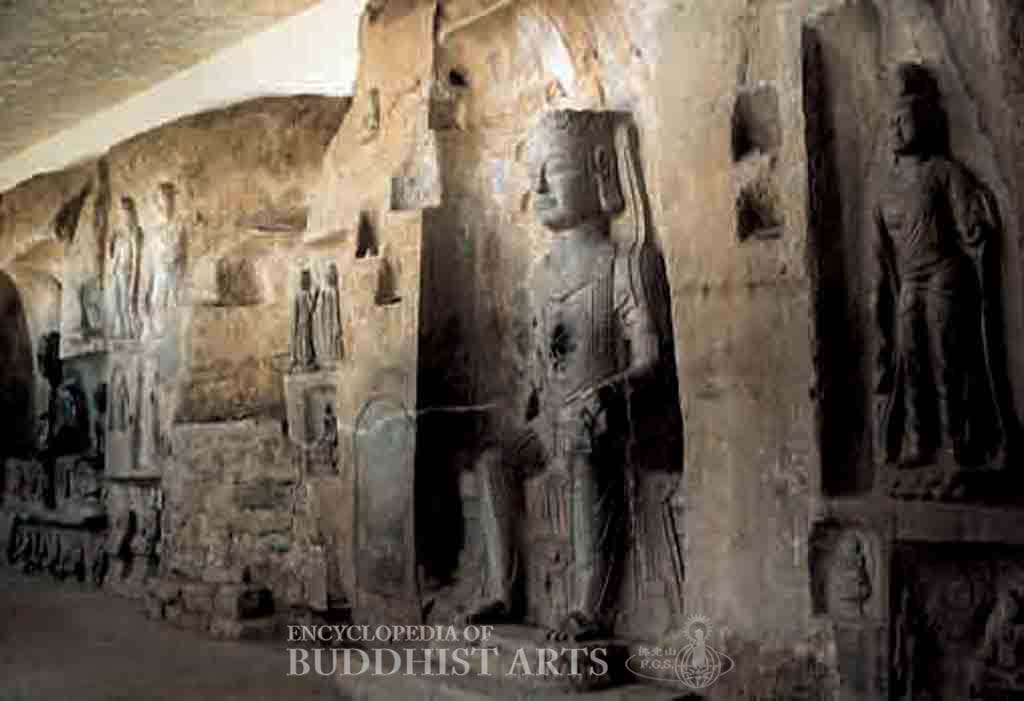
Yaowangshan Rock Carvings: Sculptures; Sui dynasty
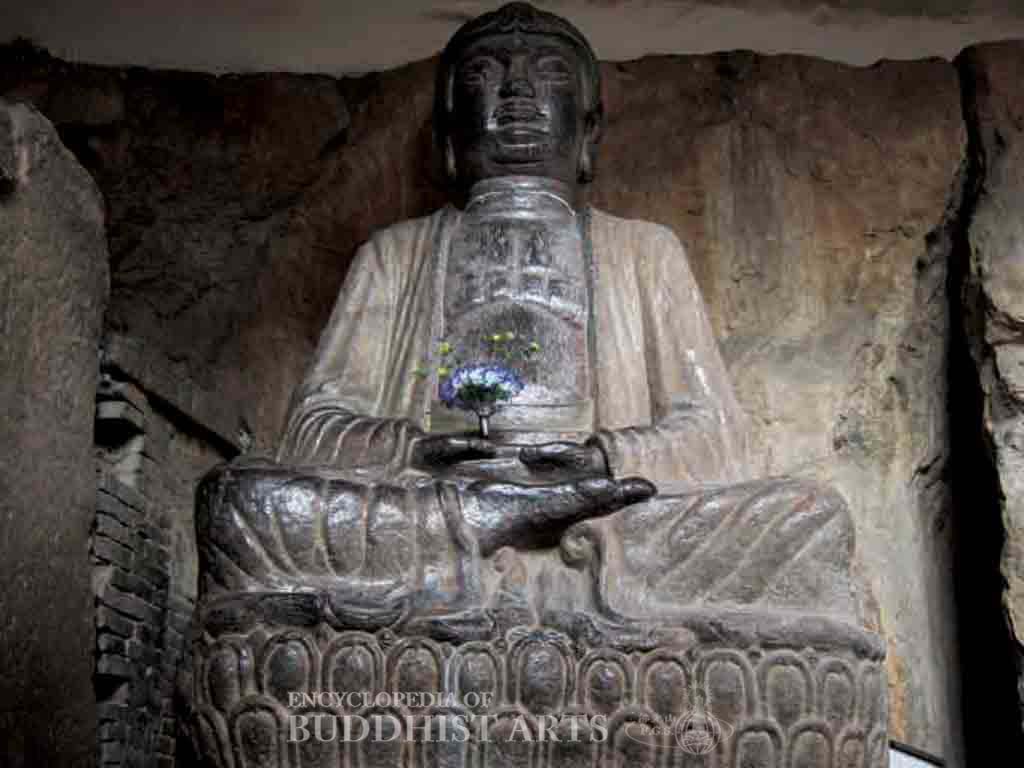
Yaowangshan Rock Carvings: Niche 22 - Seated Buddha; Ming dynasty
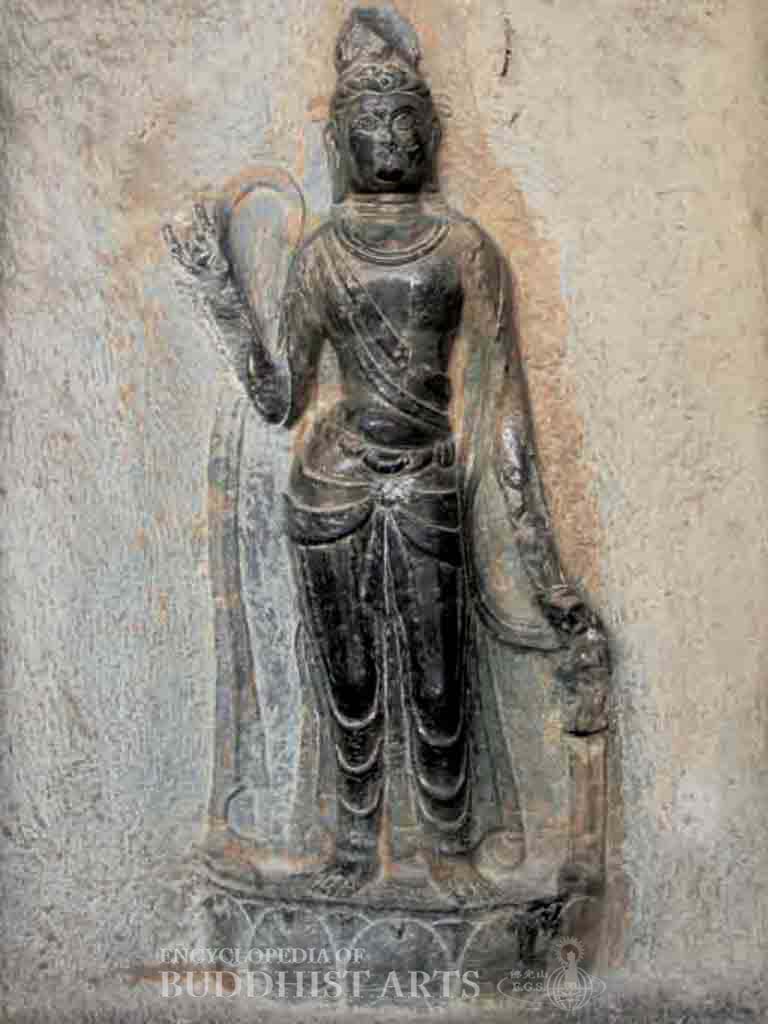
Yaowangshan Rock Carvings: Standing Bodhisattva; Tang dynasty
Yaowangshan Rock Carvings
CHINA, Shaanxi, Yaoxian
Located in Yaoxian, Shaanxi, these rock cavings caves can be found on the cliffside of Yaowangshan (Medicine King Mountain). Carving began during the Sui dynasty (581–618). Existing caves and niches total 23 and run from east to west along the cliff. The east area contains Niches 1 to 8, the center area Niches 9 to 21, and the west area Niches 22 to 23. These rock cavings were listed as a National Cultural Heritage Site in 1961.
The rock cavings were expanded greatly during the Tang dynasty (618–907), when approximately 15 niches were created. The layout and style is used to differentiate between the niches from Early Tang (618–712), High Tang (712–756), and Mid-Late Tang (756–907) periods. Niches from the Early and High Tang periods are in the east area. Inside Niche 4 is a figure of a seated Maitreya Bodhisattva with legs pendent that is considered to be the earliest statue within the group. Sitting on a Sumeru throne, the Bodhisattva is adorned with a jeweled headdress, necklace, and a large medallion. Meanwhile, Niches 5 and 6 are located nearby and both have reliefs of a Bodhisattva seated on a lotus stem in full lotus position, which mirrors typical design elements of statues from the High Tang period.
The Mid-Tang to Late Tang niches feature prominently in the central area. Representative ones are Niches 8, 12 to 17. These niches all display similar triads of a Buddha and two Bodhisattvas.
In addition, there are six niches originating from the Five Dynasties (907–960) period to the Jin dynasty (1115–1234), which are Niches 10, 11, 18, 20, 21, and 23. Inside Niche 23 is the Medicine Buddha holding a medicine bowl, wearing a monastic robe, and seated in full lotus position on a Sumeru throne. Bodhisattvas making offerings flank the Buddha, while other figures can be seen doing the same on both sides.
Niche 22 features a seated Buddha in meditation that is thought to be from the Ming dynasty (1368–1644). The Buddha’s hair is sculpted in a wavy pattern and the head displays a usnisa. The Buddha’s hands form the dhyana (meditation) mudra. This is the only freestanding statue in the Yaowangshan Rock Carvings.
For more details, go to the Encyclopedia of Buddhist Arts: Caves T-Z, page 1543.
Cite this article:
author = Hsingyun and Youheng and Johnson, Peter and Mankuang and Huntington, Susan and Edson, Gary and Neather, Robert,
booktitle = {Encyclopedia of Buddhist Arts: Caves T-Z},
pages = 1543,
title = {{Yaowangshan Rock Carvings}},
volume = 9,
year = {2016}}