
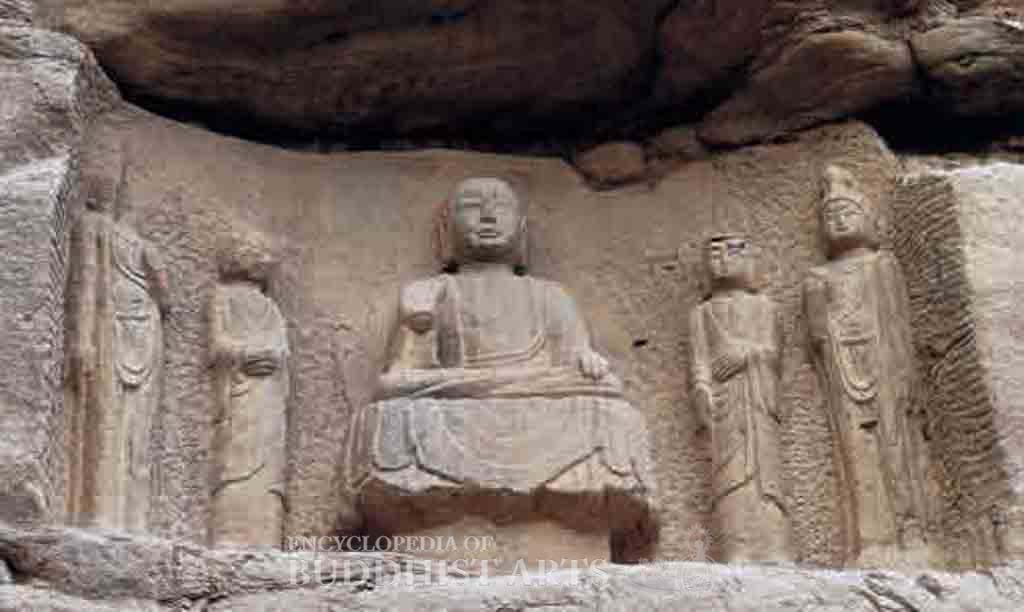
Linyou Caves: Linxiqiao Niche 2 - Buddha Pentad
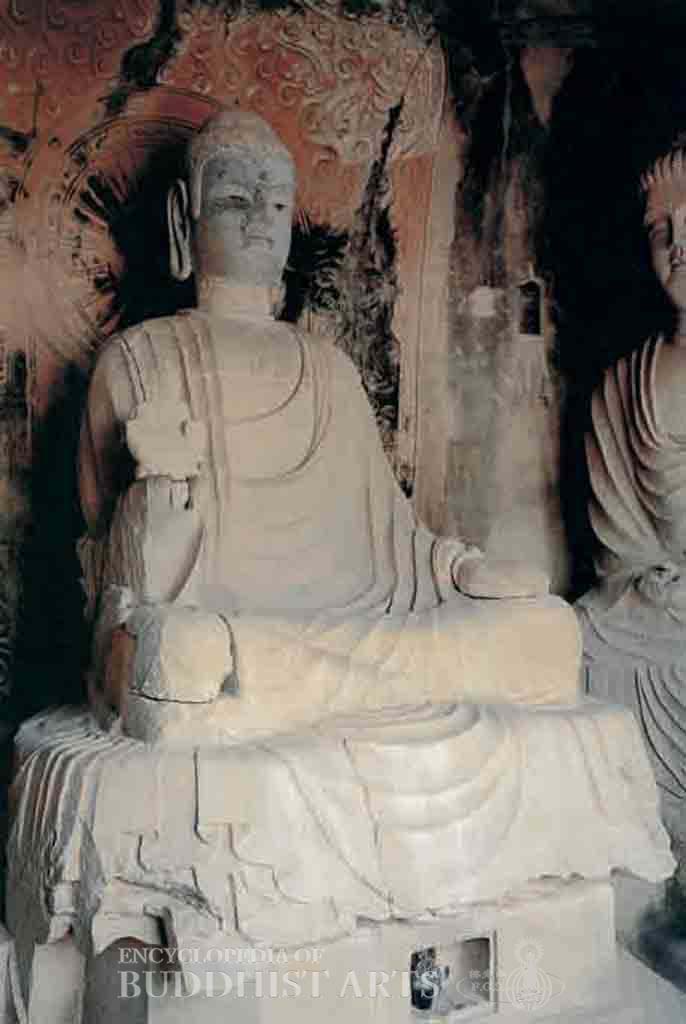
Linyou Caves: Cishan Temple Cave 1 - Seated Buddha (back wall); Tang dynasty, dated 653
Linyou Caves
CHINA, Shaanxi, Baoji
The Linyou Caves are located on a cliff along the west bank of Qi River in Linyou of Baoji. The excavation was initiated in 601 during the Sui dynasty, and continued throughout the Tang dynasty (618–907). The site is divided into two major cave groups: Cishan Temple Caves and Linqiao Caves. The Cishan Temple Caves consist of three caves that face east. Based on the Linyou County Gazetteer, written during the Qing dynasty (1644–1911), the Cishan Temple Caves contain an exquisite stone Buddha statue from the year 653.
The arched entrance to Cishan Temple Cave 1 is 4.3 m in width, while the interior, with an apsidal layout, is 6.9 m in width, 7.2 m in height, and 5.4 m in depth. Altars are built at the back (west), north, and south walls. A Buddha statue sits on the 1.5 m high altar on the back wall. The Buddha is 3.8 m in height and has a wide face and a prominent neck. A long monastic robe worn over an inner robe covers both shoulders and drapes down over the throne. The left hand rests atop the left knee, while the right hand, which was formerly raised, is missing. On the north wall, there is a 4.4 m high Buddha with a high usnisa and a gentle smile. The solemn-looking Buddha on the south wall measures 4.3 m in height. Over an inner robe tied by a knot, the figure wears a long, loose monastic robe, which covers both shoulders.
Cishan Temple Cave 2, with an apsidal layout and barrel-vaulted ceiling, is 9.5 m north of Cave 1. The main figure on the back (west) wall is 4.4 m high and exhibits vitality and strength. A rectangular stone below the figure bears an illegible inscription from the Tang dynasty. The upper and lower sections of the north and south walls each contains an ogee arched niche. The upper niche on the south wall houses a standing Bodhisattva, and the lower niche portrays a Buddha with two disciples. The upper niche on the north wall is destroyed, but the lower niche contains a Buddha and two Bodhisattvas with lotus stems on the sides.
Cave 3 was left incomplete. A weathered square niche in the middle of the west wall houses a Buddha seated in full lotus position.
The Linqiao Caves consists of eight niches. Niche 2 is the largest, measuring 1.05 m high and 1.4 m wide. The niche contains a Buddha Pentad, with Sakyamuni Buddha flanked by two disciples and two Bodhisattvas.
For more details, go to the Encyclopedia of Buddhist Arts: Caves R-L, page 653.
Cite this article:
author = Hsingyun and Youheng and Johnson, Peter and Mankuang and Huntington, Susan and Edson, Gary and Neather, Robert,
booktitle = {Encyclopedia of Buddhist Arts: Caves R-L},
pages = 653,
title = {{Linyou Caves}},
volume = 6,
year = {2016}}