
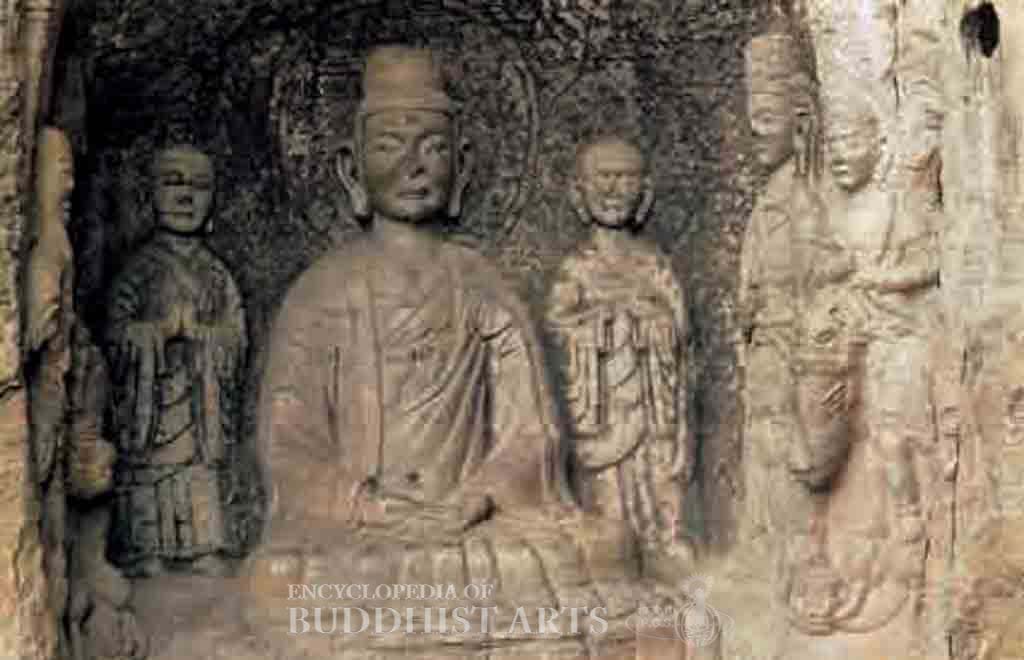
Longdong Caves: Large West Chamber - Sculptures (exterior wall, right of entrance); Yuan dynasty, dated 1318
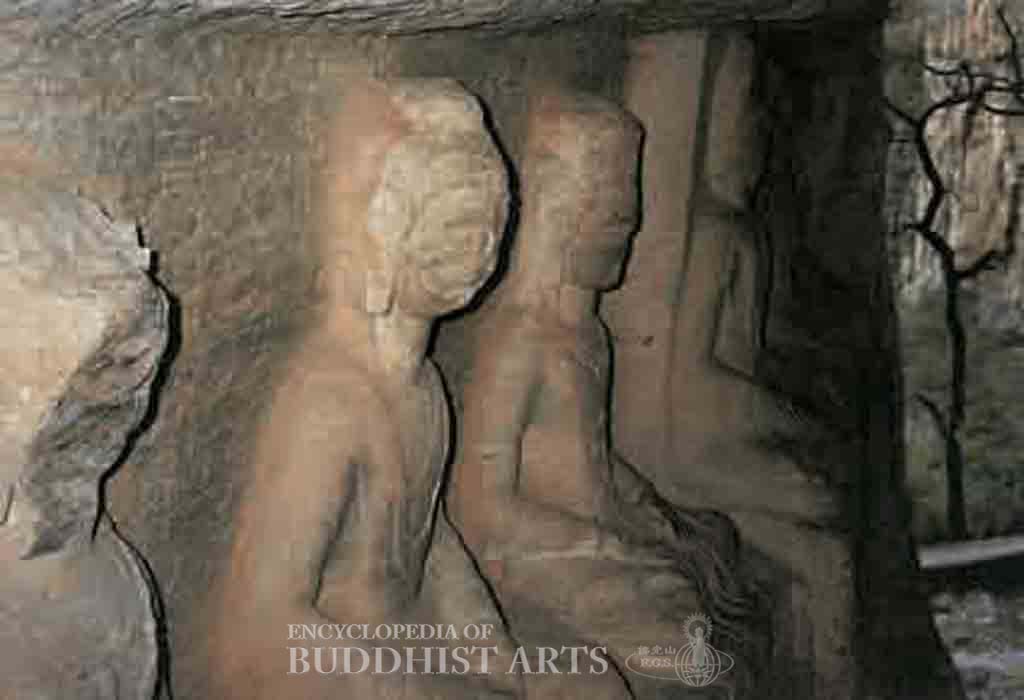
Longdong Caves: Small Cave - Sculptures; Sui dynasty
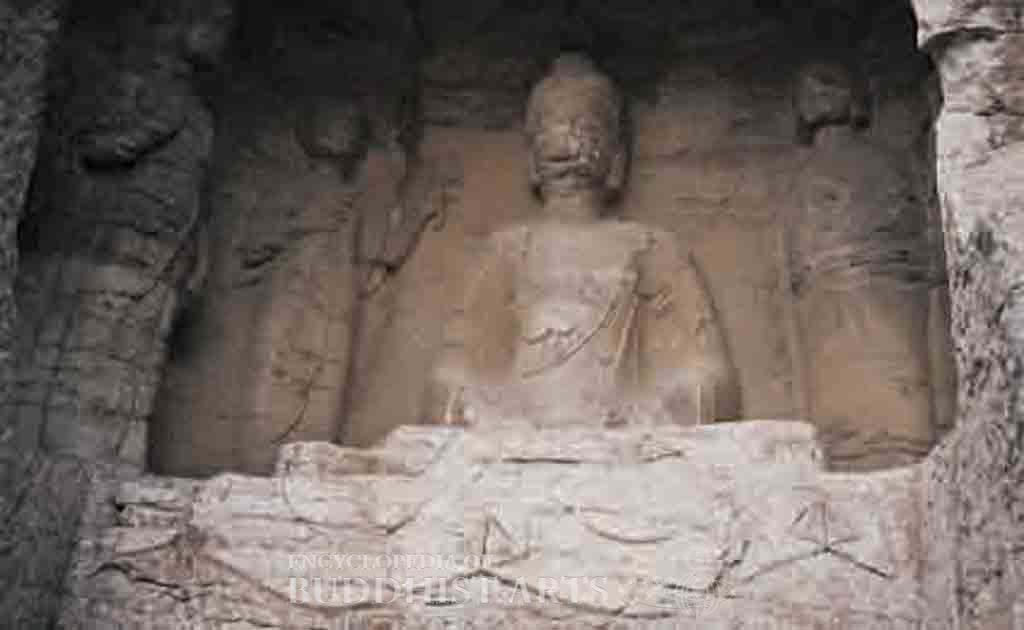
Longdong Caves: Buddha Pentad; Sui dynasty, dated 607
Longdong Caves
CHINA, Shandong, Jinan
Longdong means Dragon Cave. It consists of two caves, one large and one small, located on the west peak of Longdongshan (Dragon Cave Mountain), 15 km east of Jinan in Shandong province. Excavation at the site began during the Eastern Wei dynasty (534–550) and continued from the Sui (581–618) to Yuan (1271–1368) dynasty. The sculptures inside the large cave have experienced extreme weathering and damage, although the ones inside the small cave are better preserved.
The large cave, approximately 19 m in depth, contains two entrances leading to two north-facing chambers, known as the Large East Chamber and the Large West Chamber. The Large East Chamber houses a 4 m high standing figure on the west wall. The east wall holds carvings of a standing Buddha and two Bodhisattvas. The Large West Chamber contains numerous standing figures, measuring 24 cm to 74 cm in height. The four standing Buddhas on the east wall are flanked by one to two pairs of Bodhisattvas, except for the one closest to the entrance. The west wall houses six niches, three of which contain Buddha triads. The other three niches are either empty, or contain an unfinished or damaged figure. There are also niches on the exterior walls on both sides of the entrance. The niche on the left side houses a standing Maitreya, accompanied by an inscription from the year 537 of the Eastern Wei dynasty. The niche to the right contains one Buddha, two disciples, two Bodhisattvas, a lion keeper, and a mahout. An inscription from 1318 of the Yuan dynasty is written beside the niche.
The small cave faces east and is located on the cliff face adjacent to the Large West Chamber. A pair of square niches is found above the entrance; the upper niche contains one Buddha and two Bodhisattvas, while the lower niche houses two seated Buddhas. The entrance to the small cave is 1.5 m in width, and the cave itself is approximately 18 m in depth, narrowing toward the back. The north wall contains four groups of sculptures. From right to left, there are three seated Buddhas, one Buddha with two Bodhisattvas, a single seated Buddha, and three Buddhas. The south wall is carved with two figures, each forming a dhyana (meditation) mudra. There are also three small niches approximately 15 m to the north of the small cave.
For more details, go to the Encyclopedia of Buddhist Arts: Caves R-L, page 655.
Cite this article:
author = Hsingyun and Youheng and Johnson, Peter and Mankuang and Huntington, Susan and Edson, Gary and Neather, Robert,
booktitle = {Encyclopedia of Buddhist Arts: Caves R-L},
pages = 655,
title = {{Longdong Caves}},
volume = 6,
year = {2016}}