
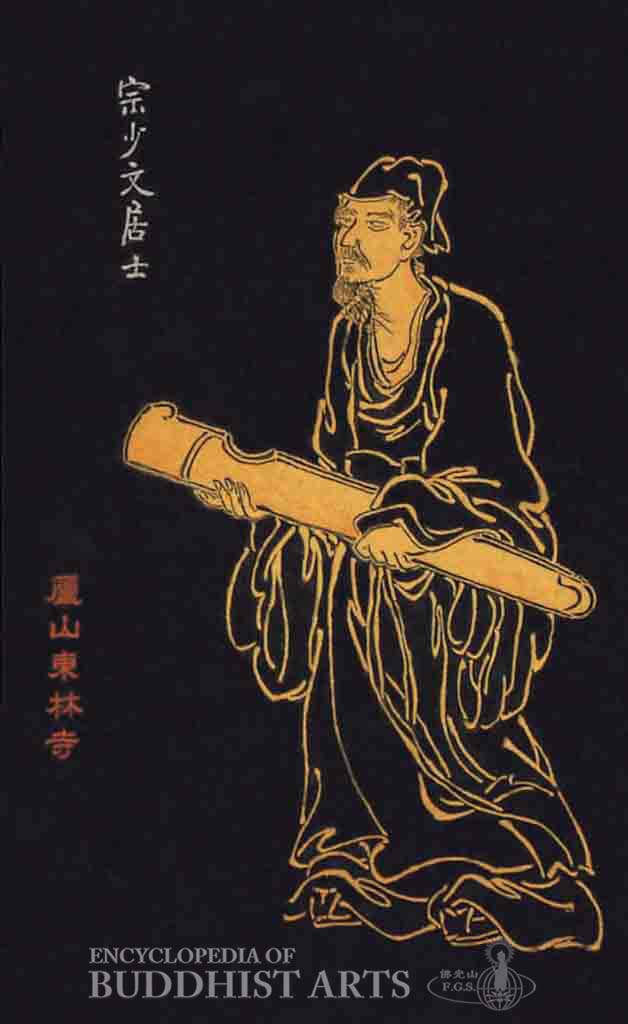
Zong Bing
Line incision on stone
Zong Bing
CHINA, Henan, Nanyang; Liu Song dynasty
Zong Bing was an artist from Nieyang (present day Zhenping, Nanyang) who was skilled in painting, calligraphy, and music. He was much sought after by the official administration with offers of official posts. He preferred to live a life of simplicity and often traveled to remote and mountainous locations. When residing in Lushan, Zong frequented the temple set up by monk Huiyuan, founder of the White Lotus Society, and composed several Buddhist writings. In his later years, when he was no longer able to travel, he painted landscapes on the wall of his abode so he could “travel while at home.”
As a landscape painter, Zong felt strongly about the spiritual significance of the interaction between mountains and water. He believed that artists should possess a form of inner self-cultivation in order to appreciate what nature presents before they can make true representations of the landscape. His approach to landscape painting was “to acknowledge the magnitude of mountains, yet not only focus on it; take a few steps backwards and observe again, and one will be able to see the tiny and minute details of interactions of nature.” This concept greatly influenced the works of subsequent generations of landscape painters.
Although many of his paintings are no longer extant, an image of Zong is located in the Patriarch Hall within Donglin Temple in Jiangxi. His grandson Zong Ce was also a great painter, with Buddhist paintings in Yongye Temple attributed to him.
For more details, go to the Encyclopedia of Buddhist Arts: People, page 370.
Cite this article:
author = Hsingyun and Youheng and Youlu and Pokorski, Stefanie and Yichao and Mankuang and Miaohsi,
booktitle = {Encyclopedia of Buddhist Arts: People },
pages = 370,
title = {{Zong Bing}},
volume = 19,
year = {2016}}