
Master Dongshan Liangjie
Ink and color on paper
Master Dongshan Liangjie
JAPAN; Muromachi period
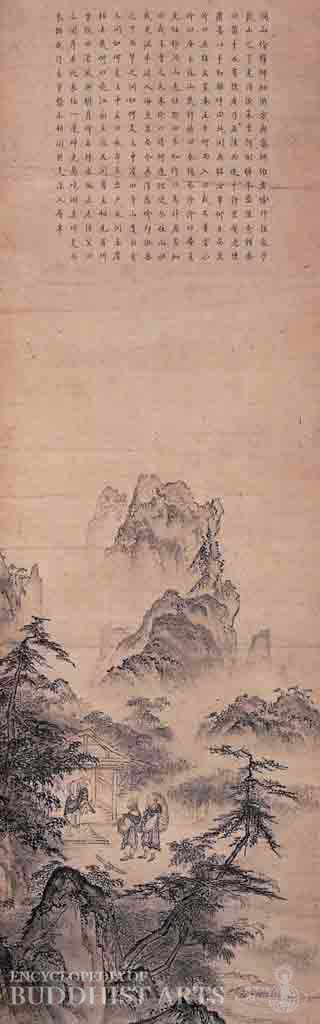
The inscription at the top of this painting, written by an unknown author, states that the scene is based on a story from the biography of Master Longshan written in the Transmission of the Lamp. The seal print in the bottom left corner of the painting belongs to the artist Gakuo Zokyu, a student of the famous monk Tensho Shubun. Based on the painting style and the inscription, this work was created during the late 15th or the early 16th century. In 1942, it was listed as an Important Cultural Property.
A Chan story tells of how Master Dongshan Liangjie visited Longshan at his hut deep in the mountains. When he arrived, Longshan came to meet him, and said, “There should be no entrance to this mountain. Where have you come from?” Dongshan replied, “Let us not discuss if there is an entrance, nor how I came in. Let me ask you, how did you enter this mountain?” Longshan said, “I came neither from the clouds nor from the water or land.” Dongshan asked another question, “May I ask how many years have you been here since you arrived?” “There is no measure of time on the mountain. Worldly measures of time have nothing to do with me,” Longshan replied. Puzzled, Dongshan continued to question the master. “Did you arrive here before the mountain, or did the mountain arrive here before you?” “I don’t know!” “Why do you not know?” “I am neither an ordinary man, nor a heavenly sage, why would I know?” “Since you’re neither an ordinary man nor a heavenly sage, have you then become the Buddha?” “Not the Buddha either!” “What then are you?” “If I can be labeled, then there is no middle path.” Dongshan then returned to the original question, “How did you enter this deep mountain?” Longshan did not answer directly. Instead he said, “I once witnessed two buffaloes fighting. As they fought, they fell into the ocean and could no longer be seen.” Hearing this, Dongshan was filled with admiration and prostrated before Longshan.
In the painting, Longshan emerges from a hut to meet Dongshan and Shenshan Senmi. The figures wear robes, shawls, and sandals. Their hands are hidden inside their sleeves. One of them has a hat hanging behind his shoulders. Mist shrouded mountains rise up in the distance behind the hut. An eagle soars above a tree-lined peak in the lower register. The figures and the hut seem insignificant within the majestic landscape, making them small beneath the vast open sky. The background is drawn using a technique that involves holding the brush parallel to the paper and lightly tapping to portray smoke, rain, mist, or cloud. There are very few extant paintings portraying Dongshan; thus this artwork holds an important historical position.
For more details, go to the Encyclopedia of Buddhist Arts: Painting I-O, page 518.
Cite this article:
author = Hsingyun and Youheng and Youlu and Wilson, Graham and Manho and Mankuang and Huntington, Susan,
booktitle = {Encyclopedia of Buddhist Arts: Painting I-O},
pages = 518,
title = {{Master Dongshan Liangjie}},
volume = 15,
year = {2016}}