
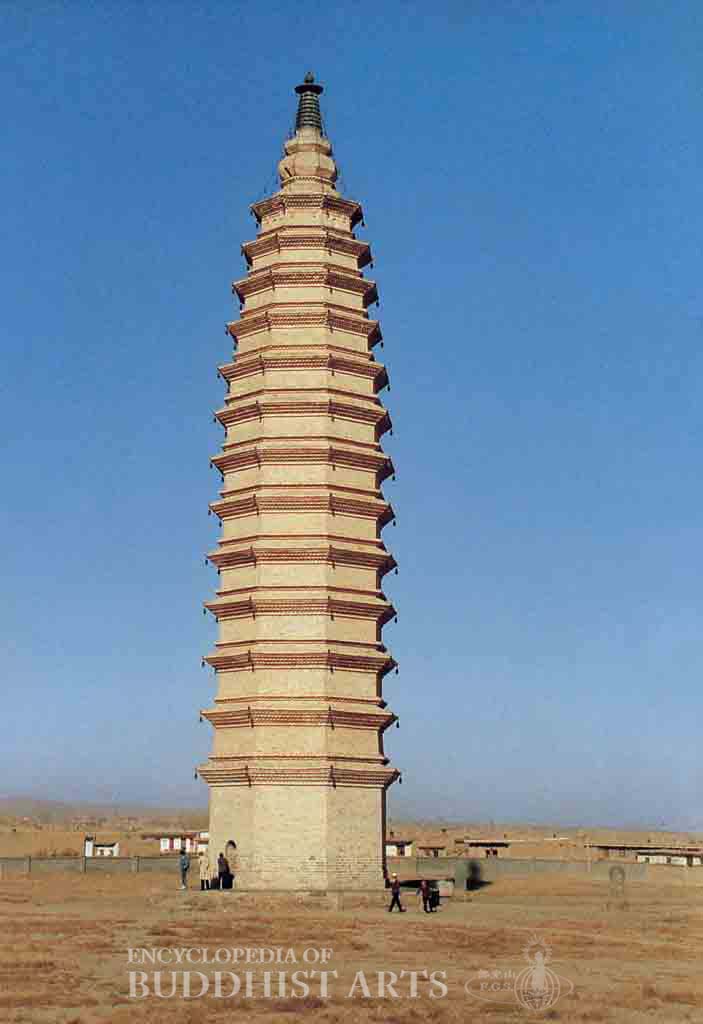
Kangji Temple Pagoda
Kangji Temple Pagoda
CHINA, Ningxia, Wuzhong
According to documents and artifacts, the pagoda was built during the Western Xia period (1032–1227). The upper section and the spire were repaired during the Ming dynasty (1368–1644) but the lower section, below the ninth tier, is still the original structure from the Western Xia period. It was listed as a Provincial Cultural Heritage Site in 1963.
The 13-tier, octagonal, brick pagoda is 42.7 m high. It stands on a thin platform. The first tier is the tallest and from the second tier upwards, the height of each tier decreases. This produces a tapered curved effect, which is commonly seen in multiple-tier pagodas of the earlier periods. The eaves are in the form of corbeling and above the eaves the beginning of the next tier is clearly defined. An arched doorway is located on the south side of the first level, while false doors and pilasters can be found on every side of the 13th tier. Every other tier is unadorned. The spire consists of an inverted bowl, an octagonal gourd, stacked rings, a canopy and a jewel.
A large number of Buddhist artifacts were discovered within the pagoda during repairs in 1985. They included Buddhist and Daoist statues, sutras, a painting of Ksitigarbha, rubbings of Buddha images, inscribed bricks, and stone steles. These artifacts provide evidence of the flourishing of Buddhism in this region.
For more details, go to the Encyclopedia of Buddhist Arts: Architecture G-L, page 589.
Cite this article:
author = Hsingyun and Youheng and Johnson, Peter and Mankuang and Lancaster, Lewis,
booktitle = {Encyclopedia of Buddhist Arts: Architecture G-L},
pages = 589,
title = {{Kangji Temple Pagoda}},
volume = 2,
year = {2016}}