
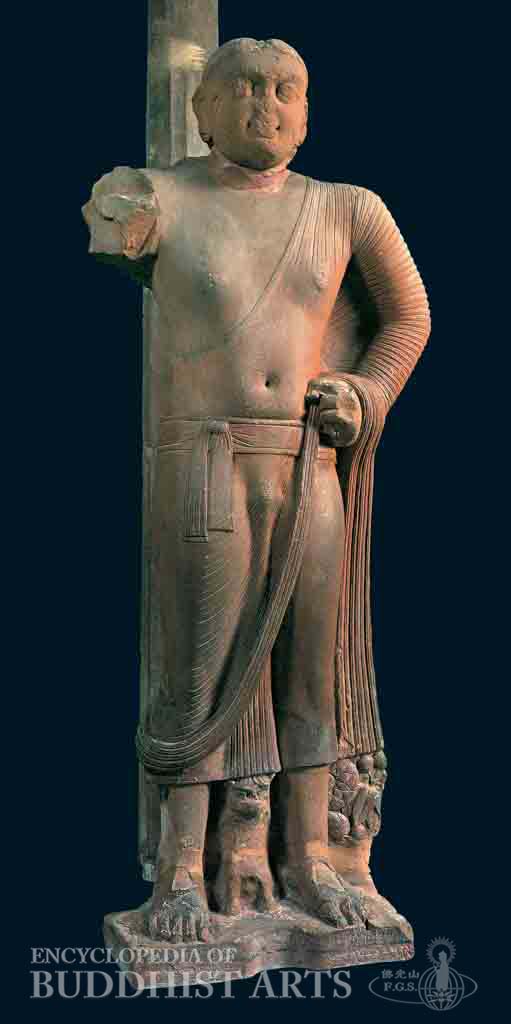
Sarnath: Standing Buddha
Red sandstone
Sarnath: Standing Buddha
INDIA, Uttar Pradesh, Varanasi
Although it was discovered at Sarnath, experts believe the statue originated from Mathura because of the type of sandstone from which it is carved. An inscription on the pedestal states the sculpture was donated by the monk Bala along with some others around 131 CE, in the 3rd year of the rule of King Kaniska (reigned circa 129–160). Another inscription on the shaft of the pillar identifies the figure as a Bodhisattva, but the charateristics and clothing are those of a Buddha. This suggests that the term Bodhisattva (Enlightened Being) may have been more general than usually understood.
The broad chested Buddha stands with the left hand at the waist, supporting a trailing stole. The diaphanous monastic robe leaves the right shoulder bare and is carved with double lines to represent folds. The lion sitting between the Buddha’s legs signifies his greatness and also his princely birth. The ribbed stone pillar behind the figure originally supported a large parasol.
For more details, go to the Encyclopedia of Buddhist Arts: Sculpture N-Sr, page 980.
Cite this article:
author = Hsingyun and Youheng and Lovelock, Yann and Chou, Yuan and Huntington, Susan and Edson, Gary and Neather, Robert,
booktitle = {Encyclopedia of Buddhist Arts: Sculpture N-Sr},
pages = 980,
title = {{Sarnath: Standing Buddha}},
volume = 12,
year = {2016}}