
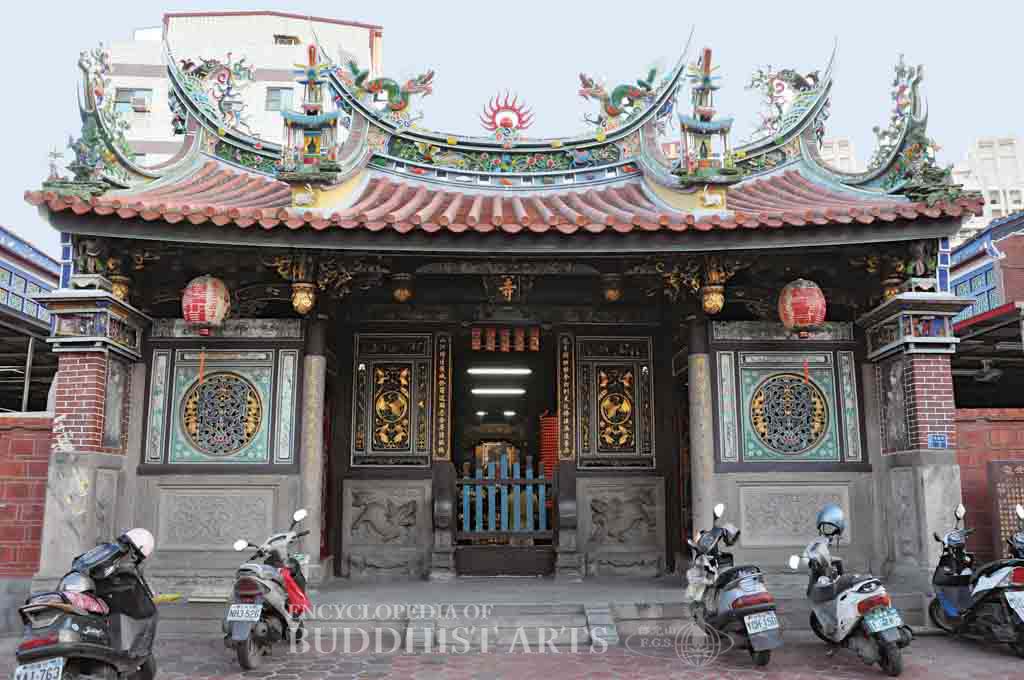
Longshan Temple: Hall of Three Rivers

Longshan Temple: Pavilion (interior)
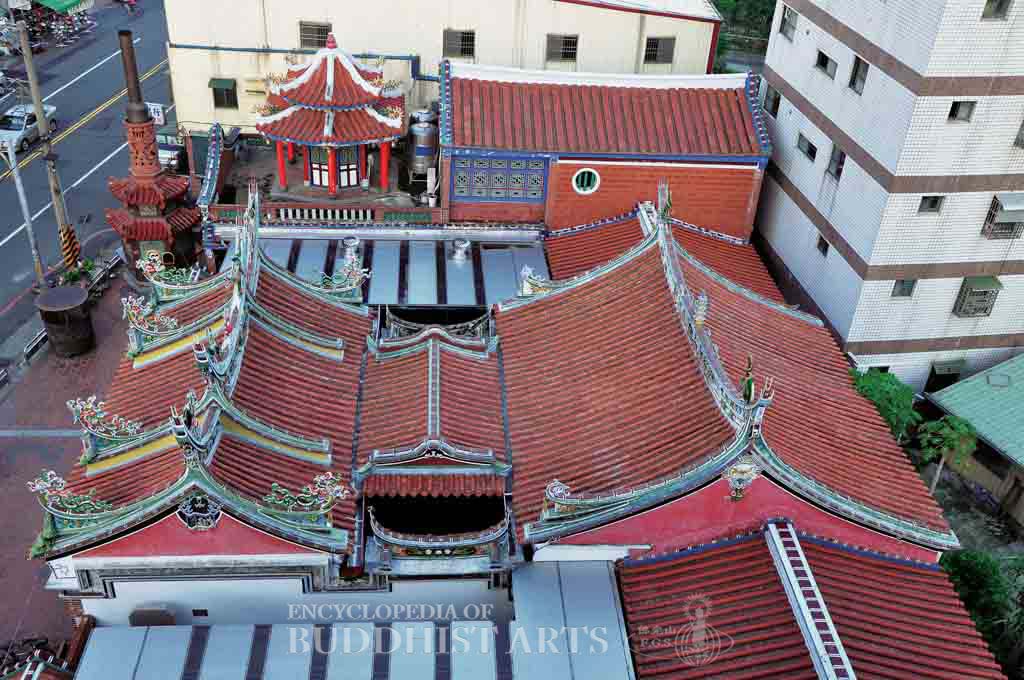
Longshan Temple (aerial view)
Longshan Temple
TAIWAN, Kaohsiung
Longshan means Dragon Mountain. The temple was built in the early years of Emperor Qianlong (reigned 1736–1795) during the Qing dynasty. It has undergone several reconstructions in its history. The temple is listed as a Historic Monument of Taiwan.
The temple layout consists of a pavilion placed between two halls with ancillary buildings on the left and right. Along the central axis the buildings include the Hall of Three Rivers, pavilion, and main hall. The roofs are connected in an H-shaped configuration. The two sides of the main hall consist of the Three Buddha Shrine and the Ksitigarbha Shrine.
The three-bay wide Hall of Three Rivers has a central roof with slightly lower ridges at each end. The ridges are highly decorated and turn upwards dramatically to form swallowtails. There are clay mosaic sculptures of paired dragons with a pearl, and sea turtles spouting water. The central bay is recessed and on either side of the doorway there are openwork carved windows with a circular inset carved with a crane. There is also a pair of stone qilin on the floor. The walls in the secondary bays are adorned with circular wood carvings of mythical creatures and tigers, as well as stone reliefs.
The pavilion has a straight ridge. The eaves are supported by bracket sets in the form of lions and elephants. The two side walls are elaborately decorated with dragon and tiger images in mosaic reliefs. The main hall has an overhanging gable roof supported by three rows of lintels with five suspended posts. There are wooden latticed drop panels and exquisitely carved corbeling in the shape of turtles. The main hall houses statues of Avalokitesvara Bodhisattva, Skanda, Sangharama, and the Eighteen Arhats. The two ancillary wings were reconstructed as two-story concrete buildings in 1933. They contain the bell and drum towers on the upper levels. The right wing contains various steles that were erected to record the construction and reconstruction of the temple.
For more details, go to the Encyclopedia of Buddhist Arts: Architecture G-L, page 693.
Cite this article:
author = Hsingyun and Youheng and Johnson, Peter and Mankuang and Lancaster, Lewis,
booktitle = {Encyclopedia of Buddhist Arts: Architecture G-L},
pages = 693,
title = {{Longshan Temple}},
volume = 2,
year = {2016}}