
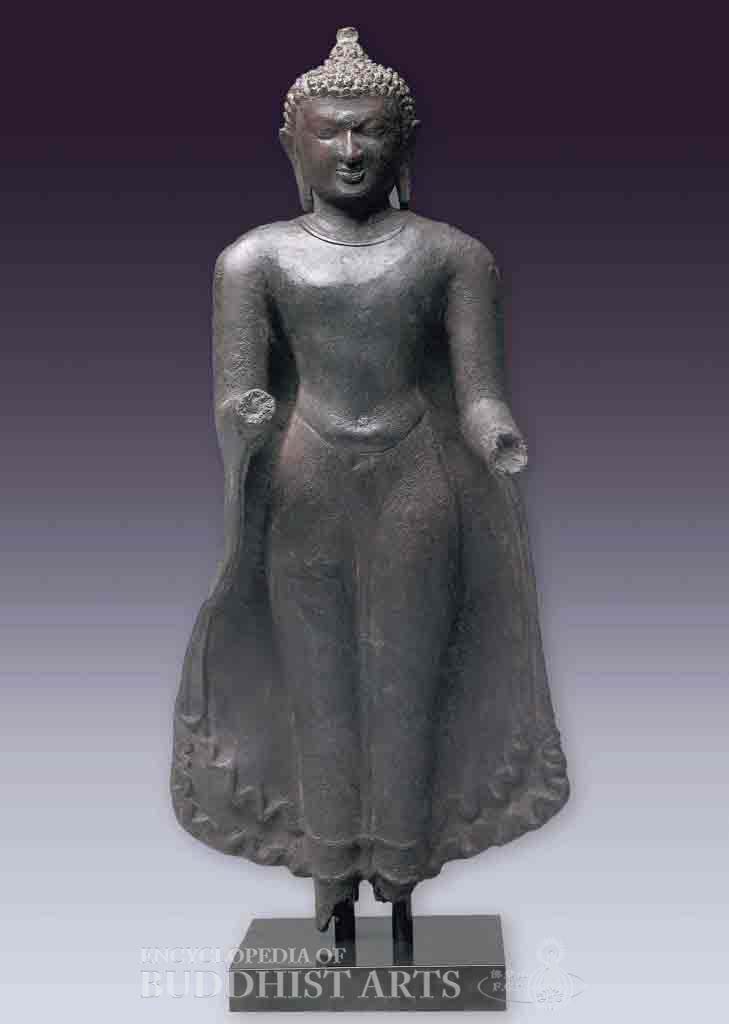
Sakyamuni Buddha
Bronze inlaid with silver
Sakyamuni Buddha
MYANMAR; Bagan Empire
The statue’s style is characteristic of the Bagan Empire (circa 849–1287). The Buddha’s head is covered with large curls leading to a small usnisa whose jeweled tip is damaged. The face and nose are wide while the mouth is small. Elongated ears reach to the shoulders. The thin monastic robe covers both shoulders and spreads out behind the body, from where it folds over the lifted wrists, and falls to calf level where the ends form unique wave patterns. The fold of the under-robe hangs down and emphasizes the shape of the legs.
For more details, go to the Encyclopedia of Buddhist Arts: Sculpture N-Sr, page 920.
Cite this article:
Hsingyun, et al. "Sakyamuni Buddha." Encyclopedia of Buddhist Arts: Sculpture N-Sr, vol. 12, 2016, pp. 920.
Hsingyun, Youheng, Yann Lovelock, Yuan Chou, Susan Huntington, Gary Edson, and Robert Neather. 2016. "Sakyamuni Buddha" In Encyclopedia of Buddhist Arts: Sculpture N-Sr, 12:920.
Hsingyun, Youheng, Lovelock, Y., Chou, Y., Huntington, S., Edson, G., & Neather, R.. (2016). Sakyamuni Buddha. In Encyclopedia of Buddhist Arts: Sculpture N-Sr (Vol. 12, pp. 920).
@misc{Hsingyun2016,
author = Hsingyun and Youheng and Lovelock, Yann and Chou, Yuan and Huntington, Susan and Edson, Gary and Neather, Robert,
booktitle = {Encyclopedia of Buddhist Arts: Sculpture N-Sr},
pages = 920,
title = {{Sakyamuni Buddha}},
volume = 12,
year = {2016}}
author = Hsingyun and Youheng and Lovelock, Yann and Chou, Yuan and Huntington, Susan and Edson, Gary and Neather, Robert,
booktitle = {Encyclopedia of Buddhist Arts: Sculpture N-Sr},
pages = 920,
title = {{Sakyamuni Buddha}},
volume = 12,
year = {2016}}