
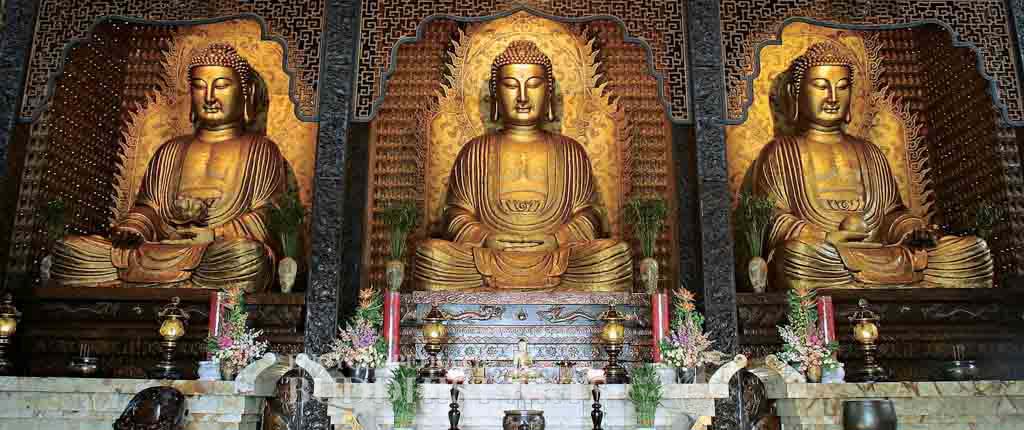
Fo Guang Shan Monastery Great Hero Hall: Three Buddhas
Glass fiber
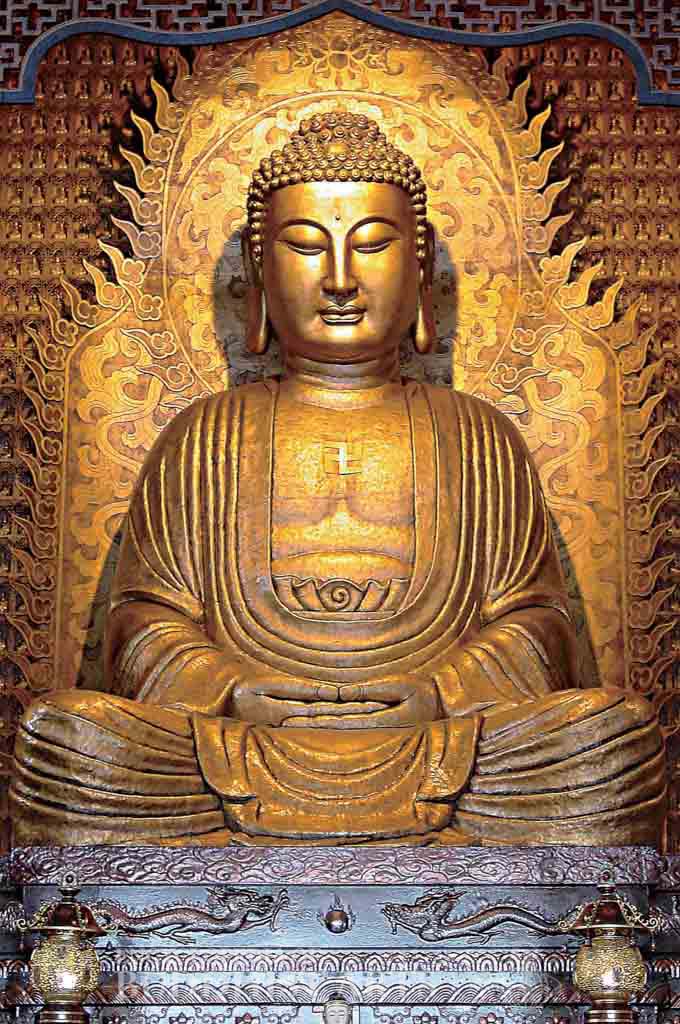
Fo Guang Shan Monastery Great Hero Hall: Three Buddhas - Sakyamuni
Fo Guang Shan Monastery Great Hero Hall: Three Buddhas
TAIWAN, Kaohsiung
The Statues of the Three Buddhas were made by Master Hsing Yun and Chen Mingji. They are located inside the Great Hero Hall, which was built in 1981, and include from left to right, Amitabha Buddha, Sakyamuni Buddha, and the Medicine Buddha. All three Buddhas are seated cross-legged upon square thrones inside carved wooden niches protected by an openwork canopy. There are a total of 14,800 small seated Buddhas behind them and on the four walls, all within their own niches. A couplet located on either side of the entrance is dedicated to the Three Buddhas within.
The design and appearance of each Buddha is similar. Signs of their status include a low usnisa with a jewel just below, long earlobes and three lines on the neck. They wear low-collared monastic robes that cover both shoulders, opening to reveal a swastika symbol on the chest. Sakyamuni is seated with both hands in dhyana (meditation) mudra. The Medicine Buddha holds a large wish-fulfilling jewel in his right hand with the other hand resting open on his knee. Amitabha’s left hand holds a lotus, while the other rests upturned in his lap. Each Buddha has a flaming mandorla that incorporates a nimbus, also edged by flames and with a lotus immediately above. This grouping of Buddhas became popular in Taiwan during Japanese rule (1895–1945).
For more details, go to the Encyclopedia of Buddhist Arts: Sculpture A-F, page 340.
Cite this article:
author = Hsingyun and Youheng and Lovelock, Yann and Chou, Yuan and Huntington, Susan and Edson, Gary and Neather, Robert,
booktitle = {Encyclopedia of Buddhist Arts: Sculpture A-F},
pages = 340,
title = {{Fo Guang Shan Monastery Great Hero Hall: Three Buddhas}},
volume = 10,
year = {2016}}