
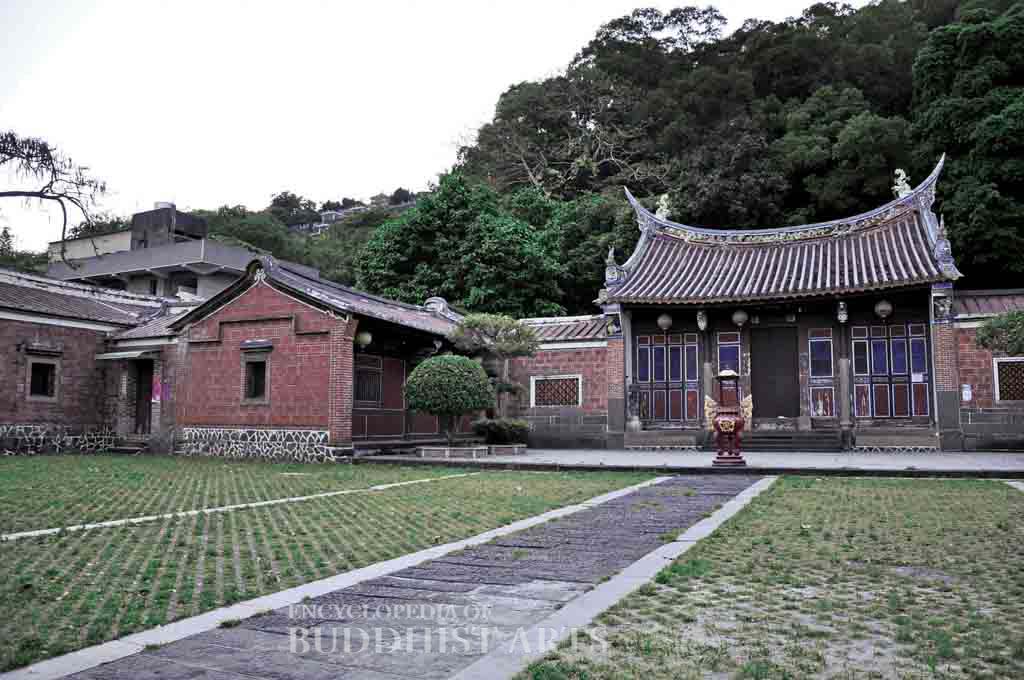
Xiyun Temple
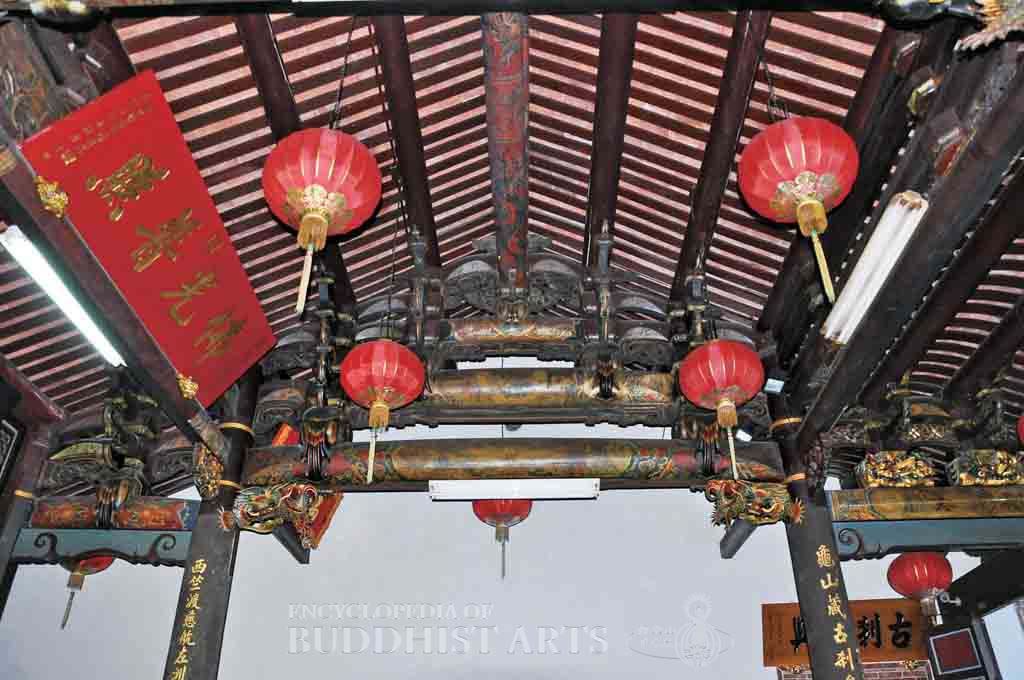
Xiyun Temple: Main Hall
Xiyun Temple
TAIWAN, New Taipei City
Xiyun means Western Cloud. In 1752 the Chinese monk Shengyuan from Yongquan Temple in Fuzhou built a hermitage at this site. In 1768, the land was donated for an expansion of the temple. It was reconstructed in 1811 and was subsequently restored several times resulting in its present appearance. The temple is listed as a Municipal Cultural Heritage Site.
The temple is built in a typical Hakka-style layout of a three-sided courtyard with extensions on the sides. The funerary stupa of Shengyuan is located on one side. The three-bay wide main hall has a single-eave flush gable roof. The main roof ridge is curved like a crescent moon ending in a swallowtail. The double ridge purlin, commonly found in Hakka-style construction, is concealed within the roof framework; however, it is unusual for the third cross-beam to be carrying the lower ridge purlin. The hall houses a statue of Avalokitesvara Bodhisattva flanked by Sudhana and Nagakanya, as well as Skanda and Sangharama Bodhisattvas. The temple contains several couplets and stele inscriptions of historical value.
For more details, go to the Encyclopedia of Buddhist Arts: Architecture T-Z, page 1330.
Cite this article:
author = Hsingyun and Youheng and Johnson, Peter and Mankuang and Lancaster, Lewis,
booktitle = {Encyclopedia of Buddhist Arts: Architecture T-Z},
pages = 1330,
title = {{Xiyun Temple}},
volume = 4,
year = {2016}}