
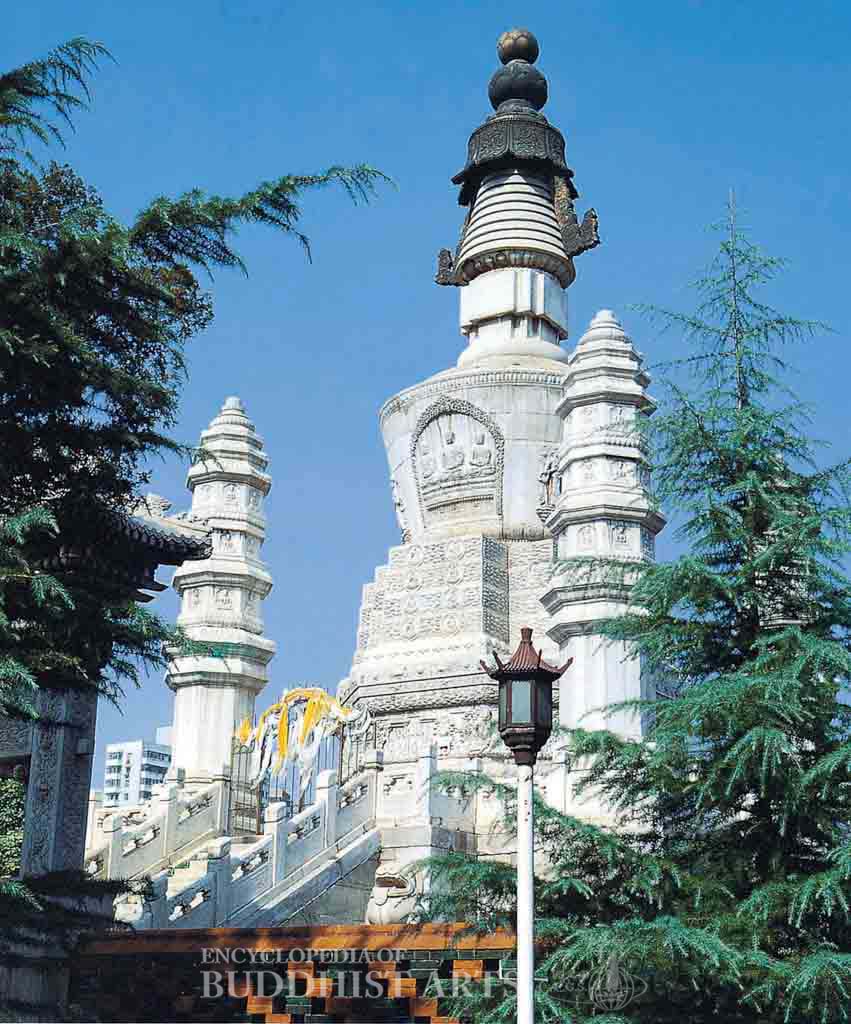
Xihuang Temple Qingjing Huacheng Pagoda
Xihuang Temple Qingjing Huacheng Pagoda
CHINA, Beijing
Xihuang Temple was constructed in 1652 for the Fifth Dalai Lama’s visit to Beijing. In 1780 the Sixth Panchen Lama came to Beijing to celebrate the 70th birthday of Emperor Qianlong (reigned 1736–1795) of the Qing dynasty and stayed at Xihuang Temple, where he passed away later in November. In 1782 the emperor issued an edict to construct the Qingjing Huacheng Stupa to the north of the temple to preserve the personal belongings of the Sixth Panchen Lama. It is therefore also called the Panchen Lama Stupa. It was listed as a National Cultural Heritage Site in 2001.
The stupa is 16 m high and has an octagonal Sumeru base. On each side of the concave section there are images depicting the Eight Great Events from the Life of the Buddha. Above the Sumeru base, there is a second base with multiple corners decorated with carvings of lotuses, scrolls, colorful clouds, seated Buddhas and Vajrapanibalins. At the front of the inverted-bowl stupa body there is a relief of a niche housing the Three Buddhas with eight standing Bodhisattvas outside the niche. On top of the stupa body there is a harmika with multiple corners, stacked rings, a canopy, and a spire consisting of two upturned lotuses.
The central stupa is surrounded by four octagonal sutra pillars, which are 7 m high and made of white stone. On the first level the pillars are inscribed with Buddhist sutras and mantras, while the other levels are carved with Buddha images and lotuses.
For more details, go to the Encyclopedia of Buddhist Arts: Architecture T-Z, page 1319.
Cite this article:
author = Hsingyun and Youheng and Johnson, Peter and Mankuang and Lancaster, Lewis,
booktitle = {Encyclopedia of Buddhist Arts: Architecture T-Z},
pages = 1319,
title = {{Xihuang Temple Qingjing Huacheng Pagoda}},
volume = 4,
year = {2016}}