
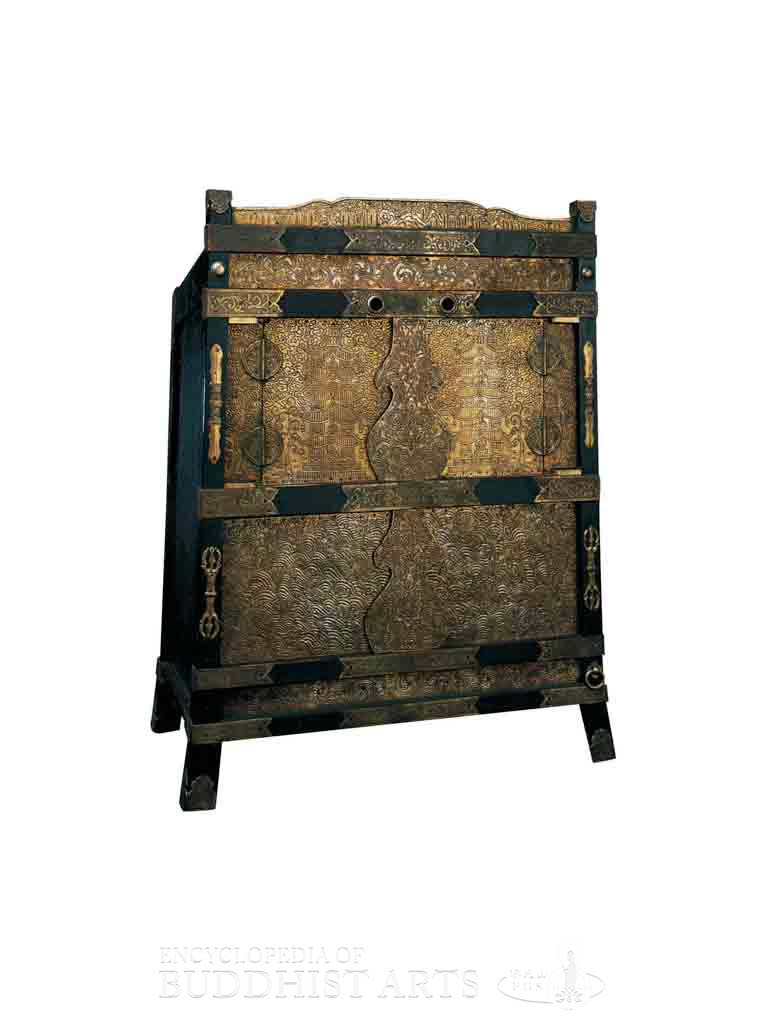
Portable Cabinet (closed)
Wood and gilt copper alloy
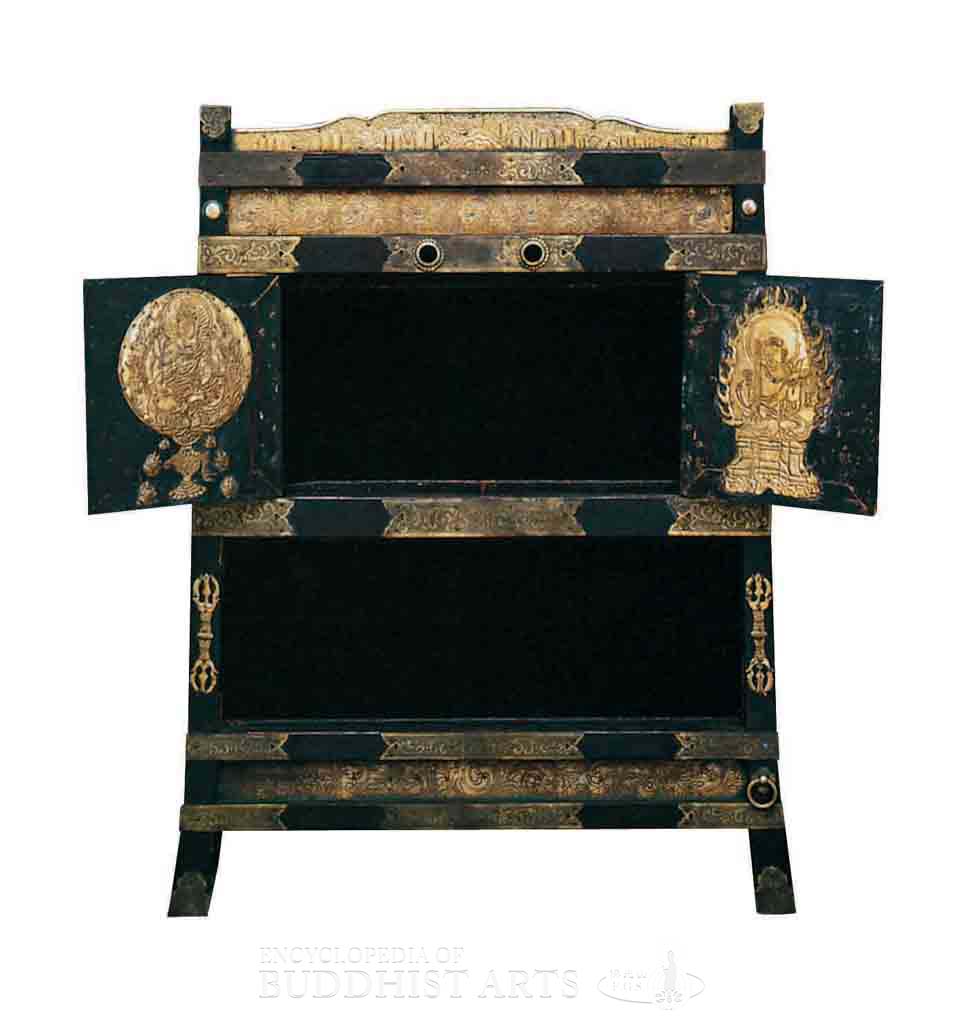
Portable Cabinet (opened)
Portable Cabinet
JAPAN; Muromachi to Momoyama period
This portable cabinet was made in the 16th century and functioned somewhat like a backpack for Japanese mountain ascetics. The upper half contained the monk’s clothing and food, while the lower half was used to store ritual items. It could also be used as a temporary altar.
The cabinet is made of wood in black lacquer and has fittings of gilt copper alloy. It measures 69 cm high, 54.5 cm wide, and 31.1 cm deep. The inner surfaces of the doors in the upper half have illustrations of protector deities: Acala on the right, and Ragaraja on the left. On the outside, each door has a gilt copper alloy panel with an image of a five-story pagoda. The lower half has a removable panel incised with designs of lotus flowers and birds floating on waves. There are vajras on each side of the front frame.
For more details, go to the Encyclopedia of Buddhist Arts: Artifacts, page 225.
Cite this article:
author = Hsingyun and Youheng and Youji and Pokorski, Stefanie and Mankuang and Fan, Wen,
booktitle = {Encyclopedia of Buddhist Arts: Artifacts },
pages = 225,
title = {{Portable Cabinet}},
volume = 18,
year = {2016}}