
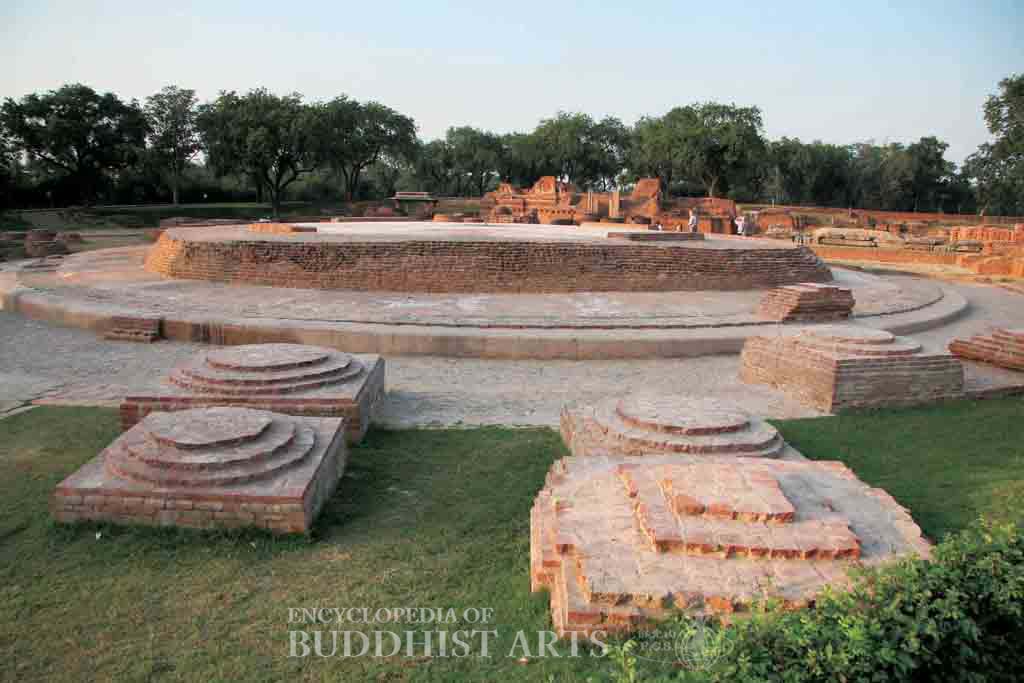
Dharmarajika Stupa
Dharmarajika Stupa
INDIA, Uttar Pradesh, Sarnath
The stupa is located about 50 m west of Dhamekh Stupa. It was built by King Asoka (reigned circa 269–232 BCE) and is one of the few stupas that has been definitely identified as being built by him. In 1794 the ruler of Varanasi demolished the stupa in order to collect the bricks and stones for building material. The ruins of Dharmarajika Stupa remained buried until British archaeologist Alexander Cunningham led a team to excavate the site in the second half of the 19th century.
The ruins of Dharmarajika Stupa consist of a circular brick platform about 13.5 m in diameter. Based on the bricks found nearby, it is believed that the circular platform was originally the foundation of a small stupa that had been expanded and enlarged six times, each time raising its height. The expansions also included the construction of railings, four gates, and circumambulation paths.
During the demolition of the stupa, a relic casket made of green marble was accidently found. A stone box was discovered inside and it is kept at the Indian Museum in Kolkata. Some stone slabs with reliefs and some large Buddha sculptures were found during later excavations. They include a seated Buddha forming the Dharmacakra (Dharma wheel) mudra from the Gupta period (circa 320–550), which is kept at the Archaeological Museum in Sarnath, and a very large Bodhisattva from the Kushan period (circa 1st–3rd century).
For more details, go to the Encyclopedia of Buddhist Arts: Architecture A-F, page 237.
Cite this article:
author = Hsingyun and Youheng and Johnson, Peter and Mankuang and Lancaster, Lewis,
booktitle = {Encyclopedia of Buddhist Arts: Architecture A-F},
pages = 237,
title = {{Dharmarajika Stupa}},
volume = 1,
year = {2016}}